Category: Lechuck
Fair Solution Platform
From Claude with some prompting
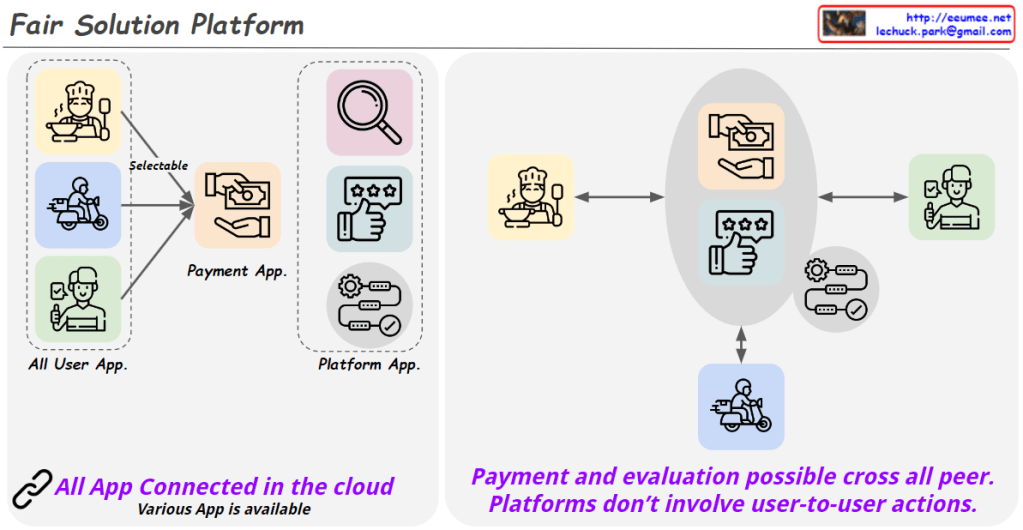
The “Fair Solution Platform” is designed with the following key concepts:
- User Empowerment:
- All users (chefs, delivery personnel, customers, etc.) can directly choose which service apps to use for actual interactions (ordering, payment, delivery, evaluation, etc.).
- Platform Neutrality:
- The platform provider does not interfere with direct user-to-user interactions.
- Instead, it creates an environment where various apps can connect and be provided.
- Connectivity and Diversity:
- All apps are connected through the cloud.
- The platform fosters an ecosystem where diverse apps can be offered.
- Additional Features:
- Provides functionality to search for services and activity results conducted on the platform.
- Fair Cost Structure:
- The platform only charges fees related to its role as a platform.
- Terms of transactions between users are decided directly by the parties involved.
- User Rights Protection:
- This model aims to safeguard the rights of actual producers and consumers.
- It facilitates direct transactions with minimal intermediary intervention.
The platform aims to maximize user autonomy, maintain platform neutrality, and create a fair trading environment. By doing so, it seeks to overcome the limitations of traditional platform models and create a more equitable and efficient service ecosystem.
composure

Optimization

From Claude with some prompting
This image illustrates the concept of “Optimization” through four graphs representing different optimization levels:
- Optimization Level 1: Shows basic usage and supply curves.
- Optimization Level 2: Similar to Level 1, but with supply (green arrows) managed more efficiently.
- Optimization Level 3: Demonstrates both usage and supply being managed more efficiently. Green arrows (supply) are adjusted at multiple points.
- Optimization Level 4: Usage and supply curves almost align, indicating optimal efficiency achieved.
In each graph, the orange line represents usage, while green arrows indicate supply. As the optimization level increases, the two lines become more aligned, showing improved efficiency.
The image title “Optimization” is at the top. The legend in the bottom left correctly shows that green arrows represent supply and orange arrows represent usage.
Work

E=mc2

From Claude with some prompting
This image provides an enhanced explanation of Einstein’s famous mass-energy equivalence equation E=mc². The key additions and contents are as follows:
- Units for each component have been added:
- Energy (E): J (Joules), erg
- Mass (m): Kg (kilograms), g (grams)
- Celeritas (c): m/s (meters per second), cm/s (centimeters per second)
- Equations showing unit consistency have been included:
- SI units: J = kg · (m/s)²
- CGS units: erg = g · (cm/s)²
- The original explanations are maintained:
- Mass: constant value that does not change, law of conservation of mass
- Celeritas: The speed of light, “Real existence, least relativity, all same for any observer”
- Overall equation: For understanding the relative if Mass and light, human measurements
- The etymology of Celeritas (from the Latin word meaning “speed” or “swiftness”) is retained.
These enhancements deepen the understanding of each component of the equation, particularly with the addition of units, which clarifies what units should be used in actual calculations. This provides crucial information for practical application and comprehension of the equation.
Gloomy day


 Lechuck Park