

The Computing for the Fair Human Life.
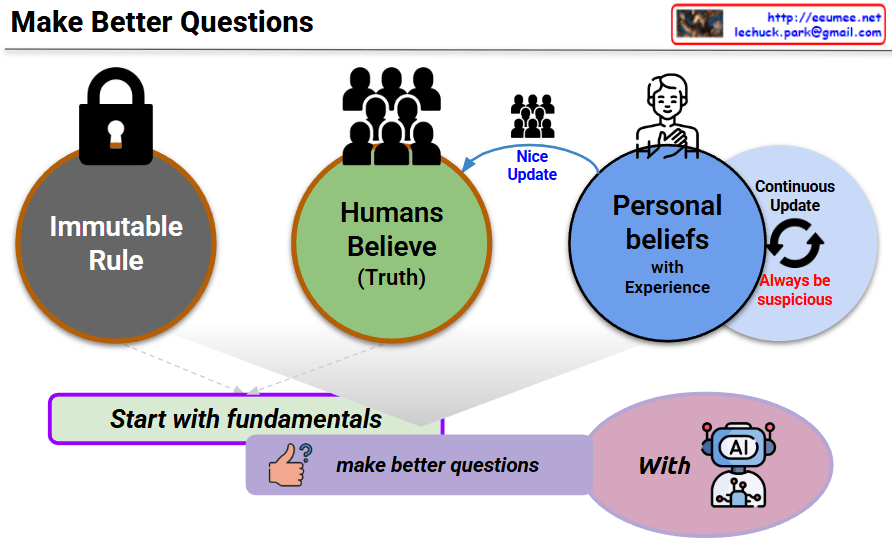
This diagram titled “Make Better Questions” illustrates a methodology for effective questioning. The key concepts are:
This diagram ultimately suggests a method for optimizing interactions with AI through constant skepticism and adherence to fundamentals while maintaining flexible thinking. It emphasizes the importance of not settling for fixed beliefs but continuously learning and evolving.
With Claude


GHIBLI style


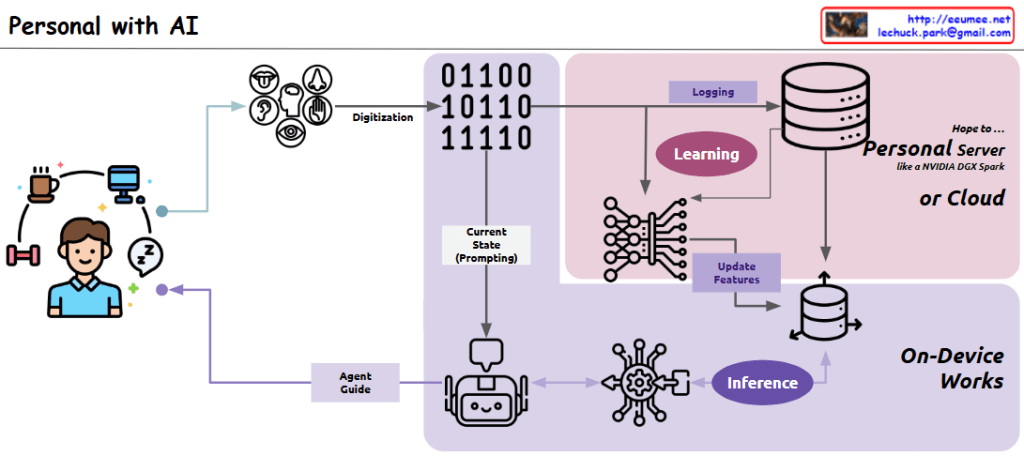
This diagram illustrates a “Personal Agent” system architecture that shows how everyday life is digitized to create an AI-based personal assistant:
Left side: The user’s daily activities (coffee, computer, exercise, sleep) are represented, which serve as the source for digitization.
Center-left: Various sensors (visual, auditory, tactile, olfactory, gustatory) capture the user’s daily activities and convert them through the “Digitization” process.
Center: The “Current State (Prompting)” component stores the digitized current state data, which is provided as prompting information to the AI agent.
Upper right (pink area): Two key processes take place:
This section runs on a “Personal Server or Cloud,” preferably using a personalized GPU server like NVIDIA DGX Spark, or alternatively in a cloud environment.
Lower right: In the “On-Device Works” area, the “Inference” process occurs. Based on current state data, the AI agent infers guidance needed for the user, and this process is handled directly on the user’s personal device.
Center bottom: The cute robot icon represents the AI agent, which provides personalized guidance to the user through the “Agent Guide” component.
Overall, this system has a cyclical structure that digitizes the user’s daily life, learns from that data to continuously update a personalized vector database, and uses the current state as a basis for the AI agent to provide customized guidance through an inference process that runs on-device.
with Claude


This diagram illustrates the key differences between traditional programming methods and modern machine learning approaches. The analytical approach follows clearly defined rules designed by humans and can precisely explain results, while the empirical approach learns patterns from data and improves efficiency through parallel processing but leaves decision-making processes as a black box.
with claude
 Lechuck Park