Data types

From DALL-E with some prompting
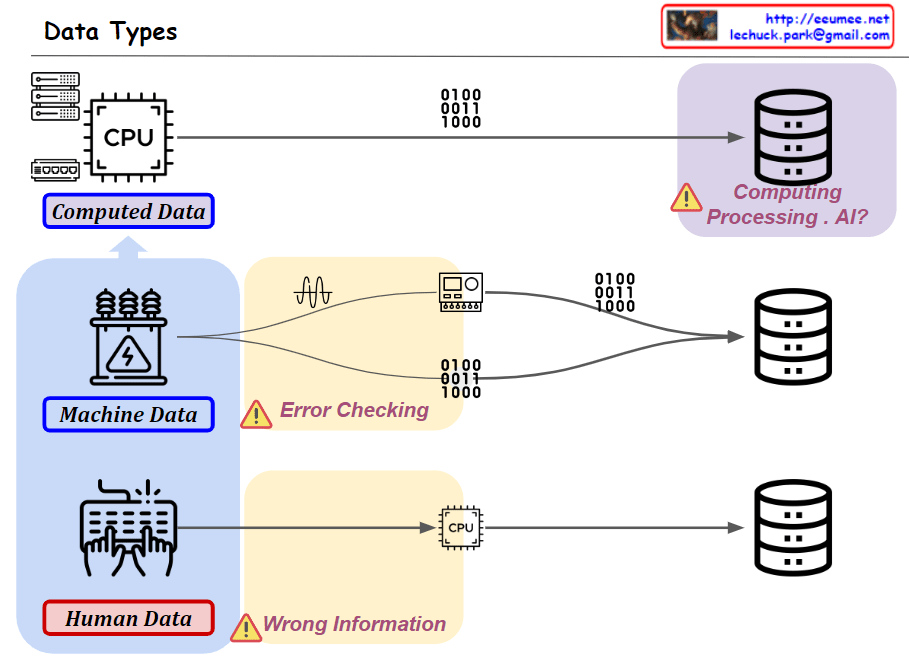
The image classifies data types and emphasizes the need for verification and response to potential errors for each type.

Computed Data: Processed by the CPU, with an implication of potential issues during computing or AI processing before storage.
Machine Data: Originating from machines or sensors, requiring error checking before storage, and awareness of possible errors.
Human Data: Entered by humans, needing verification due to the potential inclusion of wrong information, and awareness of errors.
This classification underlines the importance of ensuring accuracy in data processing and the need to be aware of and respond to potential errors.

Statistics ?

From DALL-E with some prompting
The image presents an exploration of perspectives in the context of big data and AI. “Subjective” reflects personal perception, while “Objective” shows a fact-based approach, though limited. “Statistics” introduces a big data-based AI perspective, offering a nearly complete yet unlimited framework for interpretation and judgment. This new perspective highlights the need for fresh terminology and concepts to navigate the advanced analytical landscape shaped by AI, suggesting an evolution from traditional subjective and objective paradigms to a more nuanced, data-centric approach.

Difference

From DALL-E with some prompting
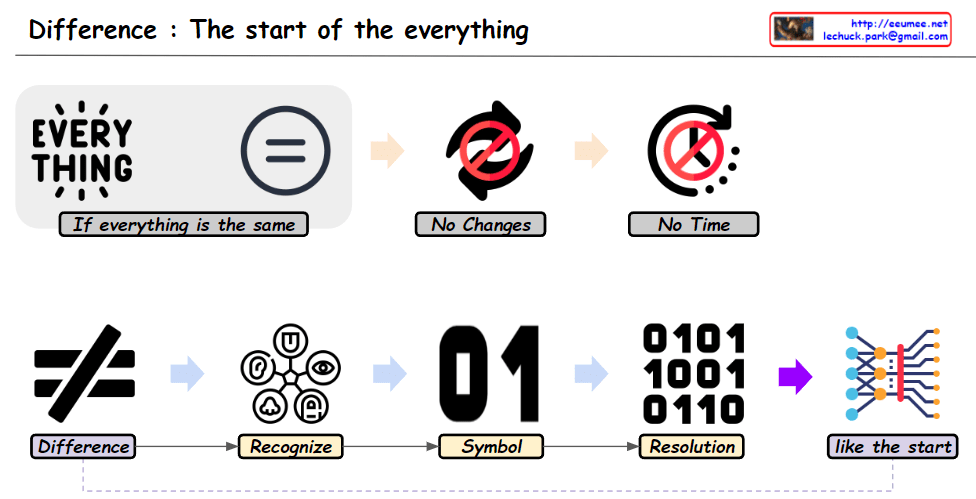
The image represents how AI approaches differences using infinite computing power, akin to recognizing the initial differences that sparked evolution. It shows that without variation (“EVERYTHING” icon), there is no concept of change or time, but differences lead to recognition (“Recognition”), which evolves into symbolization (“Symbol”) and understanding through resolution (“Resolution”). As complexities grow, so does our interpretative capacity, and now AI retraces the evolutionary journey back to the beginning. Through the human process of creating numbers and adding complex interpretations, AI now comprehends the initial differences that started it all.

Beyond data

From DALL-E with some prompting
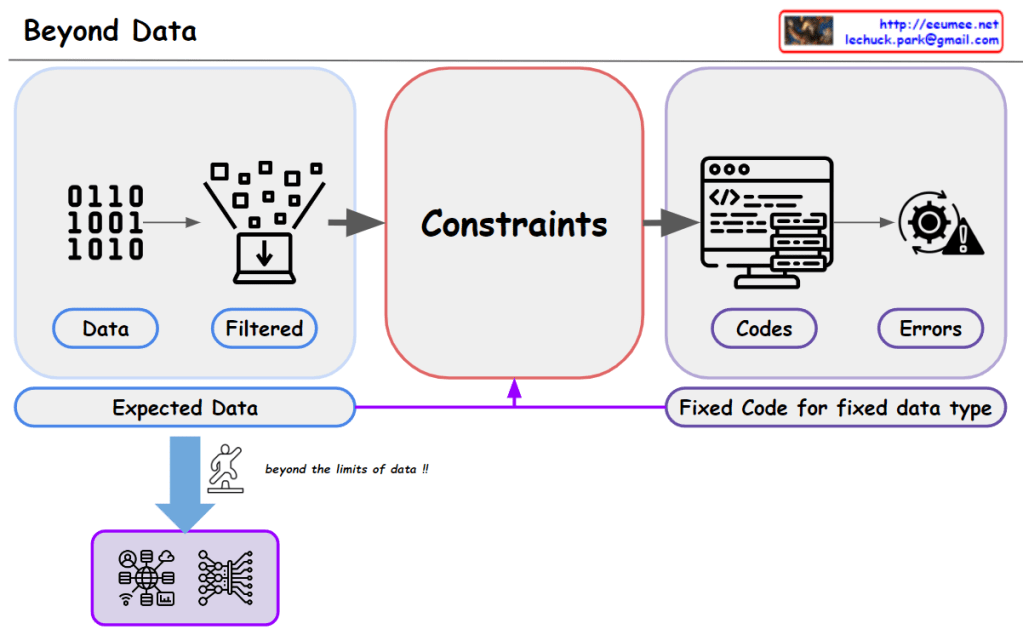
This image depicts the process of overcoming the constraints of traditional programming based on expected data through big data and deep learning. Starting on the left, binary digits labeled as “Data” are processed through a “Filtered” stage to become the necessary “Expected Data.” The box labeled “Constraints” in the center represents the limitations that can occur in programming. These constraints suggest barriers that can be overcome with big data processing and deep learning technologies. On the right, there’s a section transitioning from “Codes” to “Errors,” which signifies possible errors during the coding process. However, the text “Fixed Code for fixed data type” reflects that program code is pre-established for expected data types and does not transcend the boundaries of this data, thereby limiting its potential. The phrase “beyond the limits of data!!” at the bottom expresses the ambition of future programming to surpass the limitations of data processing by utilizing big data and deep learning.

NTP

From DALL-E with some prompting
The image appears to be a visual explanation of the Network Time Protocol (NTP). At the top, there’s a title, “Network Time Protocol,” and below it, there are icons arranged along a line that seems to represent servers, energy symbols, a thermometer, a surveillance camera, and storage devices. These icons are connected by arrows, indicating the flow of synchronization signals for time.

Below these icons, there are two messages. The first message says, “Sync Time of data from all connected Machine,” suggesting the synchronization of time across data from all connected devices. The second message reads, “sequence of events and causal relationship,” referring to the order of events and their causality. Underneath this message, icons representing the universe, Earth, a forest, and a group of people are displayed, which likely denote the concept of “Universal Time.”

Overall, the image emphasizes the importance of using Network Time Protocol to synchronize time across various devices and systems, accurately recording the sequence and causality of events, and maintaining consistent universal time globally. There’s an email address displayed in the top right corner of the image, but personal identity information cannot be shared.

Requires for DL

From DALL-E with some prompting
The image outlines the importance of data in the era of deep learning (DL). It starts with “Data,” representing various sources and types, which feeds into “Deep Learning,” depicted by a neural network diagram. The process leads to “Result,” symbolized by charts and graphs indicating the output or findings. The central message, “Data determines the results,” stresses that the quality of data significantly impacts the outcome of deep learning processes. Below, “Data Verification” suggests the need for ensuring data accuracy, which ties into the cycle of “UPDATE” and “Analysis,” highlighting an iterative process to refine and improve deep learning applications. The phrase “What to deal with DL” hints at the challenges and considerations in managing and utilizing deep learning effectively.

Unexplainable

From DALL-E with some prompting
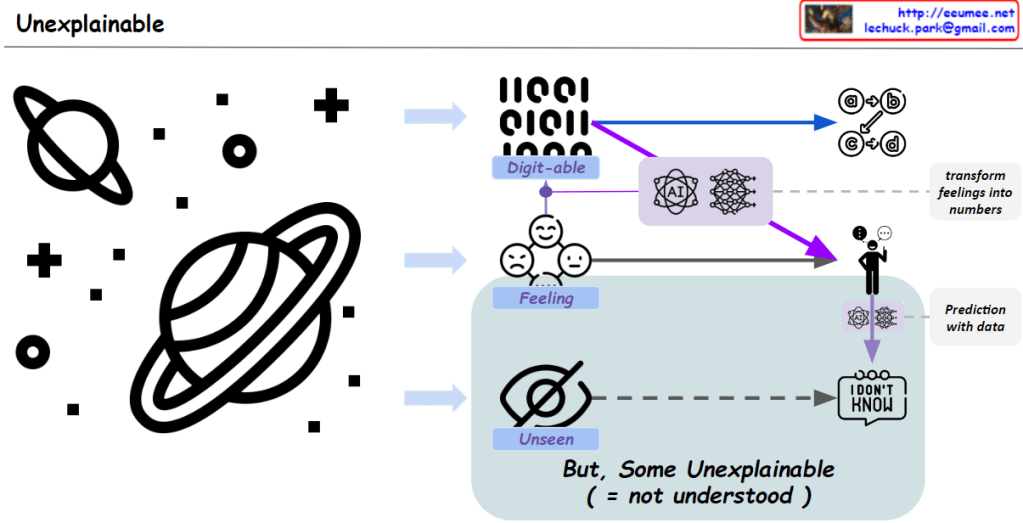
The image intends to explain two critical perspectives of AI/ML. First, it illustrates that while traditionally digitalized data was defined by rules, AI/ML enables us to judge human ‘feelings’ as data based on a more extensive dataset. Second, AI/ML allows for the prediction of the future using data; however, some parts of these significant advancements remain unexplainable and difficult for humans to comprehend fully. This interpretation suggests that while AI aims to quantify and use non-visible elements like emotions for predictions through data standardization and optimized processing, there are aspects that cannot be fully articulated or understood.