Recent Memory Control

From Perplexity with some prompting
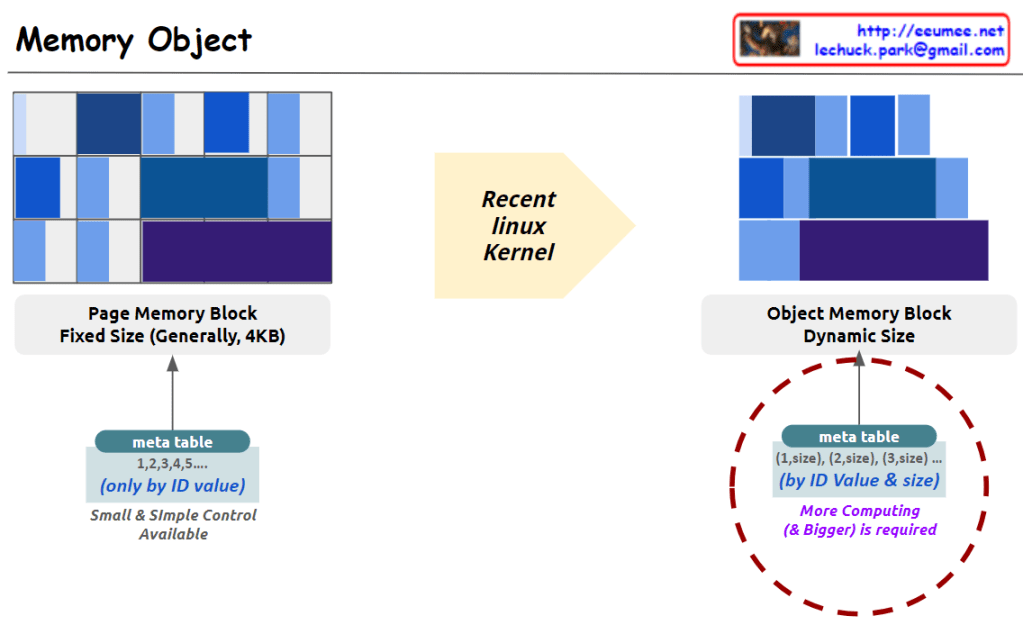
The image illustrates a change in memory object management in recent Linux kernels, focusing on the transition from fixed-size page memory blocks to dynamic-size object memory blocks.

Left: Fixed-Size Page Memory Block

  • Page Memory Block: Typically uses fixed-size blocks, generally 4KB in size.
  • Meta Table: Managed by simple ID values (e.g., 1, 2, 3, 4, 5), allowing for straightforward and efficient control.

Right: Dynamic-Size Object Memory Block

Meta Table: Requires both ID values and sizes (e.g., (1, size), (2, size)), necessitating more complex computation and larger metadata tables.

Object Memory Block: Utilizes blocks of varying sizes to accommodate different memory object sizes.

This transition reflects a shift towards more flexible memory management, allowing for better utilization of memory resources by accommodating objects of different sizes. However, it also introduces increased complexity in managing these memory allocations.

Standardization

From Claude + ChatGPT with some prompting
The image you provided shows a standardization process aimed at delivering high-quality data and consistent services. Here’s a breakdown of the structure based on the image:

Key Areas:

  1. [Data]
    • Facility: Represents physical systems or infrastructure.
    • Auto Control: Automatic controls used to manage the system.
  2. [Service]
    • Mgt. System: Management system that controls and monitors operations.
    • Process: Processes to maintain efficiency and quality.

Optimization Paths:

  1. Legacy Optimization:
    • a) Configure List-Up: Listing and organizing the configurations for the existing system.
    • b) Configure Optimization (Standardization): Optimizing and standardizing the existing system to improve performance.
    • Outcome: Enhances the existing system by improving its efficiency and consistency.
  2. New Setup:
    • a) Configure List-Up: Listing and organizing configurations for the new system.
    • b) Configure Optimization (Standardization): Optimizing and standardizing the configuration for the new system.
    • c) Configuration Requirement: Defining the specific requirements for setting up the new system.
    • d) Verification (on Installation): Verifying that the system operates correctly after installation.
    • Outcome: Builds a completely new system that provides high-quality data and consistent services.

Outcome:

The aim for both paths is to provide high-quality data and consistent service by standardizing either through optimizing legacy systems or creating entirely new setups.

This structured approach helps improve efficiency, consistency, and system performance.

Service

From Claude with some prompting
The image is a diagram titled “Service” that illustrates two main processes:

  1. Top left: “Op. Process” (Operational Process)
    • Shown as a circular structure containing:
      • “Event!!”: Represented by an exclamation mark icon
      • “Operator”: Indicated by a person icon
      • “Processing”: Depicted by an icon of connected circles
    • This process is marked with “xN”, suggesting it can be repeated multiple times.
  2. Bottom left: “D/T Service” (presumably Data/Technology Service)
    • Also presented in a circular structure, including:
      • “Data”: Shown as a graph icon
      • “Analysis(Visual)”: Represented by a monitor icon with charts
      • “Program”: Depicted by a code or document icon
    • This process is also marked with “xN”, indicating repeatability.
  3. Right side: Integrated “Op. Process” and “D/T Service”
    • A larger circle contains the “Op. Process”, which in turn encompasses the “D/T Service”
    • Within the “D/T Service” circle, “Data Result” and “Operation” are connected by a bidirectional arrow.

This diagram appears to illustrate how operational processes and data/technology services interact and integrate, likely representing a data-driven operational and decision-making process.

Golden Circle For DC Operation

From perplexity with some prompting
The image explains the “Golden Circle for DC Operation,” focusing on optimizing data center operations.

WHY: Data Center Operation Optimization

  • Purpose: To optimize the operation of data centers.
  • Service Development: Through data-driven processes, including monitoring, automation, tool development, and customer-focused services.

HOW: Consistent Process & Data Management

  • Method: Ensures reliable data through consistent processes and management.
  • Standardization: Achieved through data lists, hardware/software protocols, and service/process views and flows.

WHAT: Integrated Digital Operation Platform

  • Objective: To build an integrated digital operation platform.
  • Platform: Operator-led development that involves analysis, AI integration, and service creation.

This structure emphasizes efficiency, standardization, and a data-centric approach to data center operations.

optimization

From Claude with some prompting

  1. “Just look (the average of usage)”:
    • This stage shows a simplistic view of usage based on rough averages.
    • The supply (green arrow) is generously provided based on this average usage.
    • Actual fluctuations in usage are not considered at this point.
  2. “More Details of Usages”:
    • Upon closer inspection, continuous variations in actual usage are discovered.
    • The red dotted circle highlights these subtle fluctuations.
    • At this stage, variability is recognized but not yet addressed.
  3. “Optimization”:
    • After recognizing the variability, optimization is attempted based on peak usage.
    • The dashed green arrow indicates the supply level set to meet maximum usage.
    • Light green arrows show excess supply when actual usage is lower.
  4. “Changes of usage”:
    • Over time, usage variability increases significantly.
    • The red dotted circle emphasizes this increased volatility.
  5. “Unefficient”:
    • This demonstrates how maintaining a constant supply based on peak usage becomes inefficient when faced with high variability.
    • The orange shaded area visualizes the large gap between actual usage and supply, indicating the degree of inefficiency.
  6. “Optimization”:
    • Finally, optimization is achieved through flexible supply that adapts to actual usage patterns.
    • The green line closely matching the orange line (usage) shows supply being adjusted in real-time to match usage.
    • This approach minimizes oversupply and efficiently responds to fluctuating demand.

This series illustrates the progression from a simplistic average-based view, through recognition of detailed usage patterns, to peak-based optimization, and finally to flexible supply optimization that matches real-time demand. It demonstrates the evolution towards a more efficient and responsive resource management approach.