HTTP caching

From Claude with some prompting
The image illustrates the architecture of an HTTP caching system with the following main components:

  1. Client Side (Left):
  • Web App client
  • FAST GET requests through PROXY
  • Uses If-Modified-Since and Cache-Control headers
  1. Central Infrastructure:
  • GSLB (Global Server Load Balancer)
  • CDN Service (Content Delivery Network)
  • Edge servers (distributed cache servers)
  1. Server Side (Right):
  • Web Service server
  • FAST RETURN through REVERSE PROXY
  • Uses Last-Modified and Cache-Control headers
  • Supports Load Optimization
  • Origin server connection
  1. Cache Control Options:
  • max-age
  • no-cache
  • no-store
  • must-revalidate
  • public
  • private
  • s-maxage

This architecture represents an enterprise-grade caching system designed to optimize web performance and reduce server load. The system utilizes multiple layers of caching with CDN to deliver content to end users more quickly and efficiently.

Traffic flow starts from the client, passes through multiple caching layers, and can ultimately reach the origin server, with appropriate caching strategies applied at each layer.

This structure enables:

  • Improved response times
  • Reduced server load
  • Efficient content delivery
  • Better user experience
  • Scalable infrastructure

The combination of proxies, CDN, and various caching mechanisms creates a robust system for handling web content delivery at scale.

Metric

From Claude with some prompting
the diagram focuses on considerations for a single metric:

  1. Basic Metric Components
  • Point: Measurement point (where it’s collected)
  • Number: Actual measured values (4,5,5,8,4,3,4)
  • Precision: Accuracy of measurement
  1. Time Characteristics
  • Time Series Data: Collected in time series format
  • Real Time Streaming: Real-time streaming method
  • Sampling Rate: How many measurements per second
  • Resolution: Time resolution
  1. Change Detection
  • Changes: Value variations
    • Range: Acceptable range
    • Event: Notable changes
  • Delta: Change from previous value (new-old)
  • Threshold: Threshold settings
  1. Quality Management
  • No Data: Missing data state
  • Delay: Data latency state
  • With All Metrics: Correlation with other metrics
  1. Pattern Analysis
  • Long Time Pattern: Long-term pattern existence
  • Machine Learning: Pattern-based learning potential

In summary, this diagram comprehensively shows key considerations for a single metric:

  • Collection method (how to gather)
  • Time characteristics (how frequently to collect)
  • Change detection (what changes to note)
  • Quality management (how to ensure data reliability)
  • Utilization approach (how to analyze and use)

These aspects form the fundamental framework for understanding and implementing a single metric in a monitoring system.

EXP with AI

From Claude with some prompting
Here’s the analysis of the AI Experience (EXP) curve:

  1. Three-Phase Structure

Initial Phase

  • Slow cost increase period
  • Efficient progress relative to investment
  • Importance of clear goals and scope setting

Middle Phase

  • Steeper cost increase progression
  • Critical focus on ROI and resource allocation
  • Need for continuous cost-benefit monitoring

Final Phase

  • Exponential cost increase occurs
  • Practical goal setting rather than perfection
  • Importance of determining optimal investment timing
  1. Unreachable Area Complementary Factors and Implications

Key Complementary Elements

  • Human Decision
  • Experience Know-How
  • AI/ML Integration

Practical Implications

  • Setting realistic goals at 80-90% rather than pursuing 100% perfection
  • Balanced utilization of human expertise and AI technology
  • Development of phase-specific management strategies

This analysis demonstrates that AI projects require strategic approaches considering cost efficiency and practicality, rather than mere technology implementation.

The graph illustrates that as AI project completion approaches 100%, costs increase exponentially, and beyond a certain point, success depends on the integration of human judgment, experience, and AI/ML capabilities.

Vector

From Claude with some prompting
This image illustrates the vectorization process in three key stages.

  1. Input Data Characteristics (Left):
  • Feature: Original data characteristics
  • Numbers: Quantified information
  • countable: Discrete and clearly distinguishable data → This stage represents observable data from the real world.
  1. Transformation Process (Center):
  • Pattern: Captures regularities and recurring characteristics in data
  • Changes: Dynamic aspects and transformation of data → This represents the intermediate processing stage where raw data is transformed into vectors.
  1. Output (Right):
  • Vector: Final form transformed into a mathematical representation
  • math formula: Mathematically formalized expression
  • uncountable: State transformed into continuous space → Shown in 3D coordinate system, demonstrating the possibility of abstract data representation.

Key Insights:

  1. Data Abstraction:
  • Shows the process of converting concrete, countable data into abstract, continuous forms
  • Demonstrates the transition from discrete to continuous representation
  1. Dimensional Transformation:
  • Explains how individual features are integrated and mapped into a vector space
  • Shows the unification of separate characteristics into a cohesive mathematical form
  1. Application Areas:
  • Feature extraction in machine learning
  • Data dimensionality reduction
  • Pattern recognition
  • Word embeddings in Natural Language Processing
  • Image processing in Computer Vision
  1. Benefits:
  • Efficient processing of complex data
  • Easy application of mathematical operations
  • Discovery of relationships and patterns between data points
  • Direct applicability to machine learning algorithms
  1. Technical Implications:
  • Enables mathematical manipulation of real-world data
  • Facilitates computational processing
  • Supports advanced analytical methods
  • Enables similarity measurements between data points

This vectorization process serves as a fundamental preprocessing step in modern data science and artificial intelligence, transforming raw, observable features into mathematically tractable forms that algorithms can effectively process.

The progression from countable features to uncountable vector representations demonstrates the power of mathematical abstraction in handling complex, real-world data structures.

From Data

From Claude with some prompting
following the overall sequence from data collection to AI systems development.

  1. Data Collection and Processing (Upper “From Data” section): a) Collecting data from people worldwide b) “Get Data”: Acquiring raw data c) “Gathering Data”: Converting data into binary format d) “Statistics Analysis”: Performing data analysis e) “Making Rules/Formula”: Generating rules or formulas based on analysis
  2. Evolution of AI Systems (Lower “Human-made AI (Legacy)” section): a) Human-centered analysis:
    • “Combine formulas”: Combining rules and formulas directly created by humans
    b) Machine Learning-based analysis:
    • Rule-based Machine Learning: • Utilizes Big Data • Generates rules/formulas through machine learning • Results evaluated as “True or False”
    • Statistical Machine Learning (e.g., LLM): • Utilizes Big Data • Performs statistical analysis using advanced machine learning • Results evaluated as “Better or Worse”

Key Points Summary:

  1. Data Processing Flow: Illustrates the step-by-step process from raw data collection to rule/formula generation.
  2. AI System Evolution:
    • Begins with human-centered rule-based systems
    • Progresses to machine learning models that learn rules from data
    • Advances to sophisticated statistical models (like LLMs) that recognize complex patterns and provide nuanced results
  3. Shift in Result Interpretation:
    • Moves from simple true/false outcomes
    • To relative and context-dependent “better/worse” evaluations

This image effectively demonstrates the progression of data processing and AI technology, particularly highlighting how AI systems have become more complex and sophisticated. It shows the transition from human-derived rules to data-driven machine learning approaches, culminating in advanced statistical models that can handle nuanced analysis and produce more contextualized results.

Loop

From Claude with some prompting

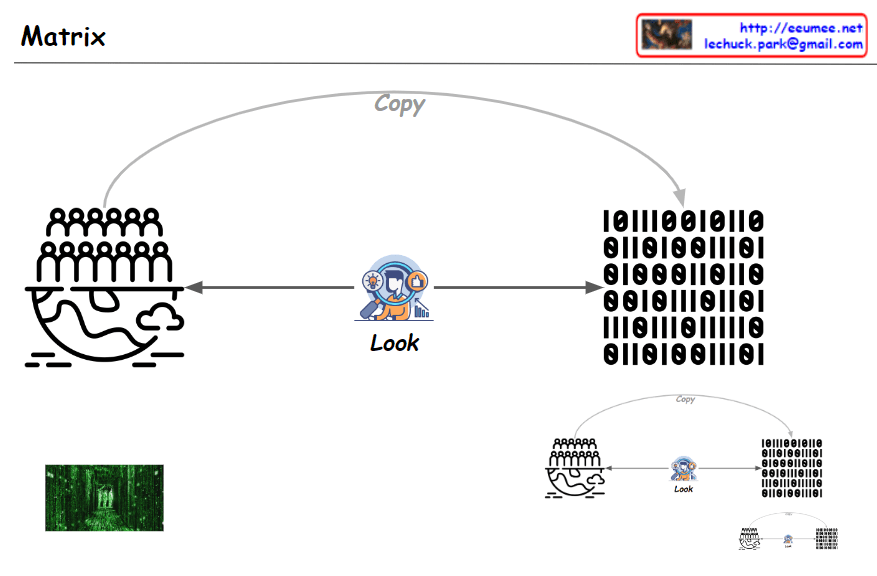
  1. Relationship between Reality and Digital World:
    • The left image represents our real world.
    • The numbers on the right show a virtual world created by computers.
    • This illustrates the process of transferring our reality into a computer environment.
  2. Human Observation and Digital Replication:
    • The central character symbolizes humans observing and studying the real world.
    • The ‘Look’ label indicates humans closely examining reality.
    • This represents human efforts to understand the real world and recreate it digitally.
  3. Endless Virtual Worlds:
    • The smaller repetition of the image at the bottom is significant.
    • It suggests that within a virtual world, another virtual world can be created.
    • This shows the potential for an infinite loop of virtual realities.
  4. Technological Advancement:
    • The ‘Copy’ arrow represents the process of transferring reality into digital form.
    • It indicates the increasing digitization of everything around us.
  5. Significance of The Matrix Movie:
    • The image implies that The Matrix film effectively illustrates the digitization process in modern society.
    • The movie explores the idea that in the future, distinguishing between reality and the virtual world may become challenging.
  6. Points to Ponder:
    • This image raises various questions about technological advancement.
    • For instance, “What is true reality?” or “Can a computer-generated world become reality?”

This image demonstrates human attempts to observe and understand the real world, then transfer it into a digital realm. It connects to the concept of digital twins – digital replications of real-world entities. The image also suggests that this process can repeat and intensify indefinitely, presenting both the possibilities and challenges of technological advancement. Ultimately, it succinctly illustrates the increasing digitization of our society and the philosophical questions this trend raises.