ARIMA

From Claude with some prompting
The image depicts the Autoregressive Integrated Moving Average (ARIMA) Integrated Moving Average Model, which is a time series forecasting technique.

The main components are:

  1. AR (Autoregressive):
    • This component models the past pattern in the data.
    • It performs regression analysis on the historical data.
  2. I (Integrated):
    • This component handles the non-stationarity in the time series data.
    • It applies differencing to make the data stationary.
  3. MA (Moving Average):
    • This component uses the past error terms to calculate the current forecast.
    • It applies a moving average to the error terms.

The flow of the model is as follows:

  1. Past Pattern: The historical data patterns are analyzed.
  2. Regression: The past patterns are used to perform regression analysis.
  3. Difference: The non-stationary data is made stationary through differencing.
  4. Applying Weights + Sliding Window: The regression analysis and differencing are combined, with a sliding window used to update the model.
  5. Prediction: The model generates forecasts based on the previous steps.
  6. Stabilization: The forecasts are stabilized and smoothed.
  7. Remove error: The model removes any remaining error from the forecasts, bringing them closer to the true average.

The diagram also includes visual representations of the forecast output, showing both upward and downward trends.

Overall, this ARIMA model integrates autoregressive, differencing, and moving average components to provide accurate time series forecasts while handling non-stationarity in the data.

Entropy

From ChatGPT with some prompting
This image explains entropy growth from two perspectives: human and particle viewpoints.


1. Left (Human View: Ordered State)

  • Image: Dots tightly packed in a cube.
  • Human Perspective: A highly ordered state with low entropy, as dots are confined to specific positions.
  • Particle Perspective: Particles experience restrictions, resulting in a sense of disorder due to limited freedom.

2. Middle (Transition State)

  • Image: Dots spreading out.
  • Human Perspective: Increasing disorder as the system transitions to multiple possible states, leading to higher entropy.
  • Particle Perspective: Particles gain more freedom, moving toward their individual order.

3. Right (Human View: Disordered State)

  • Image: Dots randomly distributed.
  • Human Perspective: Maximum disorder, representing the highest entropy state.
  • Particle Perspective: Particles achieve their highest freedom, forming their unique “order” in randomness.

4. Entropy Growth (Human vs. Particle View)

  • Human Perspective: Order → Disorder (entropy increases).
  • Particle Perspective: Restrictions decrease, and particles transition from “disorder” to finding their own freedom and order.

This dual perspective illustrates entropy as both an increase in disorder (human view) and an emergence of particle freedom and order (particle view).

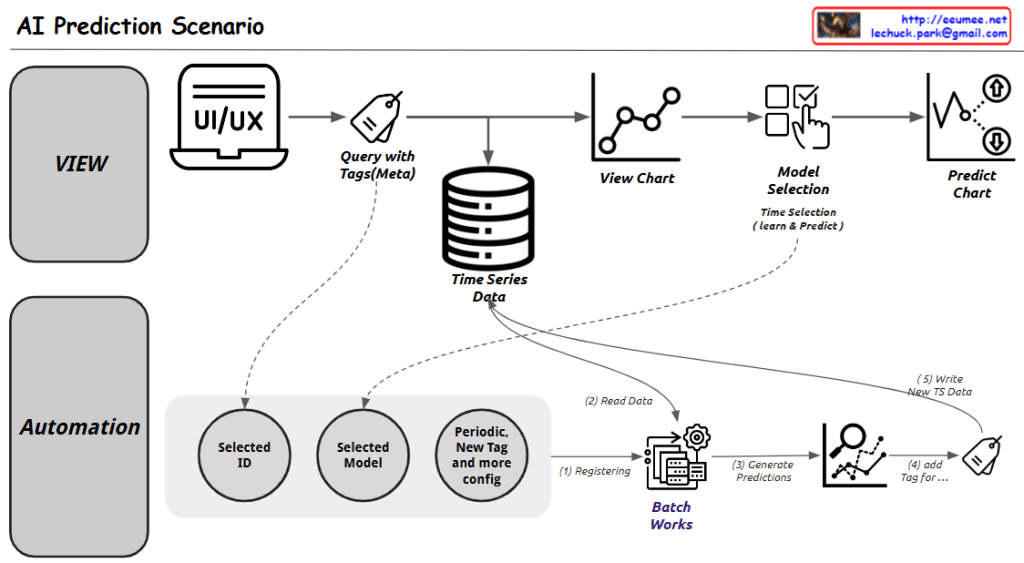
AI Prediction

From Claude with some prompting
This diagram illustrates an AI Prediction System workflow, which is divided into two main sections:

  1. Upper Section (VIEW):
  • Starts with a UI/UX interface
  • Executes queries with tags (metadata)
  • Connects to time series data storage
  • Displays data visualization charts
  • Includes model selection step
  • Finally generates prediction charts
  1. Lower Section (Automation):
  • Selected ID
  • Selected Model
  • Periodic, new tags and additional configuration
  • Batch work processing (consisting of 4 steps):
    1. Registering
    2. Read Data
    3. Generate Predictions
    4. Add Tag
  • Writing new time series data

The system provides two main functionalities:

  1. A user interface for direct data viewing and prediction execution
  2. Automated batch processing for periodic predictions and data updates

Key Components:

  • Time Series Data storage as a central database
  • View Chart for data visualization
  • Model Selection with time selection (learn & predict)
  • Predict Chart as the final output
  • Batch Works system for automated processing

The workflow demonstrates a comprehensive approach to handling both manual and automated AI predictions, combining user interaction with systematic data processing and analysis. The system appears designed to handle time series data efficiently while providing both immediate and scheduled prediction capabilities.

Synchronization Issues

From Claude with some prompting
This diagram illustrates various synchronization issues and their solutions in system synchronization processes. Let me break it down into three main parts:

  1. Copy-related Issues
  • Problems: High Load and Lack of Real Time
  • Solutions:
    • Increment Copy
    • Sync Scheduling
  1. Replication-related Issues
  • Problem: Network Delay
  • Solutions:
    • Timestamp Control
    • Checksum for comparison
  1. Synchronization-related Issues
  • Problems: Deadlock and Race Condition
  • Solutions:
    • Timeout settings
    • Priority Control
    • Semaphore/Mutex
    • Failure Recovery

Key Processes:

  • Maintaining “Keep the Same” status between systems
  • Detecting and notifying all changes (Noti & Detect All Changes)
  • Reflecting changes to other systems (reflect)

The diagram is well-structured with these notable features:

  1. Hierarchical Organization
  • Shows synchronization issues from top to bottom level
  • Progresses from Copy → Replications → Synchronization → Process Synchronization
  1. Clear Problem-Solution Mapping
  • Problems presented on the left (High Load, Network Delay, Deadlock, etc.)
  • Solutions presented on the right (visualized as green buttons)
  1. Visual Consistency
  • Problems shown in orange boxes
  • Solutions shown in green buttons
  • Process flows clearly indicated with arrows
  1. Practical Approach
  • Includes both theoretical concepts and practical implementation elements
  • Incorporates operational considerations like Failure Recovery

This structured organization serves as a valuable guide for understanding and solving complex synchronization problems in distributed systems or database replication systems.