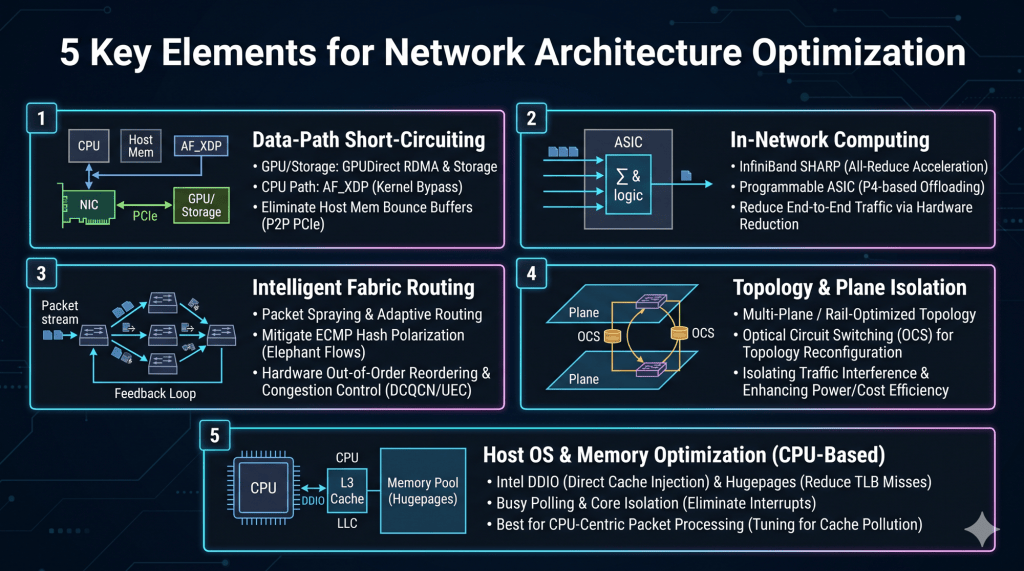
This infographic titled “5 Key Elements for Network Architecture Optimization” breaks down how modern high-speed networks eliminate bottlenecks across five architectural layers:
- 1. Data-Path Short-Circuiting: Uses GPUDirect RDMA/Storage (P2P PCIe) to connect the NIC directly to GPU/Storage without host memory bounce buffers, alongside AF_XDP for CPU-path kernel bypass.
- 2. In-Network Computing: Offloads data aggregation and custom logic directly into switch hardware via InfiniBand SHARP (for All-Reduce acceleration) and P4 Programmable ASICs, reducing end-to-end traffic.
- 3. Intelligent Fabric Routing: Employs Packet Spraying and Adaptive Routing to eliminate ECMP hash polarization (Elephant Flows), paired with hardware out-of-order reordering and feedback-driven congestion control (DCQCN/UEC).
- 4. Topology & Plane Isolation: Combines Multi-Plane (Rail-Optimized) designs with Optical Circuit Switching (OCS) for dynamic topology reconfiguration, isolating traffic interference while improving power and cost efficiency.
- 5. Host OS & Memory Optimization (CPU-Based): Accelerates CPU-centric packet processing using Intel DDIO (direct L3 cache injection with tuning against cache pollution), Hugepages (fewer TLB misses), and Busy Polling/Core Isolation (zero interrupt overhead).
Modern network optimization pairs host-level bypasses (GPUDirect, AF_XDP, DDIO) with intelligent fabric offloading (SHARP, Packet Spraying, OCS) to maximize throughput and guarantee ultra-low latency.
#NetworkArchitecture #HardwareOffload #GPUDirect #InNetworkComputing #AIInfrastructure #HighPerformanceComputing #PacketSpraying #OCS #AF_XDP #LowLatency


