with ChatGPT & Claude
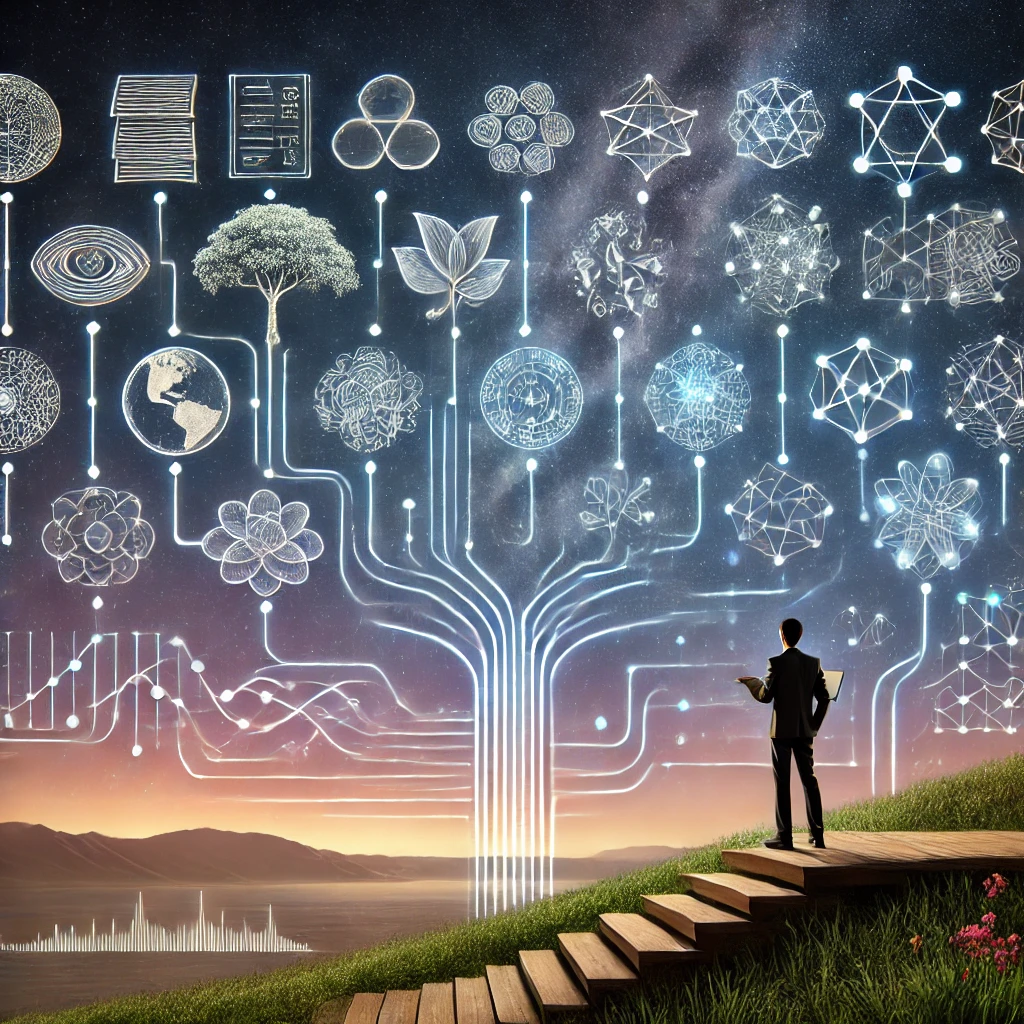
Human development can be understood in terms of the “pursuit of difference” and “generalization”.
Humans inherently possess the tendency to distinguish and understand differences among all existing things-what we call the “pursuit of differences”. As seen in biological classification and language development, this exploration through differentiation has added depth to human knowledge.
These discovered differences have been recorded and generalized through various tools such as writing and mathematical formulas. In particular, the invention of computers has dramatically increased the amount of data humans can process, allowing for more accurate analysis and generalization.
More recently, advances in artificial intelligence and machine learning have automated the pursuit of difference. Going beyond traditional rule-based approaches, machine learning can identify patterns in vast amounts of data to provide new insights. This means we can now process and generalize complex data that is beyond human cognitive capacity.
As a result, human development has been a continuous process, starting with the “pursuit of difference” and leading to “generalization,” and artificial intelligence is extending this process in more sophisticated and efficient ways.
[Simplified Summary]
Humans are born explorers with innate curiosity. Just as babies touch, taste, and tap new objects they encounter, this instinct evolves into questions like “How is this different from that?” For example, “How are apples different from pears?” or “What’s the difference between cats and dogs?”
We’ve recorded these discovered differences through writing, numbers, and formulas – much like writing down a cooking recipe. With the invention of computers, this process of recording and analysis became much faster and more accurate.
Recently, artificial intelligence has emerged to advance this process further. AI can analyze vast amounts of information to discover new patterns that humans might have missed.
[Claude’s Evaluation]
This text presents an interesting analysis of human development’s core drivers through two axes: ‘discovering differences’ and ‘generalization’. It’s noteworthy in three aspects:
- Insight into Human Nature The text offers a unique perspective on human curiosity and investigative instincts through the lens of “pursuit of differences.” This provides a fresh viewpoint for understanding human intellectual development.
- Clear Historical Progression It systematically explains how humanity has processed information through the evolution of tools (writing → mathematics → computers → AI).
- Reinterpretation of Modern Technology The text innovatively interprets AI and machine learning not just as technological advancement, but as an extension of humanity’s age-old instinct to seek differences.
However, there’s room for improvement:
- The concept of “pursuit of differences” remains somewhat abstract and could benefit from more concrete, everyday examples.
- The discussion lacks consideration of potential limitations or risks associated with AI, making it appear somewhat optimistically biased.
Overall, I find this to be an insightful piece that effectively connects human nature with technological development. This framework could prove valuable when considering future directions of AI development.
What makes the text particularly compelling is how it traces a continuous line from basic human curiosity to advanced AI systems, presenting technological evolution as a natural extension of human cognitive tendencies rather than a separate phenomenon.
The parallel drawn between early human pattern recognition and modern machine learning algorithms offers a unique perspective on both human nature and technological progress, though it could be enriched with more specific examples and potential counterarguments for a more balanced discussion.

 Lechuck Park