with a claude’s help
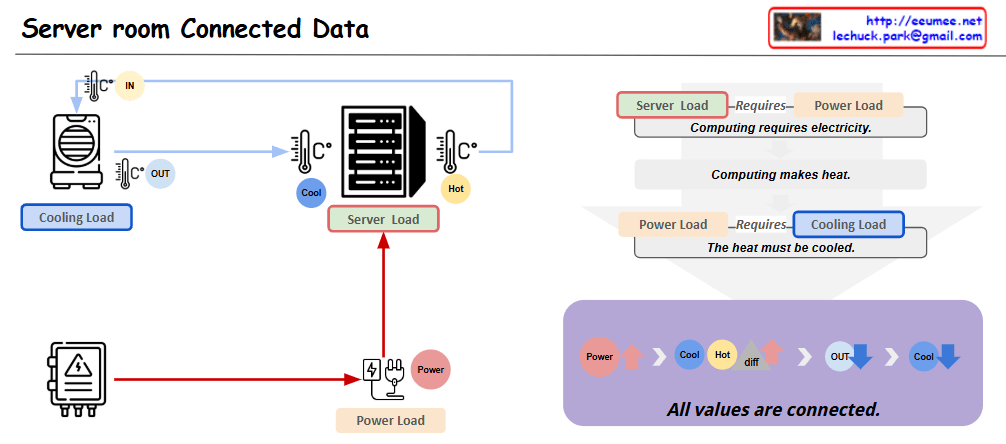
This diagram represents the key interconnected elements within a server room in a data center. It is composed of three main components:
- Server Load: This represents the computing processing demand on the server hardware.
- Cooling Load: This represents the cooling system’s load required to remove the heat generated by the server equipment.
- Power Load: This represents the electrical power demand needed to operate the server equipment.
These three elements are closely related. As the Server Load increases, the Power Load increases, which then leads to greater heat generation and an increase in Cooling Load.
Applying this to an actual data center environment, important considerations would include:
- Server rack placement: Efficient rack arrangement to optimize cooling performance and power distribution.
- Hot air exhaust channels: Dedicated pathways to effectively expel the hot air from the server racks, reducing Cooling Load.
- Cooling system capacity: Sufficient CRAC (Computer Room Air Conditioning) units to handle the Cooling Load.
- Power supply: Appropriate PDU (Power Distribution Unit) to provide the necessary Power Load for stable server operation.
By accounting for these real-world data center infrastructure elements, the diagram can be further enhanced to provide more practical and applicable insights.
Overall, this diagram effectively illustrates the core interdependent components within a server room and how they relate to the actual data center operational environment.Copy

 Lechuck Park