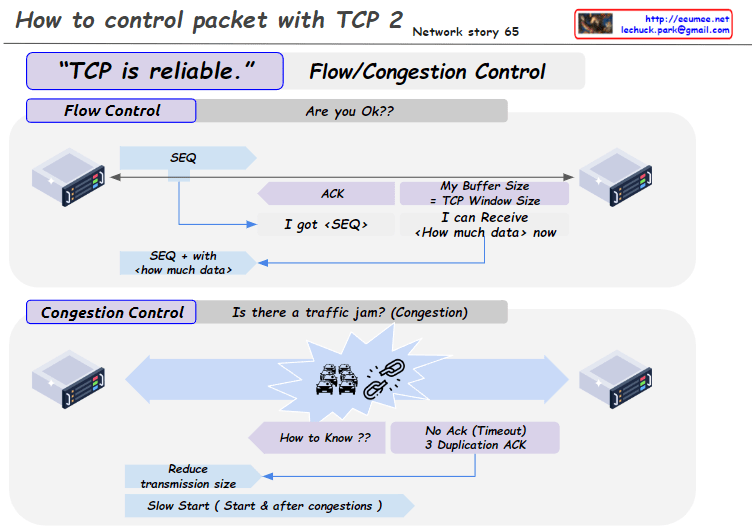
From Claude with some prompting This image illustrates the flow control and congestion control mechanisms, which are examples of why TCP (Transmission Control Protocol) is considered a reliable protocol.
TCP is a protocol that employs various mechanisms to ensure reliable data transmission.
Flow Control:
It uses sequence numbers and acknowledgments to regulate the amount of data transmitted based on the receiver’s buffer size, preventing data loss.
This mechanism contributes to TCP’s reliable delivery guarantee.
Congestion Control:
It detects network congestion and adjusts the transmission rate to avoid further congestion.
This allows TCP to provide stable and efficient data transfer.
Therefore, flow control and congestion control are key factors that enable TCP to be regarded as a reliable transport protocol. Through these mechanisms, TCP prevents data loss, network overload, and ensures stable communication.
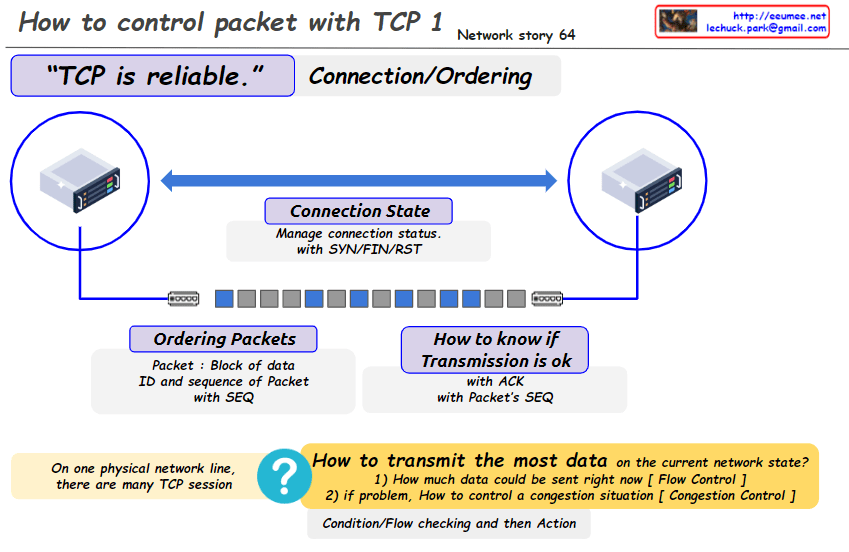
From Claude with some prompting This image explains how packets are controlled and transmitted using TCP (Transmission Control Protocol), which is a reliable communication protocol.
The key points are:
TCP is reliable and provides connection/ordering of packets.
Connection state is managed using SYN/FIN/RST packets to establish, maintain, and tear down connections.
Packets are organized into an ordered sequence using sequence numbers (SEQ).
Acknowledgments (ACK) with the packet’s SEQ number indicate successful transmission.
The image also raises two main questions:
How much data can be sent right now based on the current network state? (Flow Control)
If there is a problem, how to control congestion? (Congestion Control)
The image suggests that condition/flow checking should be performed, and then appropriate action taken for transmitting the most data possible on the current network state while handling potential congestion situations.
From Claude with some prompting This image explains the concept of Maximum Segment Size (MSS) in computer networking. MSS refers to the maximum size of the data payload that can be transmitted in a single TCP segment. The main points illustrated are:
The TCP header and IP header each have a fixed size of 20 bytes.
MSS is defined as the maximum size of the TCP payload within a single packet.
MSS is used for TCP communication to control congestion and prevent large TCP packets at the application level.
This is contrasted with the Maximum Transmission Unit (MTU) which limits packet size at the physical layer, such as in Ethernet switches.
The image depicts a concept called “One Time Transfer Data Size” with 1 MTU packet being sent, followed by acknowledgment (3 DUP ACK), and then a timeout period.
The overall purpose of MSS is to manage and optimize data transmission by limiting the segment size, thereby facilitating better congestion control and efficient network performance.
From Gemini with some prompting Example Presentation Script
BGP Session Overview
Hello everyone. Today, we will delve into the details of the BGP session establishment process. BGP is an internet routing protocol that facilitates the exchange of routing information between different autonomous systems. Establishing a stable BGP session is critical for efficient traffic forwarding across the internet.
TCP Connection Establishment
A BGP session commences with a TCP 3-way handshake on port 179. After establishing a reliable connection, the session proceeds to the Open message exchange phase to negotiate the fundamental parameters for the BGP session.
Open Message Exchange and Keepalive Message Exchange
The Open message exchange establishes BGP parameters such as version, autonomous system number, and Hold Timer. Hold Timer defines the session’s inactivity timeout. Keepalive messages maintain the connection by periodically exchanging messages. If no Keepalive message is received within the Hold Time, the session terminates.
Update Message Transmission and Path Selection
The core of the BGP session lies in the Update message transmission. Update messages contain new, modified, or withdrawn routing information. They include network, next hop, and path attribute information, enabling routing table updates and optimal path selection.
Withdrawal Message and Loop Prevention
Obsolete routing information is announced through Withdrawal messages and subsequently removed from the routing table. AS path information prevents routing loops and allows each AS to control the exchanged routing information.
Conclusion
The BGP session establishment process comprises TCP connection establishment, Open message exchange, Keepalive message exchange, Update message transmission, path selection, Withdrawal message, loop prevention, and policy enforcement. This process ensures a stable BGP session and facilitates efficient routing information exchange.
From DALL-E with some prompting The image provides a detailed explanation of the ‘traceroute’ network diagnostic tool and how it functions, along with potential error messages and their meanings. The ‘traceroute’ command can work with not only ICMP but also TCP/UDP protocols, allowing it to trace the path data packets take through a network to reach the destination. Specifically, the command ‘traceroute -T -p 80 [destination]’ is used to trace the route to the destination over TCP port 80.
The diagram displays several routers (labeled 1, 2, 3, 4) that the traceroute may encounter on its path. Accompanying these are four cases, each illustrating a different error scenario that might occur during the trace:
Case1: A TCP block might occur, potentially due to a firewall or Access Control List (ACL), indicated by ICMP Type 3, Code 2 (Protocol Unreachable) or Code 10 (Communication with Destination Host is Administratively Prohibited).
Case2: A block on TCP Port 80 might be encountered, also possibly because of a firewall or ACL.
Case3: A general TCP block, which might be caused by iptables or similar tools, indicated by ICMP Type 3, Code 2 (Protocol Unreachable) or Code 13 (Communication Administratively Prohibited).
Case4: A block on TCP Port 80 or a service not being open on the destination, which can result in messages such as “Port Unreachable” or “Connection Refused”.
Each case provides the relevant ICMP message type and code that might be returned if such a situation occurs, which is crucial for network administrators or IT professionals in diagnosing and resolving network connectivity issues.
From DALL-E with some prompting This image explains how TCP provides reliable data transmission compared to UDP and underscores the reasons for this reliability. While UDP has a simple header structure utilizing basic port numbers and checksums, TCP includes additional fields in its header to ensure reliability. These supplementary fields encompass sequence and acknowledgment numbers for confirming data transmission and ordering, flags for connection state management, window size for flow control, and mechanisms for congestion control. The reliability of TCP is enabled through this complex header structure, with each field playing an essential role in ensuring accurate and dependable data transfer. Therefore, the reliability of all TCP communications is established through these specific fields in the header, emphasizing that TCP not just ‘enables’ reliability but ‘implements’ it in practice.


 Lechuck Park