TCP/IP Better

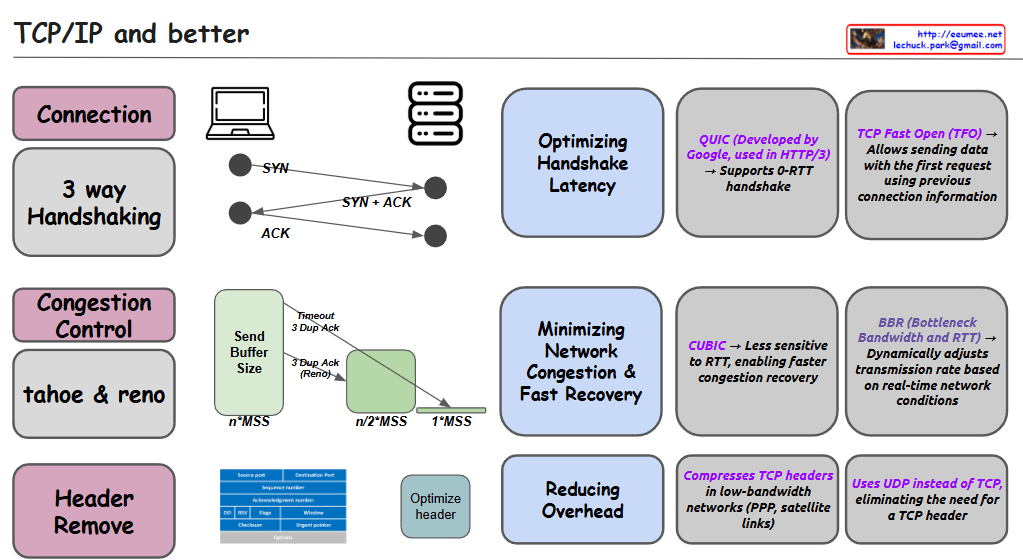
This image is an informational diagram titled “TCP/IP and better” that explains various aspects of network protocols and optimizations.

The diagram is organized into three main sections:

  1. Connection
    • Shows “3 way Handshaking” with a visual representation of the SYN, SYN+ACK, ACK sequence
    • “Optimizing Handshake Latency” section mentions:
      • QUIC (Developed by Google, used in HTTP/3) → Supports 0-RTT handshake
      • TCP Fast Open (TFO) → Allows sending data with the first request using previous connection information
  2. Congestion Control
    • Lists “tahoe & reno” congestion control algorithms
    • Shows diagrams of Send Buffer Size with concepts like “Timeout 3-Dup-Ack” and “3-Dup Ack (Reno)”
    • “Minimizing Network Congestion & Fast Recovery” section mentions:
      • CUBIC → Less sensitive to RTT, enabling faster congestion recovery
      • BBR (Bottleneck Bandwidth and RTT) → Dynamically adjusts transmission rate based on real-time network conditions
  3. Header Remove
    • Shows TCP header structure diagram and “Optimize header” section
    • “Reducing Overhead” section mentions:
      • Compresses TCP headers in low-bandwidth networks (PPP, satellite links)
      • Uses UDP instead of TCP, eliminating the need for a TCP header

The diagram appears to be an educational resource about TCP/IP protocols and various optimizations that have been developed to improve network performance, particularly focused on connection establishment, congestion control, and overhead reduction.

With Claude
HTTP/3 with QUIC & TLS1.3

From Claude with some prompting
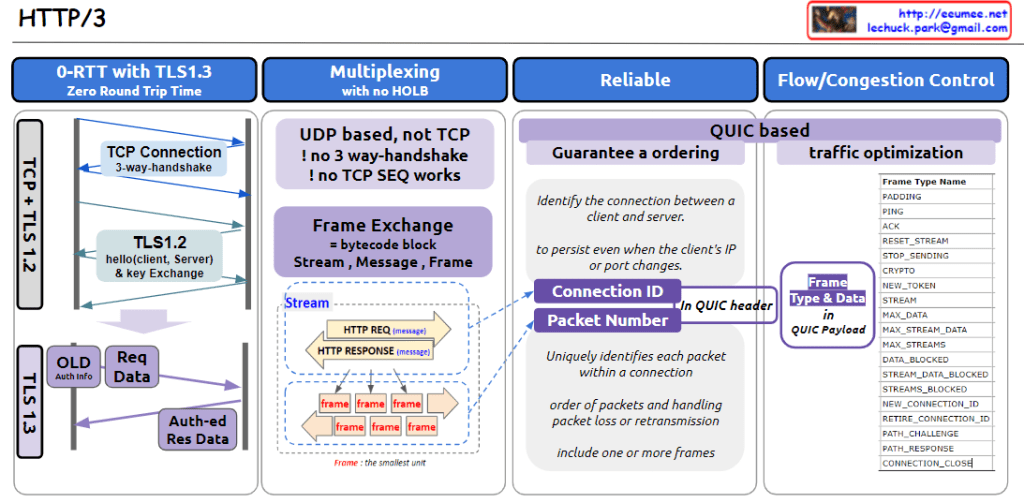
This image provides an overview of HTTP/3, highlighting its key features and components:

  1. 0-RTT with TLS1.3 (Zero Round Trip Time):
    • Compares TLS 1.2 and 1.3 connection processes.
    • TLS 1.3 offers faster handshake, reducing latency.
  2. Multiplexing with no HOLB (Head-of-Line Blocking):
    • UDP-based, eliminating TCP’s 3-way handshake and TCP SEQ.
    • Uses frame exchange, structured as streams, messages, and frames.
  3. Reliable:
    • QUIC-based, ensuring reliable data transfer.
    • Uses Connection ID to maintain connections despite client IP or port changes.
    • Packet Number uniquely identifies each packet within a connection.
  4. Flow/Congestion Control:
    • Lists various frame types for traffic optimization.

The diagram emphasizes that HTTP/3 is UDP-based and utilizes the QUIC protocol to enhance connection reliability and efficiency. It illustrates core concepts such as frame-based data exchange and the use of Connection IDs.

The image also details the QUIC header structure, explains how packet ordering and loss handling work, and provides a comprehensive list of frame types used in HTTP/3.

Overall, this diagram effectively visualizes the improvements HTTP/3 brings over its predecessors in terms of speed, reliability, and efficiency in data transfer.

HTTP Changes

From Claude with some prompting
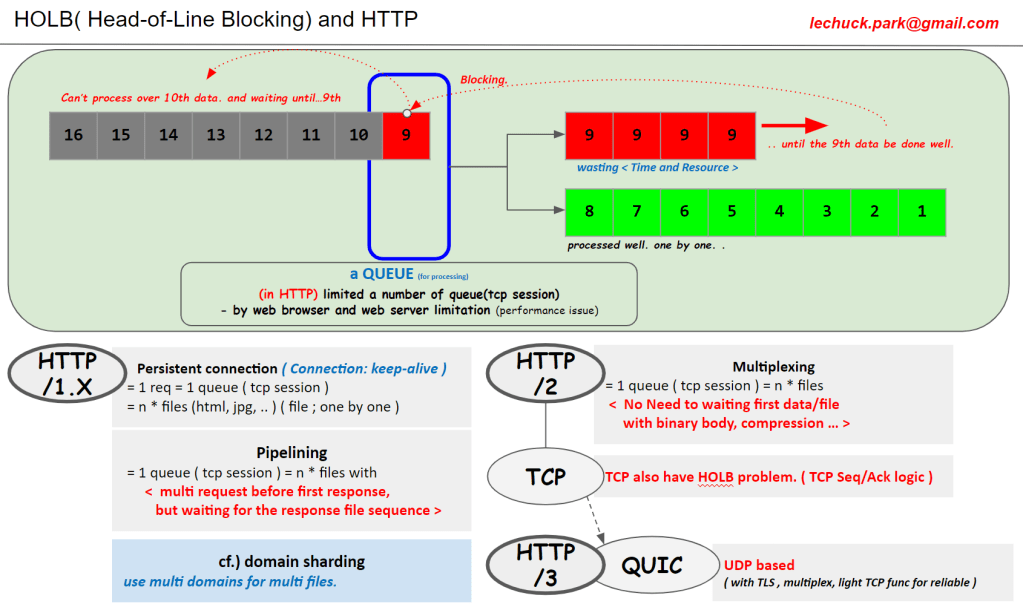
HTTP: HTTP uses text-based HTML with a head and body structure. HTTP/1.1 introduced Keep-Alive for maintaining TCP connections, but suffers from header overhead and Head-of-Line Blocking issues. Servers cannot push data without a client request.

HTTP/2: HTTP/2 introduced binary framing to improve performance. It enhances efficiency through header compression and multiplexing, and added server push functionality. It also strengthened authentication and encryption using TLS/SSL.

HTTP/3: HTTP/3 operates over the QUIC protocol using UDP instead of TCP. It includes TLS 1.3 by default and provides lower latency and improved multiplexing. HTTP/3 significantly enhances performance through 0-RTT connection establishment, elimination of TCP handshakes, and solving Head-of-Line Blocking issues. It also offers reliable data streams over UDP and ensures data ordering on each stream.