Amazing ML

From Claude with some prompting
This diagram effectively illustrates the core principles of machine learning.

Basic Components:

  1. Number Pattern at the Top: 1 → 4 → 7 → 10 → 14
  • Presented with the question “Have a pattern??”
  1. Neural Network Diagram in the Center
  • Visualizes the machine learning process of pattern discovery
  1. Discovered Rule at the Bottom: Y = 3x + 1
  • Mathematical expression of the pattern found in the data

Key Messages:

  1. Pattern Discovery from Data
  • Using just 5 data points
  • Clear mathematical pattern can be discovered
  • Rule where each number adds 3 to the previous one
  1. Infinite Scalability
  • One simple discovered rule (Y = 3x + 1)
  • Can predict infinite data points (Infinite Data)
  • Demonstrates machine learning’s power of ‘generalization’

This diagram showcases machine learning’s most powerful characteristic:

  • Learning from limited data
  • Discovering simple yet powerful rules
  • Ability to predict infinite new cases

It’s similar to how physical laws like E = mc² can explain infinite natural phenomena with a single equation. The diagram effectively shows how machine learning serves as a powerful tool for discovering these fundamental patterns hidden within data.

The beauty of this concept lies in its simplicity and power:

  • Using just 5 visible data points
  • Finding a mathematical pattern
  • Creating a rule that can predict an infinite number of future points

This demonstrates the essence of machine learning: the ability to take finite observations and transform them into a universal rule that can make predictions far beyond the original training data.

Vector

From Claude with some prompting
This image illustrates the vectorization process in three key stages.

  1. Input Data Characteristics (Left):
  • Feature: Original data characteristics
  • Numbers: Quantified information
  • countable: Discrete and clearly distinguishable data → This stage represents observable data from the real world.
  1. Transformation Process (Center):
  • Pattern: Captures regularities and recurring characteristics in data
  • Changes: Dynamic aspects and transformation of data → This represents the intermediate processing stage where raw data is transformed into vectors.
  1. Output (Right):
  • Vector: Final form transformed into a mathematical representation
  • math formula: Mathematically formalized expression
  • uncountable: State transformed into continuous space → Shown in 3D coordinate system, demonstrating the possibility of abstract data representation.

Key Insights:

  1. Data Abstraction:
  • Shows the process of converting concrete, countable data into abstract, continuous forms
  • Demonstrates the transition from discrete to continuous representation
  1. Dimensional Transformation:
  • Explains how individual features are integrated and mapped into a vector space
  • Shows the unification of separate characteristics into a cohesive mathematical form
  1. Application Areas:
  • Feature extraction in machine learning
  • Data dimensionality reduction
  • Pattern recognition
  • Word embeddings in Natural Language Processing
  • Image processing in Computer Vision
  1. Benefits:
  • Efficient processing of complex data
  • Easy application of mathematical operations
  • Discovery of relationships and patterns between data points
  • Direct applicability to machine learning algorithms
  1. Technical Implications:
  • Enables mathematical manipulation of real-world data
  • Facilitates computational processing
  • Supports advanced analytical methods
  • Enables similarity measurements between data points

This vectorization process serves as a fundamental preprocessing step in modern data science and artificial intelligence, transforming raw, observable features into mathematically tractable forms that algorithms can effectively process.

The progression from countable features to uncountable vector representations demonstrates the power of mathematical abstraction in handling complex, real-world data structures.

Easy Prediction

From Claude with some prompting
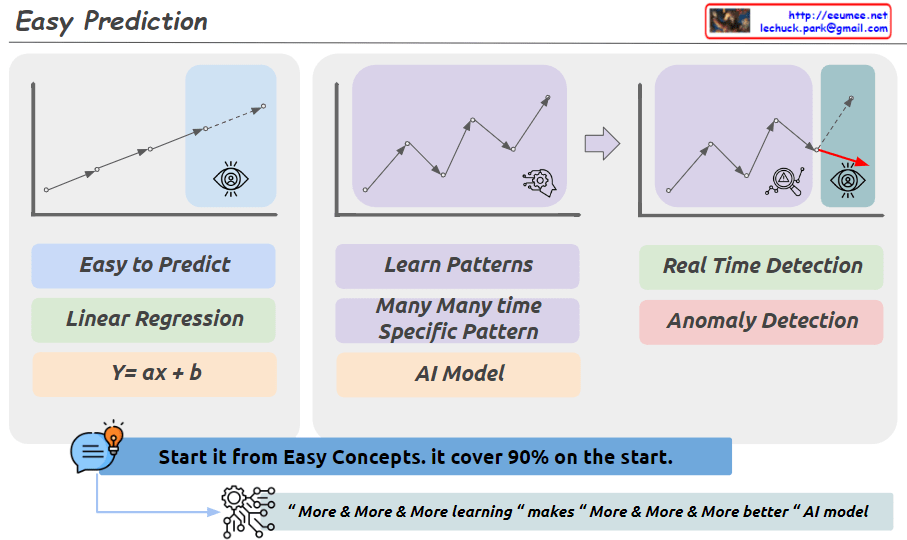
This image illustrates three main approaches to prediction and pattern recognition.

First, for easy prediction, a linear regression model (Linear Regression, y=ax+b) can be used. This is represented by a simple upward trendline. While a basic concept, it is emphasized that this can cover 90% of cases.

Second, for learning complex patterns that recur over time, an AI model is required. This is depicted by the jagged line shape.

Third, for real-time anomaly detection, sudden spike patterns need to be identified.

Additionally, at the bottom of the image, a new phrase has been added: “More & More & More learning makes More & More & More better AI model.” This conveys the idea that as an AI model learns from more and more data, its performance continues to improve.

In summary, the image highlights a step-by-step approach: starting with simple concepts to build a foundation, then utilizing AI models to learn complex patterns, and continuously improving the models through ongoing data learning and training. The key emphasis is on starting with the basics, while recognizing the potential of advanced AI techniques when combined with extensive learning from data.