
From Claude with some prompting
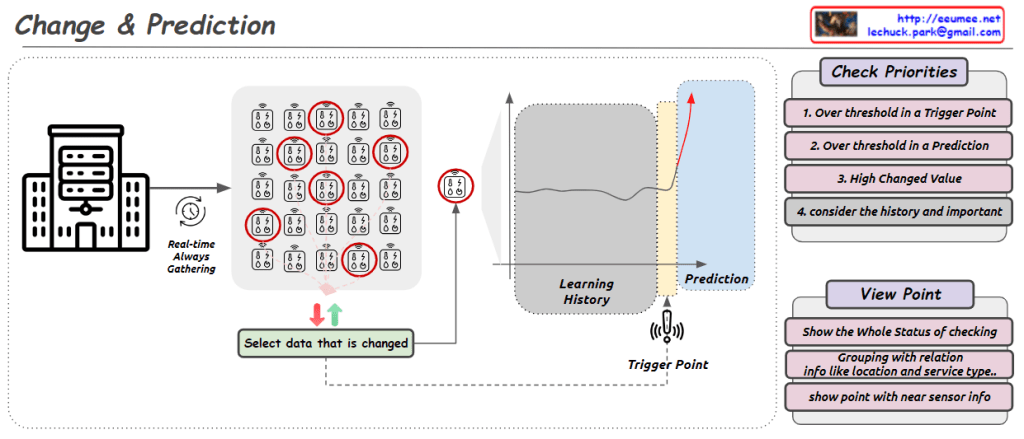
This image illustrates a Prediction and Detection system for time series data. Let me break down the key components:
- Left Large Box (Learning and Prediction Section):
- Blue line: Actual Temperature data
- Red dotted line: Predicted Temperature data
- Uses time series prediction models like LSTM, ARIMA, and Prophet for learning
- Top Right (Threshold-based Anomaly Detection):
- “Abnormal Detection with Threshold”
- Detects abnormal temperature changes based on threshold values
- The area marked with a red circle shows where values exceed the threshold
- Includes “Warning” and “Critical” threshold levels
- Bottom Right (Pattern-based Anomaly Detection):
- “Anomaly Detection with Predict-Pattern”
- Compares predicted patterns with actual data to detect anomalies
- The area marked with a green circle shows where actual data deviates from the predicted pattern
The system detects anomalies in two ways:
- When values exceed predetermined thresholds
- When actual data significantly deviates from predicted patterns
This type of system is particularly useful in:
- Industrial monitoring
- Equipment maintenance
- Early warning systems
- Quality control
- System health monitoring
The combination of prediction and dual detection methods (threshold and pattern-based) provides a robust approach to identifying potential issues before they become critical problems.

 Lechuck Park