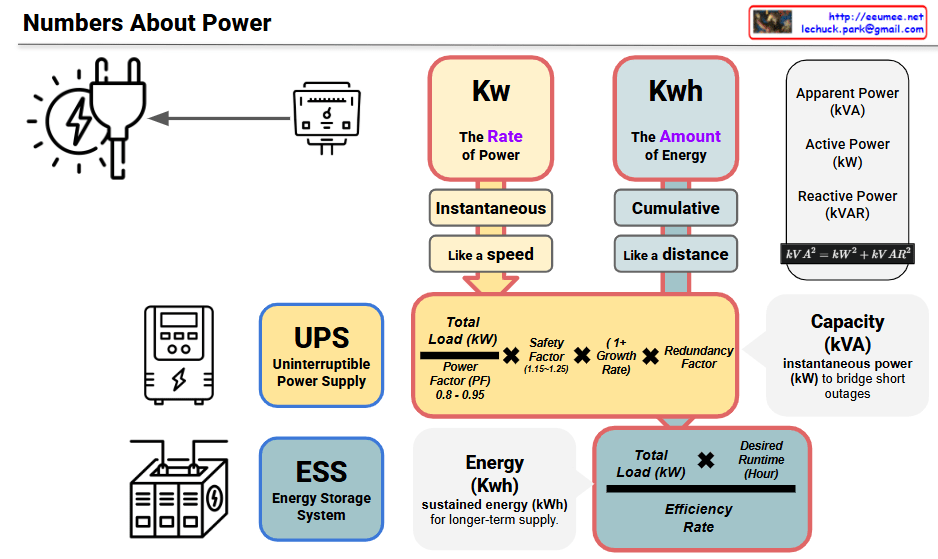
kW (Instantaneous Power) ↔ UPS (Uninterruptible Power Supply)
UPS Core Objective: Instantaneous Power Supply Capability
- kW represents the power needed “right now at this moment”
- UPS priority is immediate power supply during outages
- Like the “speed” concept in the image, UPS focuses on instantaneous power delivery speed
- Design actual kW capacity considering Power Factor (PF) 0.8-0.95
- Calculate total load (kW) reflecting safety factor, growth rate, and redundancy
kWh (Energy Capacity) ↔ ESS (Energy Storage System)
ESS Core Objective: Sustained Energy Supply Capability
- kWh indicates “how long” power can be supplied
- ESS priority is long-term stable power supply
- Like the “distance” concept in the image, ESS focuses on power supply duration
- Required ESS capacity = Total Load (kW) × Desired Runtime (Hours)
- Design actual storage capacity considering efficiency rate
Complementary Operation Strategy
Phase 1: UPS Immediate Response
- Power outage → UPS immediately supplies power in kW units
- Short-term power supply for minutes to tens of minutes
Phase 2: ESS Long-term Support
- Extended outages → ESS provides sustained power in kWh units
- Long-term power supply for hours to days
Summary: This structure optimally matches kW (instantaneousness) with UPS strengths and kWh (sustainability) with ESS capabilities. UPS handles immediate power needs while ESS ensures long-duration supply, creating a comprehensive power backup solution.
With Claude
 Lechuck Park