Control Flow Enforcement Tech.

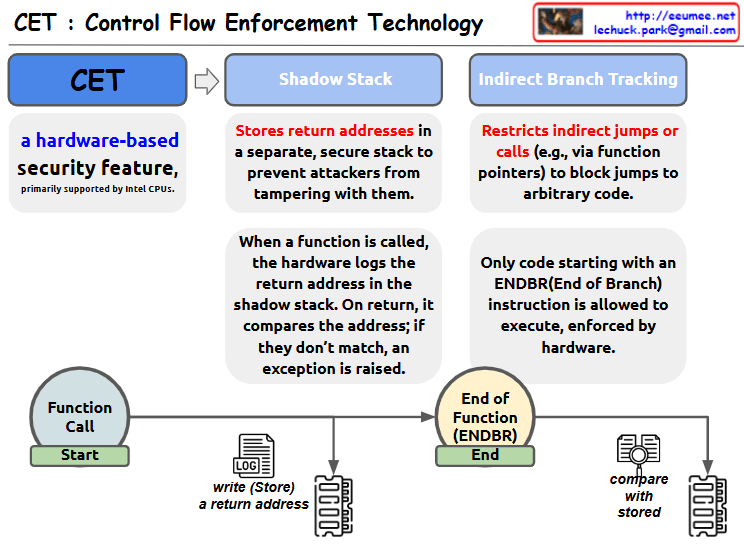
This image is an illustrative diagram of Control Flow Enforcement Technology (CET). CET is a hardware-based security feature, primarily supported by Intel CPUs.

The diagram shows the two main mechanisms of CET:

  1. Shadow Stack:
  • Stores the return address on a separate, secure stack to prevent an attacker from changing it.
  • When a function is called, the hardware writes the return address to the shadow stack.
  • When the function returns, the address on the stack is compared to the address on the shadow stack, and an exception is thrown if they don’t match.
  1. Indirect Branch Tracking:
  • Restricts indirect jumps or calls via function pointers, etc. to prevent jumps to arbitrary code.
  • Hardware enforces that only code that starts with an End of Branch (ENDBR) instruction can be executed.

At the bottom of the diagram is a visual representation of the process of calling a function and exiting the function with the ENDBR instruction. This shows the process of logging (storing) the return address when the function is called and comparing it to the stored address when the function exits.

With Claude

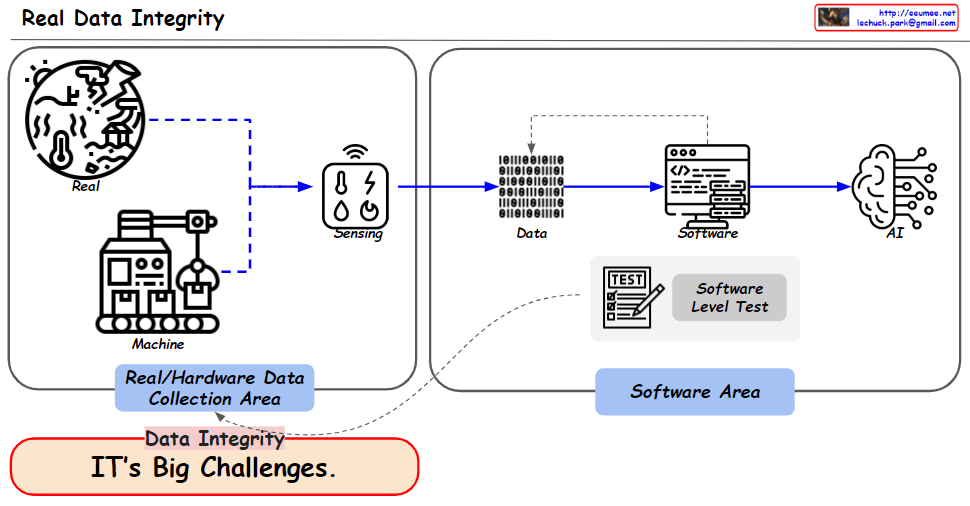
Never miss an alert

From DALL-E with some prompting
The image illustrates the interaction between an alert system and a data analysis system, comprised of two distinct stages:

Raw Level Hardware (HW) Alert Detection:
This stage emphasizes internal alarms, which are hardwired to ensure that alerts are raised in critical situations without any buffering, allowing for the fastest possible alarm detection. The message “Don’t forget This Step is required” underscores the indispensability of this stage.

Analyzed Software (SW) Alert Detection:
Data passes through storage devices to analysis tools, where it can be subject to delays or potential loss. The data is analyzed by code, enabling advanced analysis with AI. However, the phrase “Even though You have a wonderful Data Analysis System” reiterates the importance of raw-level alert detection, regardless of the sophistication of the data analysis system.

Overall, the image indicates that raw-level alerts are crucial for immediate response needs, and while advanced data analysis can enhance system alerting and monitoring, it cannot replace the need for immediate alert mechanisms. The title “Never miss an alert” emphasizes the critical nature of these alert systems.

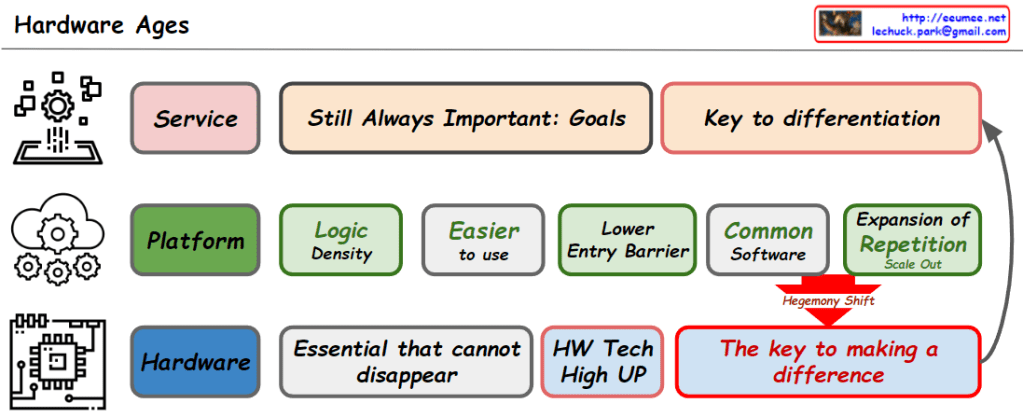
Hardware Ages

From DALL-E with some prompting
The diagram illustrates the evolution of computing services, signaling a shift from software-centric cloud services to hardware infrastructure as a means of differentiation. As software becomes more accessible and commonplace, the focus is highlighted on the essential, enduring nature of hardware and its growing importance in establishing a competitive edge in the industry, a movement termed ‘Hegemony Shift’.