Workload trigger

From Claude with some prompting
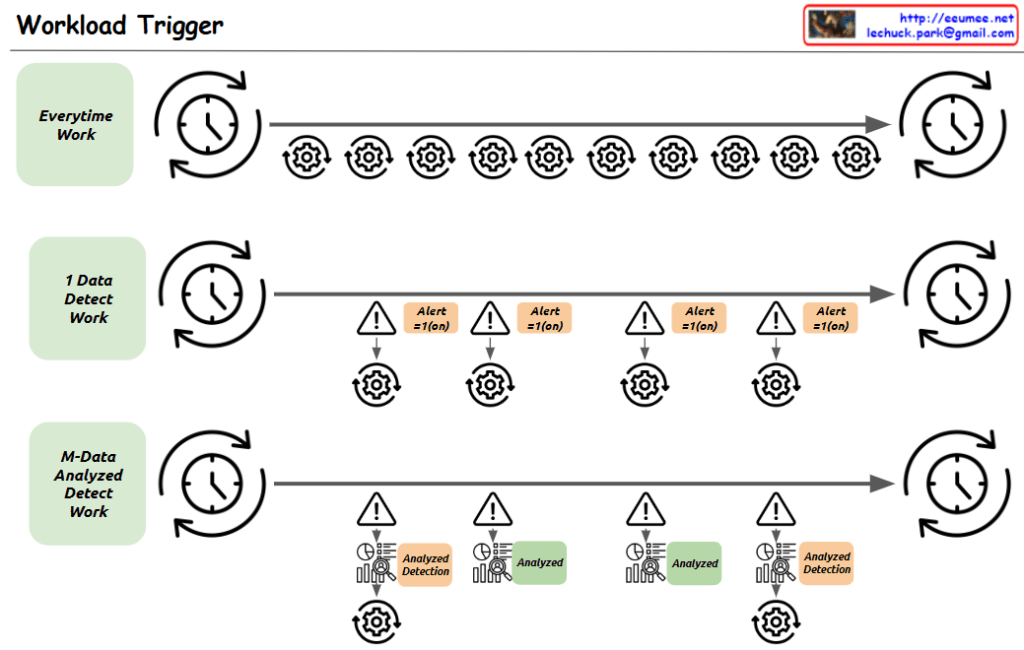
The image appears to be a diagram illustrating a “Workload Trigger” process. It shows three main stages of work:

  1. “Everytime Work”: This stage indicates work that is performed at a regular interval, represented by the repeating gear symbols.
  2. “1 Data Detect Work”: This stage shows data detection work that triggers alerts based on certain conditions, represented by the alert symbols.
  3. “M-Data Analyzed Detect Work”: This stage shows data analysis work that also triggers alerts based on the analysis results, represented by the analyzed detection symbols.

The overall flow of the diagram moves from left to right, with the work cycling through the three main stages. The timing of the work cycles is indicated by the clocks at the start and end of each stage.

The diagram seems to be illustrating some kind of automated monitoring or analysis workflow that triggers alerts based on the detection of certain data patterns or conditions.

Prediction & Detection

From Claude with some prompting
This image illustrates a Prediction and Detection system for time series data. Let me break down the key components:

  1. Left Large Box (Learning and Prediction Section):
  • Blue line: Actual Temperature data
  • Red dotted line: Predicted Temperature data
  • Uses time series prediction models like LSTM, ARIMA, and Prophet for learning
  1. Top Right (Threshold-based Anomaly Detection):
  • “Abnormal Detection with Threshold”
  • Detects abnormal temperature changes based on threshold values
  • The area marked with a red circle shows where values exceed the threshold
  • Includes “Warning” and “Critical” threshold levels
  1. Bottom Right (Pattern-based Anomaly Detection):
  • “Anomaly Detection with Predict-Pattern”
  • Compares predicted patterns with actual data to detect anomalies
  • The area marked with a green circle shows where actual data deviates from the predicted pattern

The system detects anomalies in two ways:

  1. When values exceed predetermined thresholds
  2. When actual data significantly deviates from predicted patterns

This type of system is particularly useful in:

  • Industrial monitoring
  • Equipment maintenance
  • Early warning systems
  • Quality control
  • System health monitoring

The combination of prediction and dual detection methods (threshold and pattern-based) provides a robust approach to identifying potential issues before they become critical problems.