TCP/IP Better

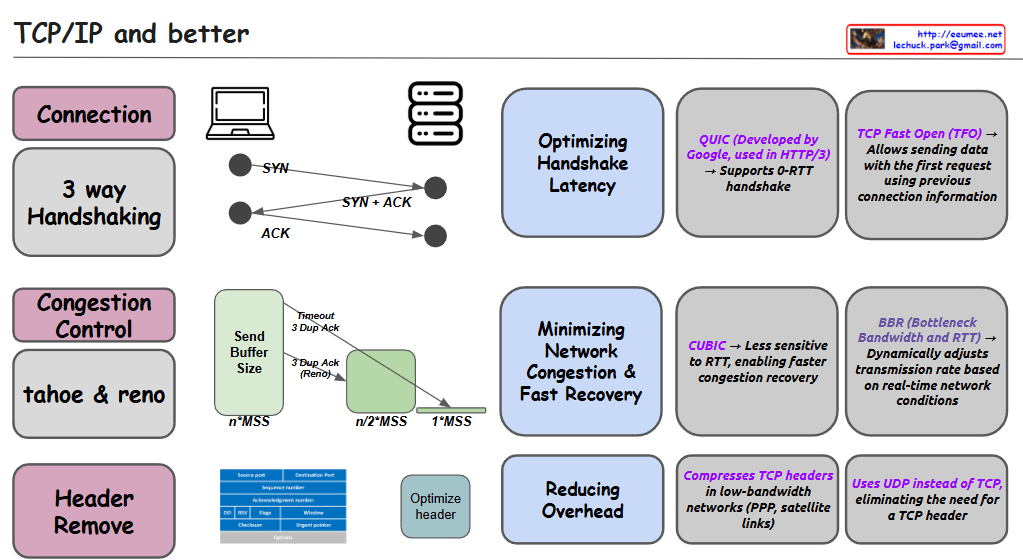
This image is an informational diagram titled “TCP/IP and better” that explains various aspects of network protocols and optimizations.

The diagram is organized into three main sections:

  1. Connection
    • Shows “3 way Handshaking” with a visual representation of the SYN, SYN+ACK, ACK sequence
    • “Optimizing Handshake Latency” section mentions:
      • QUIC (Developed by Google, used in HTTP/3) → Supports 0-RTT handshake
      • TCP Fast Open (TFO) → Allows sending data with the first request using previous connection information
  2. Congestion Control
    • Lists “tahoe & reno” congestion control algorithms
    • Shows diagrams of Send Buffer Size with concepts like “Timeout 3-Dup-Ack” and “3-Dup Ack (Reno)”
    • “Minimizing Network Congestion & Fast Recovery” section mentions:
      • CUBIC → Less sensitive to RTT, enabling faster congestion recovery
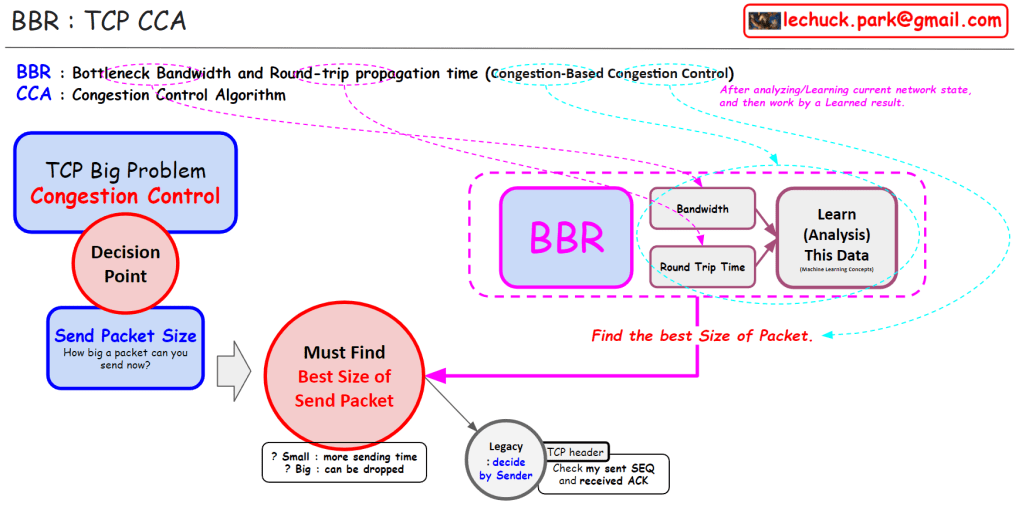
      • BBR (Bottleneck Bandwidth and RTT) → Dynamically adjusts transmission rate based on real-time network conditions
  3. Header Remove
    • Shows TCP header structure diagram and “Optimize header” section
    • “Reducing Overhead” section mentions:
      • Compresses TCP headers in low-bandwidth networks (PPP, satellite links)
      • Uses UDP instead of TCP, eliminating the need for a TCP header

The diagram appears to be an educational resource about TCP/IP protocols and various optimizations that have been developed to improve network performance, particularly focused on connection establishment, congestion control, and overhead reduction.

With Claude
TCP Reliable 2

From Claude with some prompting
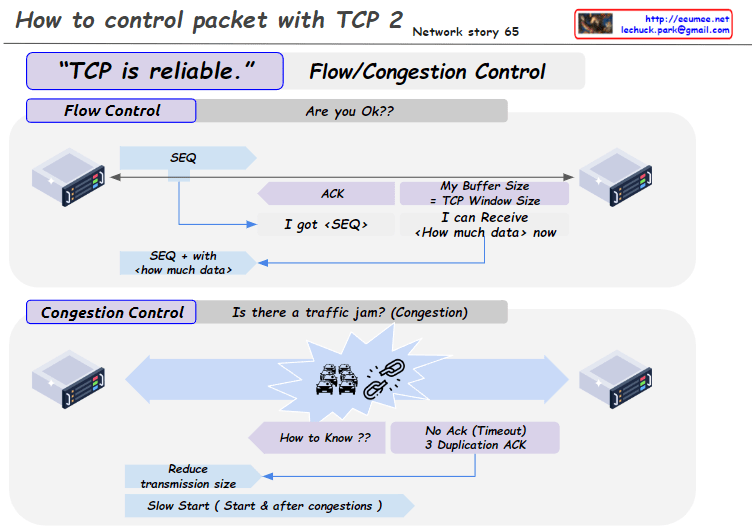
This image illustrates the flow control and congestion control mechanisms, which are examples of why TCP (Transmission Control Protocol) is considered a reliable protocol.

  1. TCP is a protocol that employs various mechanisms to ensure reliable data transmission.
  2. Flow Control:
    • It uses sequence numbers and acknowledgments to regulate the amount of data transmitted based on the receiver’s buffer size, preventing data loss.
    • This mechanism contributes to TCP’s reliable delivery guarantee.
  3. Congestion Control:
    • It detects network congestion and adjusts the transmission rate to avoid further congestion.
    • This allows TCP to provide stable and efficient data transfer.

Therefore, flow control and congestion control are key factors that enable TCP to be regarded as a reliable transport protocol. Through these mechanisms, TCP prevents data loss, network overload, and ensures stable communication.


MSS

From Claude with some prompting
This image explains the concept of Maximum Segment Size (MSS) in computer networking. MSS refers to the maximum size of the data payload that can be transmitted in a single TCP segment. The main points illustrated are:

  1. The TCP header and IP header each have a fixed size of 20 bytes.
  2. MSS is defined as the maximum size of the TCP payload within a single packet.
  3. MSS is used for TCP communication to control congestion and prevent large TCP packets at the application level.
  4. This is contrasted with the Maximum Transmission Unit (MTU) which limits packet size at the physical layer, such as in Ethernet switches.
  5. The image depicts a concept called “One Time Transfer Data Size” with 1 MTU packet being sent, followed by acknowledgment (3 DUP ACK), and then a timeout period.

The overall purpose of MSS is to manage and optimize data transmission by limiting the segment size, thereby facilitating better congestion control and efficient network performance.