HTTP caching

From Claude with some prompting
The image illustrates the architecture of an HTTP caching system with the following main components:

  1. Client Side (Left):
  • Web App client
  • FAST GET requests through PROXY
  • Uses If-Modified-Since and Cache-Control headers
  1. Central Infrastructure:
  • GSLB (Global Server Load Balancer)
  • CDN Service (Content Delivery Network)
  • Edge servers (distributed cache servers)
  1. Server Side (Right):
  • Web Service server
  • FAST RETURN through REVERSE PROXY
  • Uses Last-Modified and Cache-Control headers
  • Supports Load Optimization
  • Origin server connection
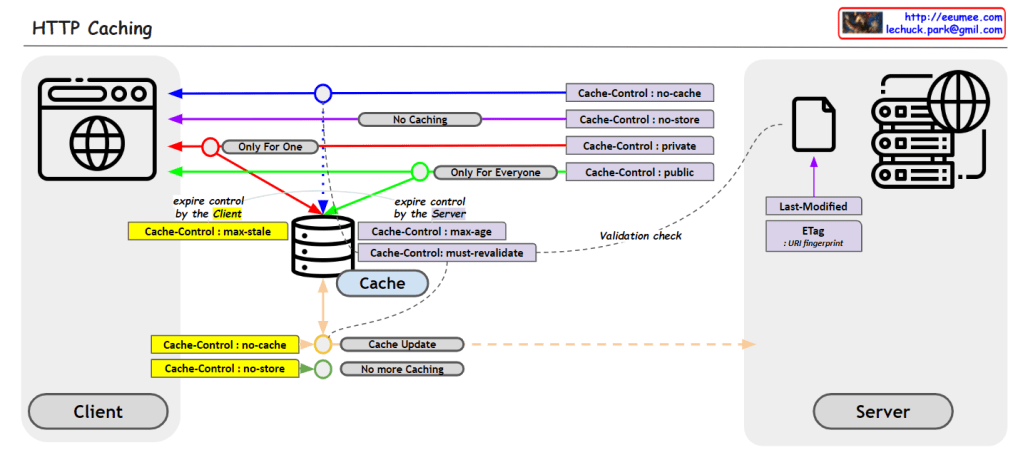
  1. Cache Control Options:
  • max-age
  • no-cache
  • no-store
  • must-revalidate
  • public
  • private
  • s-maxage

This architecture represents an enterprise-grade caching system designed to optimize web performance and reduce server load. The system utilizes multiple layers of caching with CDN to deliver content to end users more quickly and efficiently.

Traffic flow starts from the client, passes through multiple caching layers, and can ultimately reach the origin server, with appropriate caching strategies applied at each layer.

This structure enables:

  • Improved response times
  • Reduced server load
  • Efficient content delivery
  • Better user experience
  • Scalable infrastructure

The combination of proxies, CDN, and various caching mechanisms creates a robust system for handling web content delivery at scale.
Domain to IP

From Claude with some prompting
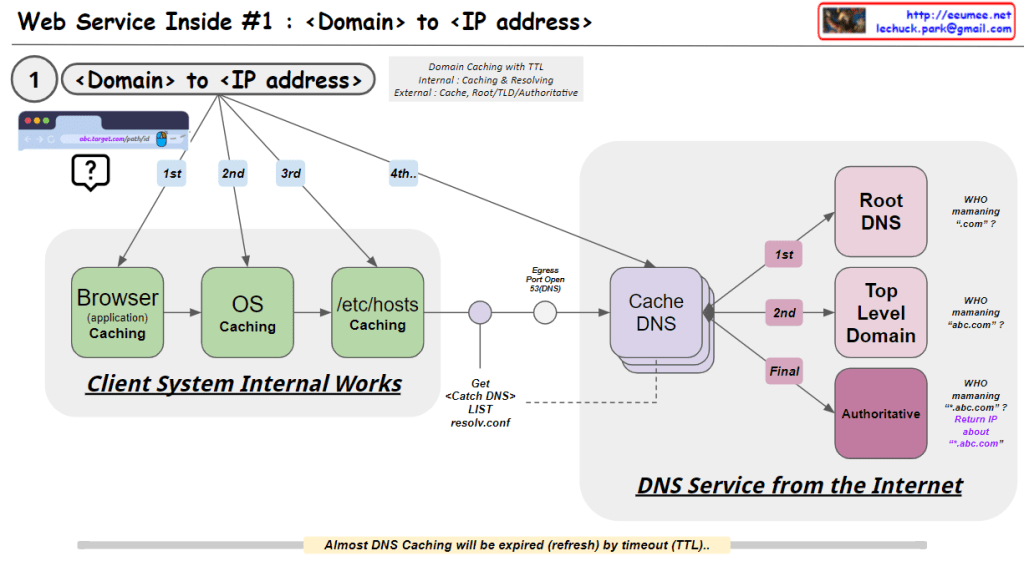
This image illustrates the process of converting a domain name to an IP address, which is the first step in web service operations. Here’s a breakdown of the image:

  1. Client System Internal Works:
    • Browser (application) Caching: The first level of caching occurs in the web browser.
    • OS Caching: The second level of caching is at the operating system level.
    • /etc/hosts Caching: The third level involves checking the local hosts file.
  2. DNS Service from the Internet:
    • Cache DNS: This is the first point of contact with external DNS services.
    • Root DNS: Manages top-level domains like “.com”.
    • Top Level Domain: Manages specific top-level domains (e.g., “.com”, “.org”).
    • Authoritative DNS: Provides the final, authoritative IP address for the specific domain.

The process follows a hierarchical order:

  1. Check Browser cache
  2. Check OS cache
  3. Check /etc/hosts file
  4. Query Cache DNS server
  5. If not found, Cache DNS queries Root DNS
  6. Then queries Top Level Domain
  7. Finally queries Authoritative DNS to get the IP address

The image also notes:

  • DNS caching uses TTL (Time To Live) for expiration.
  • The system uses a resolve.conf file to get the Cache DNS list.
  • It questions who is managing various levels of DNS (“.com”, “abc.com”, etc.)

This process ensures efficient and hierarchical resolution of domain names to IP addresses, utilizing various caching mechanisms to improve speed and reduce network load.

DNS work sequence

From Claude with some prompting
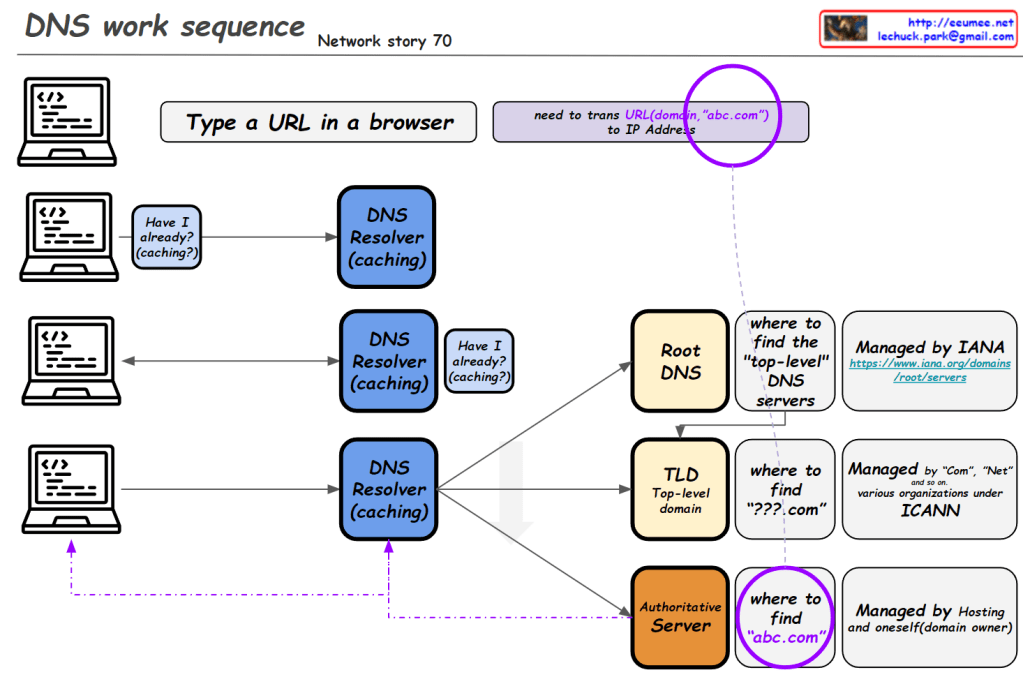
This image illustrates the DNS (Domain Name System) work sequence. Here’s a breakdown:

  1. It starts with typing a URL in a browser. For example, entering “abc.com” requires translation to an IP address.
  2. The DNS resolution process begins, involving multiple levels of DNS resolvers with caching capabilities.
  3. At each level, there’s a “Have I already? (caching?)” check. If the information is cached, it’s used immediately.
  4. If not found, it proceeds to the next level:
    • Root DNS: Provides information on top-level DNS servers (Managed by IANA)
    • TLD (Top-Level Domain): Gives information on domains like “.com” (Managed by various organizations under ICANN)
    • Authoritative Server: Provides actual domain information (e.g., abc.com, managed by hosting providers or domain owners)
  5. Through these stages, the system finds the necessary information to ultimately obtain the IP address of the entered domain.

This diagram effectively demonstrates the hierarchical structure of DNS lookup process and the caching mechanism at each stage.