TCP Reliable 2

From Claude with some prompting
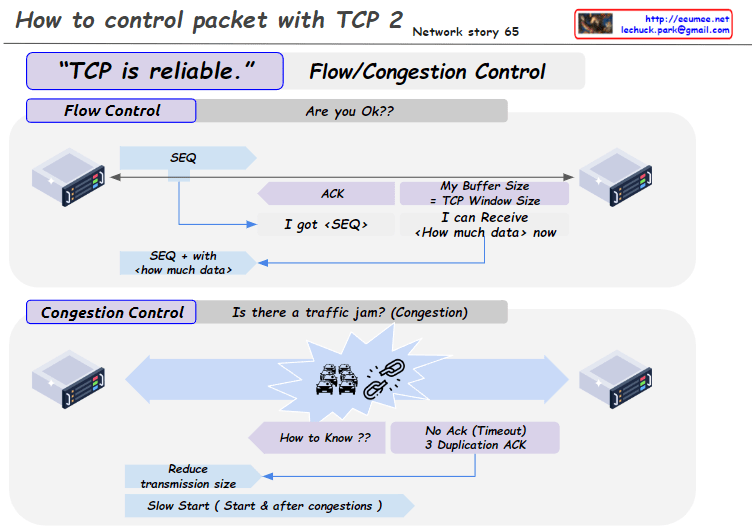
This image illustrates the flow control and congestion control mechanisms, which are examples of why TCP (Transmission Control Protocol) is considered a reliable protocol.

  1. TCP is a protocol that employs various mechanisms to ensure reliable data transmission.
  2. Flow Control:
    • It uses sequence numbers and acknowledgments to regulate the amount of data transmitted based on the receiver’s buffer size, preventing data loss.
    • This mechanism contributes to TCP’s reliable delivery guarantee.
  3. Congestion Control:
    • It detects network congestion and adjusts the transmission rate to avoid further congestion.
    • This allows TCP to provide stable and efficient data transfer.

Therefore, flow control and congestion control are key factors that enable TCP to be regarded as a reliable transport protocol. Through these mechanisms, TCP prevents data loss, network overload, and ensures stable communication.

TCP Reliable 1

From Claude with some prompting
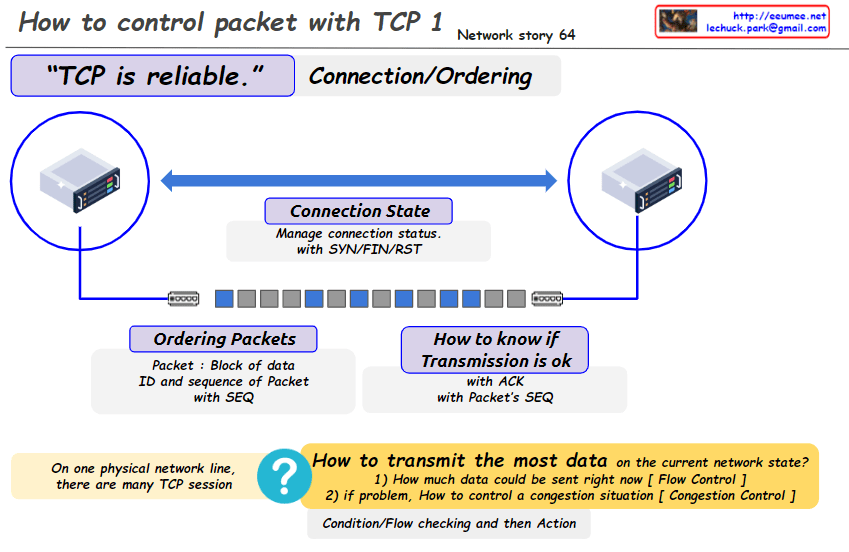
This image explains how packets are controlled and transmitted using TCP (Transmission Control Protocol), which is a reliable communication protocol.

The key points are:

  1. TCP is reliable and provides connection/ordering of packets.
  2. Connection state is managed using SYN/FIN/RST packets to establish, maintain, and tear down connections.
  3. Packets are organized into an ordered sequence using sequence numbers (SEQ).
  4. Acknowledgments (ACK) with the packet’s SEQ number indicate successful transmission.

The image also raises two main questions:

  1. How much data can be sent right now based on the current network state? (Flow Control)
  2. If there is a problem, how to control congestion? (Congestion Control)

The image suggests that condition/flow checking should be performed, and then appropriate action taken for transmitting the most data possible on the current network state while handling potential congestion situations.