
Cooling time
The Computing for the Fair Human Life.
From Claude with some prompting
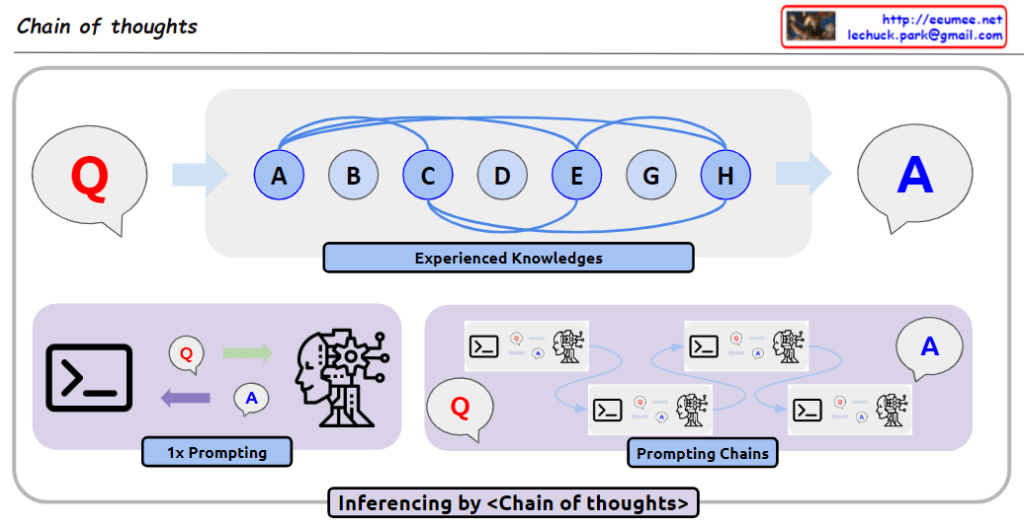
This diagram titled “Chain of thoughts” illustrates an inferencing method implemented in AI language models like ChatGPT, inspired by human deductive reasoning processes and leveraging prompting techniques.
Key components:
This diagram visualizes how AI systems, particularly models like ChatGPT, go beyond simple input-output relationships. It mimics human deductive reasoning by using a multi-step thought process (Chain of thoughts) to answer complex questions. The AI utilizes its existing knowledge base and creates new connections to perform deeper reasoning.
This approach suggests that AI can process information and generate new insights in a manner similar to human cognition, rather than merely reproducing learned information. It demonstrates the AI’s capability to engage in more sophisticated problem-solving and analysis through a structured chain of thoughts.

From Claude with some prompting
This image illustrates the architecture of CUDA (Compute Unified Device Architecture), a parallel computing platform and programming model developed by NVIDIA. The main components are as follows:
This diagram shows the allocation of tasks from the CPU to CUDA cores, the parallel processing capability of CUDA cores, and overall system control through memory and API. CUDA is used to accelerate complex computations by leveraging the powerful parallel processing capabilities of GPUs.
The diagram effectively simplifies the CUDA architecture to provide an overview of its key components and their relationships, suitable for educational purposes or high-level explanations.

From Claude with some prompting
The image illustrates “The Quantum of Communication”. Here, ‘quantum’ doesn’t refer to the physics concept, but rather to numbers as the smallest unit of communication that can be understood uniformly among humans with minimal misinterpretation.
Key elements of the image:
The image presents the idea that in human communication, ‘numbers’ can serve as the clearest and most universally understood minimal unit – the ‘quantum’ of communication. It contrasts the ambiguity and potential for misunderstanding in natural language with the precision of numerical expression. The overall message is that numerical or mathematical communication offers a more accurate and perfect form of information exchange compared to the variability in natural language interpretation.
Always


From Claude with some prompting
This diagram illustrates the complexity of problem-solving in real-world situations:
This diagram highlights that in real problem-solving processes, identifying and prioritizing the most important issues among many is more critical than simply resolving individual problems. It effectively captures the essence of decision-making and problem-solving in complex, real-world environments, where the challenge often lies in determining what to tackle first rather than in the solutions themselves.
 Lechuck Park