Interrupt Handling for real-time

With a Claude’s Help
the real-time interrupt handling :

Interrupt Handling Components and Process:

  1. Interrupt Prioritization
  • Uses assigned priority levels to determine which interrupt should be handled first
  • Ensures critical tasks are processed in order of importance
  1. Interrupt Queuing
  • When multiple interrupts occur, they are placed in a queue for sequential processing
  • Helps maintain organized processing order
  1. Efficient Handling Process
  • Uses a data structure that maps each interrupt to its corresponding Interrupt Service Routine (ISR)
  • Implements this mapping through the Interrupt Vector Table (IVT)
  1. Interrupt Controllers
  • Modern systems utilize interrupt controllers
  • Manages and prioritizes interrupts efficiently
  1. Types of Interrupts
  • Maskable Interrupts (IRQs)
  • Non-Maskable Interrupts (NMIs)
  • High-priority Interrupts
  • Software Interrupts
  • Hardware Interrupts

Real-Time Performance Benefits:

  1. Critical Task Management
  • Ensures critical tasks are always handled first
  • Maintains system responsiveness
  1. System Stability
  • Ensures no interrupt is missed or lost
  • Maintains reliable system operation
  1. Scalability
  • Efficiently manages a growing number of devices and interrupts
  • Adapts to increasing system complexity
  1. Improved User Experience
  • Creates responsive systems that react quickly to user inputs or events
  • Enhances overall system performance and user interaction

This structure provides a comprehensive framework for handling interrupts in real-time systems, ensuring efficient and reliable processing of system events and user interactions.CopyR


THIS IS KOREA.

현재 한국은 아픔과 위기를 겪고 있습니다.
하지만 이겨내고 극복하고 다시 웃을 것입니다.
힘내고 희생하고 앞으로 나아가는 멋진 국민들이 있기 때문입니다.
감사합니다. 또 감사합니다. 대한민국 만세!!!

Korea is currently experiencing pain and crisis.
But we will overcome, and smile again.
Because we have wonderful people who are strong, who sacrifice and move forward.
Thank you. Thank you again. Fighting!! the Republic of Korea!

CPU Isolation & Affinity

With a Claude’s Help
CPU Isolation & Affinity is a concept that focuses on pinning and isolating CPU cores for real-time tasks. The diagram breaks down into several key components:

  1. CPU Isolation
  • Restricts specific processes or threads to run only on specific CPU cores
  • Isolates other processes from using that core to ensure predictable performance and minimize interference
  1. CPU Affinity
  • Refers to preferring a process or thread to run on a specific CPU core
  • Doesn’t necessarily mean it will only run on that core, but increases the probability that it will run on that core as much as possible
  1. Application Areas:

a) Real-time Systems

  • Critical for predictable response times
  • CPU isolation minimizes latency by ensuring specific tasks run without interference on the cores assigned to them

b) High Performance Computing

  • Effective utilization of CPU cache is critical
  • CPU affinity allows processes that reference data frequently to run on the same core to increase cache hit rates and improve performance

c) Multi-core Systems

  • If certain cores have hardware acceleration capabilities
  • Can increase efficiency by assigning cores based on the task

This system of CPU management is particularly important for:

  • Ensuring predictable performance in time-sensitive applications
  • Optimizing cache usage and system performance
  • Making efficient use of specialized hardware capabilities in different cores

These features are essential tools for optimizing system performance and ensuring reliability in real-time operations.

Metric Monitoring Strategy

With a Claude’s Help
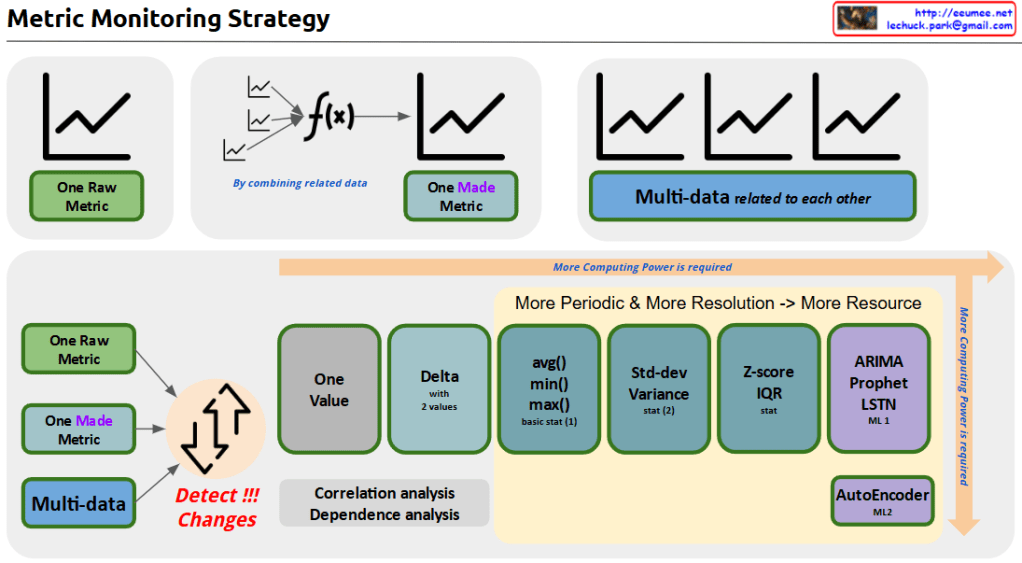
the Metric Monitoring System diagram:

  1. Data Hierarchy (Top)
  • Raw Metric: Unprocessed source data
  • Made Metric: Combined metrics from related data
  • Multi-data: Interrelated metrics sets
  1. Analysis Pipeline (Bottom)

Progressive Stages:

  • Basic: Change detection, single value, delta analysis
  • Intermediate: Basic statistics (avg/min/max), standard deviation
  • Advanced: Z-score/IQR
  • ML-based: ARIMA/Prophet, LSTM, AutoEncoder

Key Features:

  • Computing power increases with complexity (left to right)
  • Correlation and dependency analysis integration
  • Two-tier ML approach: ML1 (prediction), ML2 (pattern recognition)

Implementation Benefits:

  • Resource optimization through staged processing
  • Scalable analysis from basic monitoring to predictive analytics
  • Comprehensive anomaly detection
  • Flexible system adaptable to different monitoring needs

The system provides a complete framework from simple metric tracking to advanced machine learning-based analysis, enabling both reactive and predictive monitoring capabilities.

Additional Values:

  • Early warning system potential
  • Root cause analysis support
  • Predictive maintenance enablement
  • Resource allocation optimization
  • System health forecasting

This architecture supports both operational monitoring and strategic analysis needs while maintaining resource efficiency through its graduated approach to data processing.Copy

MLOCK (LINUX KERNEL)

With a Claude’s Help
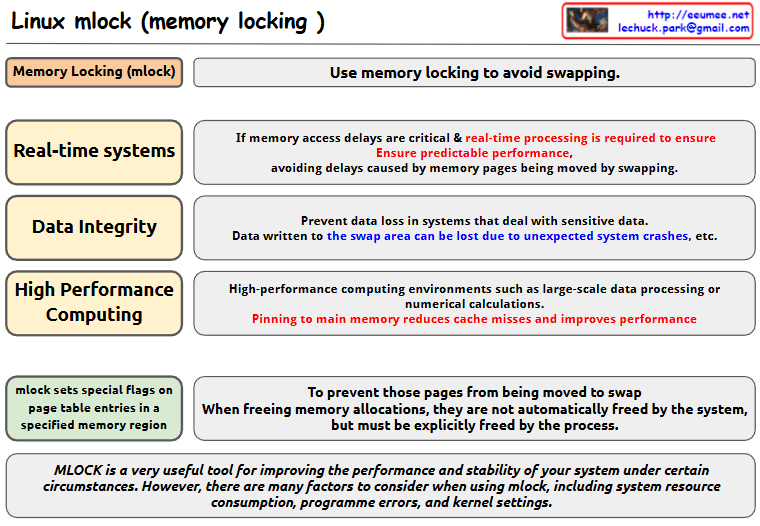
this image about Linux mlock (memory locking):

  1. Basic Concept
  • mlock is used to avoid memory swapping
  • It sets special flags on page table entries in specified memory regions
  1. Main Use Cases
  • Real-time Systems
    • Critical for systems where memory access delays are crucial
    • Ensures predictable performance
    • Prevents delays caused by memory pages being moved by swapping
  • Data Integrity
    • Prevents data loss in systems dealing with sensitive data
    • Data written to swap areas can be lost due to unexpected system crashes
  • High Performance Computing
    • Used in environments like large-scale data processing or numerical calculations
    • Pinning to main memory reduces cache misses and improves performance
  1. Implementation Details
  • When memory locations are freed using mlock, they must be explicitly freed by the process
  • The system does not automatically free these pages
  1. Important Note mlock is a very useful tool for improving system performance and stability under certain circumstances. However, users need to consider various factors when using mlock, including:
  • System resource consumption
  • Programme errors
  • Kernel settings

This tool is valuable for system optimization but should be used carefully with consideration of these factors and requirements.

The image presents this information in a clear diagram format, with boxes highlighting each major use case and their specific benefits for system performance and stability.Copy

Operation

With a Claude’s Help

  1. Normal State:
  • Represented by a gear icon with a green checkmark
  • Indicates system operating under normal conditions
  • Initial state of the monitoring process
  1. Anomaly Detection:
  • Shown with a magnifying glass and graph patterns
  • The graph patterns are more clearly visualized than before
  • Represents the phase where deviations from normal patterns are detected
  1. Abnormal State:
  • Depicted by a human figure with warning indicators
  • Represents confirmed abnormal conditions requiring intervention
  • Links directly to action steps
  1. Analysis and Response Process:
  • Comparison with normal: Shown through A/B document comparison icons
  • Analysis: Data examination phase
  • predictive Action: Now written in lowercase, indicating predicted response measures
  • Recovery Action: Implementation of actual recovery measures
  1. Learning Feedback:
  • Shows how lessons from recovery actions are fed back into the system
  • Creates a continuous improvement loop
  • Connects recovery actions back to normal operations

The workflow continues to effectively illustrate the complete operational cycle, from monitoring and detection through analysis, response, and continuous learning. It demonstrates a systematic approach to handling operational anomalies and maintaining system stability.