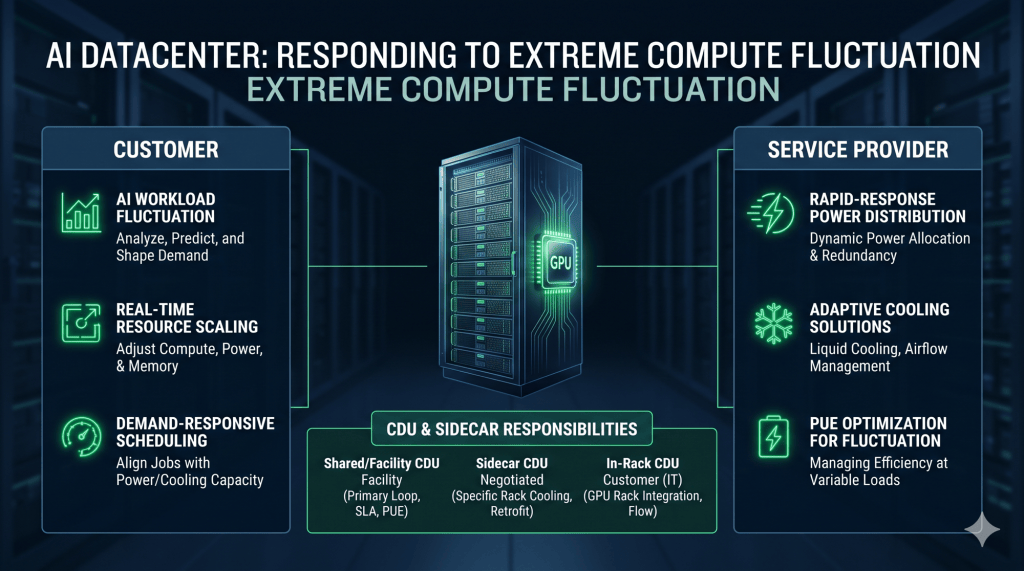
This infographic illustrates how AI data centers manage extreme compute fluctuations by dividing responsibilities between customers and service providers around a central GPU server rack. Set against a dark, futuristic data center aisle with glowing green accents, the layout connects a central GPU rack to two primary panels on the left and right, along with a dedicated demarcation box at the bottom.
Customer Responsibilities (Left Panel) Focusing on workload and demand control, the customer’s role is broken down into three areas:
- AI Workload Fluctuation: Analyzing, predicting, and shaping compute demand.
- Real-Time Resource Scaling: Dynamically adjusting compute, power, and memory resources.
- Demand-Responsive Scheduling: Aligning AI jobs with available power and cooling capacity.
Service Provider Responsibilities (Right Panel) Focusing on infrastructure agility and efficiency, the service provider manages three core functions:
- Rapid-Response Power Distribution: Delivering dynamic power allocation and redundancy.
- Adaptive Cooling Solutions: Implementing liquid cooling and airflow management.
- PUE Optimization for Fluctuation: Managing energy efficiency across variable loads.
CDU & Sidecar Responsibilities (Bottom Center) Directly beneath the central GPU rack, a horizontal box outlines ownership boundaries for liquid cooling distribution units:
- Shared/Facility CDU: Managed by the Facility, covering the primary loop, SLA, and PUE.
- Sidecar CDU: Negotiated between parties, focusing on specific rack cooling and retrofits.
- In-Rack CDU: Managed by Customer (IT), covering GPU rack integration and flow.
To handle volatile AI compute loads effectively, customers must actively predict and schedule their workloads while service providers deliver agile power, adaptive cooling, and variable-load PUE optimization—all supported by clearly defined ownership boundaries for shared, sidecar, and in-rack CDUs.
#AIDataCenter #Colocation #GPUInfrastructure #LiquidCooling #CDU #DataCenterEfficiency #PUE #AIWorkloads #ThermalManagement #PowerDistribution


