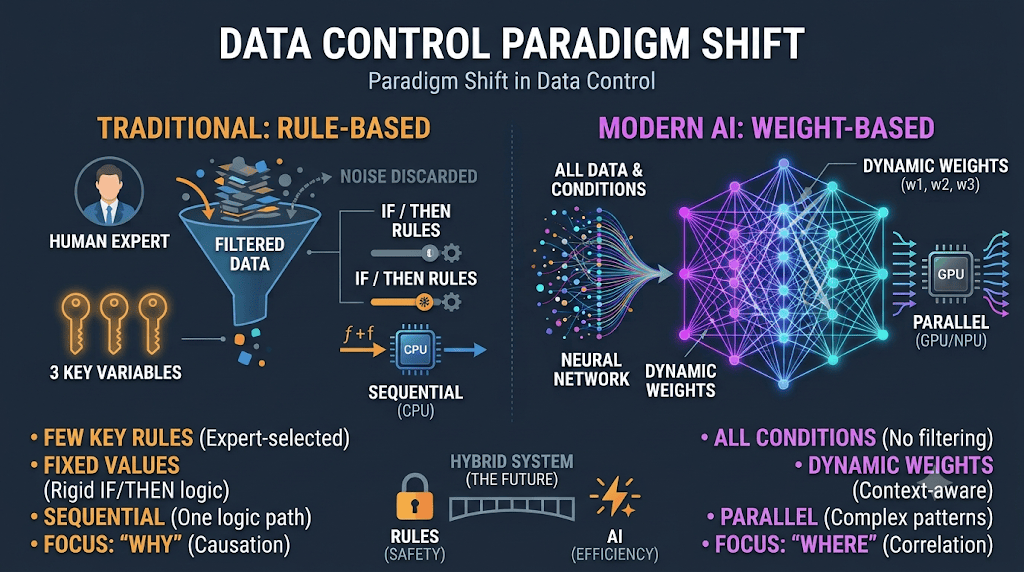
The infographic titled “DATA CONTROL PARADIGM SHIFT” visually contrasts two fundamentally different eras of computing and system control—moving from human-driven, deterministic logic to data-driven, probabilistic AI—before converging on a unified future architecture at the bottom.
1. Left Side: “TRADITIONAL: RULE-BASED” (Human-Centric & Deterministic)
Warm orange and muted blue tones illustrate a structured, top-down filtering process:
- Human Expert & 3 Key Variables: An icon of a human expert sits above three glowing orange keys, symbolizing how domain specialists rely on intuition and experience to handpick only a few decisive variables.
- Filtered Data Funnel: A central funnel takes in raw information and strips away surrounding context as “NOISE DISCARDED,” allowing only a tiny fraction of pre-selected data points to pass through.
- IF / THEN Rules & Sequential (CPU) Execution: The filtered variables feed into mechanical sliders and gears representing fixed conditional statements (IF / THEN RULES), which are then processed one step at a time along a single linear path(f + f) through a CPU.
- Core Characteristics: The bottom-left summary defines this paradigm through four pillars: FEW KEY RULES (Expert-selected), FIXED VALUES (Rigid IF/THEN logic), SEQUENTIAL (One logic path), and FOCUS: “WHY” (Causation).
2. Right Side: “MODERN AI: WEIGHT-BASED” (Data-Centric & Probabilistic)
Vibrant neon purple and cyan gradients depict an expansive, high-dimensional flow where nothing is thrown away:
- All Data & Conditions: Instead of a funnel, a dense swarm of multi-colored particles streams directly into the system, showing that every environmental variable and subtle signal is absorbed without human pre-filtering.
- Neural Network & Dynamic Weights: At the center sits a glowing, interconnected geometric mesh representing a multidimensional weight space. Pointers highlight DYNAMIC WEIGHTS (w1, w2, w3) at the nodes, illustrating how the network continuously recalibrates the importance of each condition in real time based on context.
- Parallel (GPU/NPU) Processing: Multiple wavy streams exit the network simultaneously through a GPU icon, visually capturing massive matrix operations processed all at once rather than in a single queue.
- Core Characteristics: The bottom-right text anchors this approach in four keywords: ALL CONDITIONS (No filtering), DYNAMIC WEIGHTS (Context-aware), PARALLEL (Complex patterns), and FOCUS: “WHERE” (Correlation).
3. Bottom Center: “HYBRID SYSTEM (THE FUTURE)”
At the base of the infographic, a structural bridge connects the two paradigms to show how real-world mission-critical systems operate:
- Rules (Safety) + AI (Efficiency): An orange padlock icon on the left represents deterministic RULES that enforce hard safety boundaries, while a glowing lightning spark on the right represents AI driving maximum operational efficiency. The bridge between them illustrates that the future of control lies in wrapping probabilistic AI optimization inside rock-solid, rule-based safety guardrails.
Core Takeaway
Traditional engineering coped with complexity by discarding 80% of real-world data as “noise” and coding rigid, sequential IF/THEN rules around a few human-selected variables to understand causation (“Why”). Modern AI flips this paradigm by ingesting all conditions without filtering, using dynamic weights and parallel GPU/NPU compute to map complex, high-dimensional correlations (“Where”). Ultimately, the most resilient modern architectures merge both worlds into a Hybrid System—leveraging AI weights for peak efficiency while relying on explicit numerical rules for absolute safety.
#DataControl #ParadigmShift #AIEngineering #RuleBasedVsAI #DynamicWeights #HybridAI #SystemArchitecture #ParallelComputing #NeuralNetworks #AIOps #TechInfographic #DeepLearning
With Gemini


