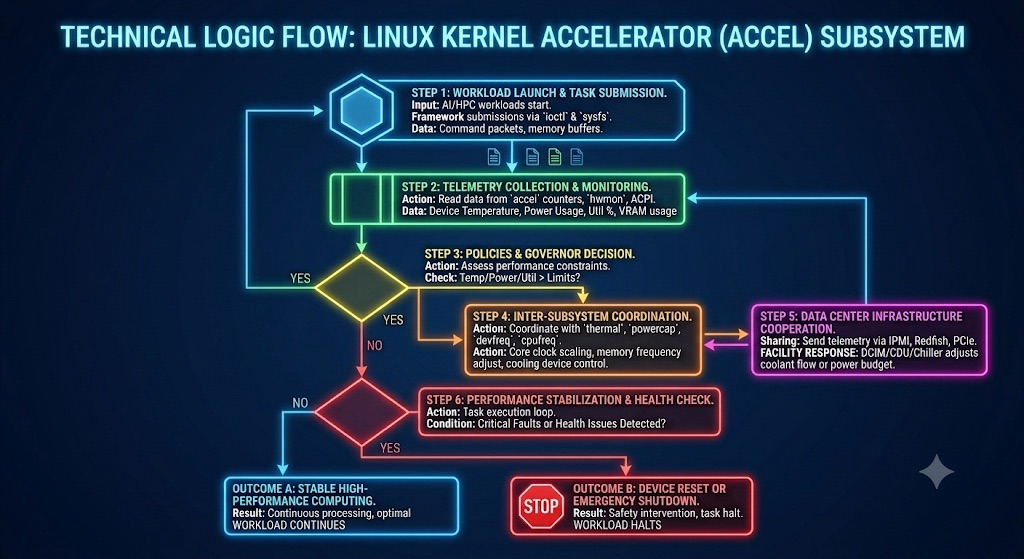
This diagram outlines the sequential, closed-loop technical logic flow of the Linux Kernel Accelerator (accel) subsystem as it manages heavy AI/HPC workloads while interacting with data center cooling infrastructure.
Here is the step-by-step breakdown of how it works:
1. Workload Initiation & Telemetry (Steps 1 & 2)
- Step 1: AI tasks enter the pipeline via standard ioctl and sysfs calls, pushing command packets and memory buffers to the hardware.
- Step 2: The kernel instantly goes into monitoring mode, using hwmon and ACPI to pull critical telemetry data points: Device Temperature, Power Usage, Utilization %, and VRAM usage.
2. Policy Check & Mitigation Loop (Steps 3, 4, & 5)
- Step 3: The Thermal/Power Governor evaluates the telemetry against strict safety limits.
- If Limits Are Exceeded (YES): It triggers a two-pronged defense strategy:
- Step 4 (Local Action): The kernel coordinates internally with thermal, powercap, and devfreq subsystems to scale down core clocks and crank up internal fans.
- Step 5 (Global Action): It broadcasts this telemetry outward via IPMI/Redfish. The data center’s CDU (Coolant Distribution Unit) or Chiller responds by dynamically boosting liquid coolant flow to that specific rack. This loops back to Step 2 to re-evaluate the system.
3. Stabilization & Final Outcomes (Step 6)
- Step 6: If thresholds are safe (NO at Step 3), the workload runs in a stable execution loop while continuously checking for critical system faults.
- Outcome A (All Good): If no critical issues are found, the system achieves Stable High-Performance Computing, and the AI workload continues running at peak efficiency.
- Outcome B (Emergency): If a critical safety fault is detected, the kernel triggers a Device Reset or Emergency Shutdown to protect the physical hardware, halting the workload immediately.
💡 Summary Takeaway:
It is an automated playbook showing how the Linux kernel balances raw AI computing performance with hardware safety—acting locally on the chip and globally with the data center’s physical cooling loops.
With Gemini


