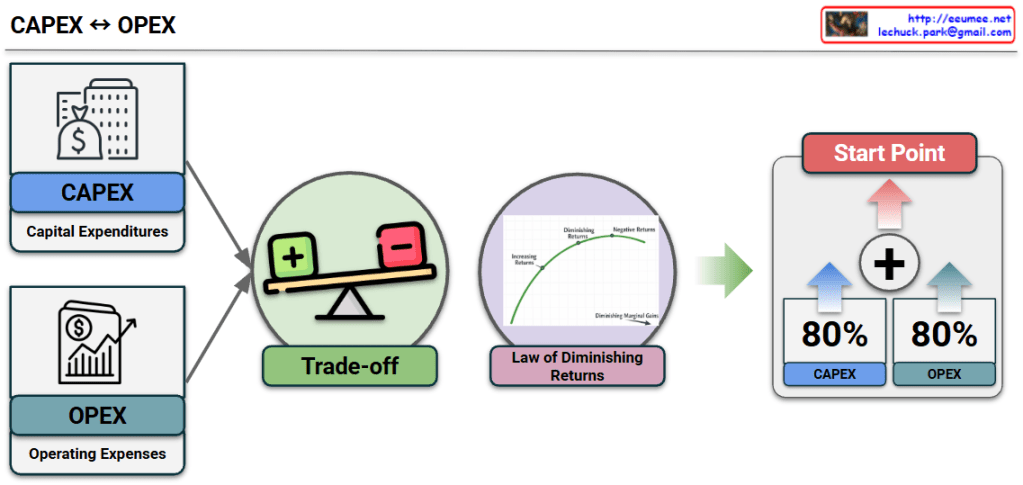
1. Definitions (The Pillars)
- CAPEX (Capital Expenditures): Upfront investments for physical assets (e.g., hardware, infrastructure) to create future value.
- OPEX (Operating Expenses): Ongoing costs required to run the day-to-day operations (e.g., maintenance, utilities, subscriptions).
2. The Economic Logic
- Trade-off: There is a natural tension between the two; higher upfront investment (CAPEX) can lower future operating costs (OPEX), and vice versa.
- Law of Diminishing Returns: This graph warns that striving for 100% perfection in optimization yields progressively smaller benefits relative to the effort and cost invested.
3. Strategic Conclusion: The 80% Rule
- The infographic proposes a pragmatic “Start Point.”
- Instead of delaying for perfection, it suggests that achieving 80% readiness in CAPEX and 80% efficiency in OPEX is the sweet spot. This balance allows for a timely launch without falling into the trap of diminishing returns.
Summary
- While CAPEX and OPEX involve a necessary trade-off, striving for 100% optimization in both leads to diminishing returns.
- Over-optimization drains resources and delays execution without proportional gains.
- The most efficient strategy is to define the “Start Point” at 80% readiness for both, favoring speed and agility over perfection.
#CAPEXvsOPEX #BusinessStrategy #CostOptimization #DiminishingReturns #TechInfrastructure #OperationalEfficiency #Infographic #TechVisualizer #DecisionMaking

 Lechuck Park