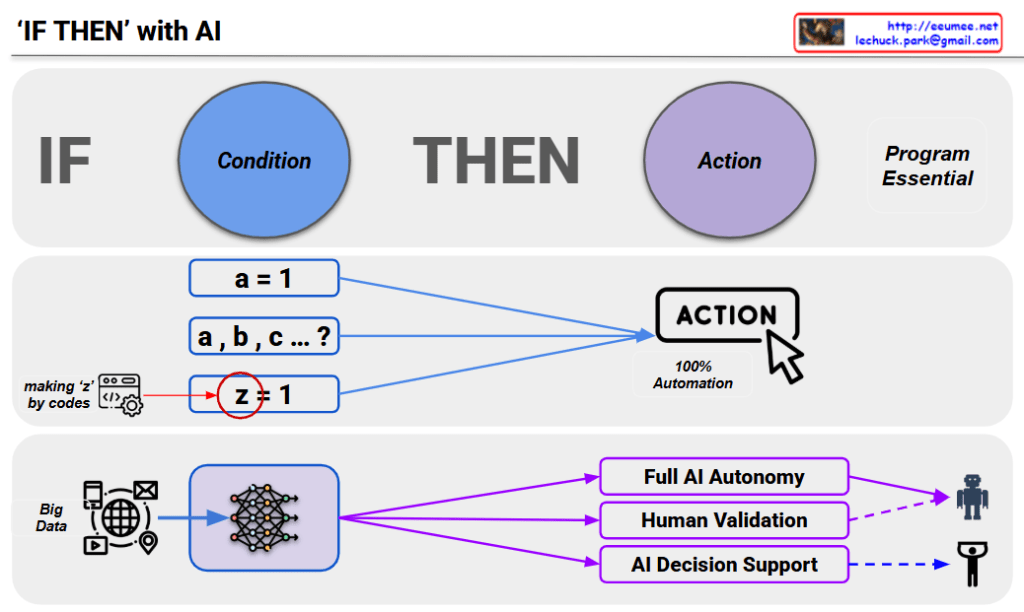
This image is a diagram titled “IF-THEN with AI” that explains conditional logic and automation levels in AI systems.
Top Section: Basic IF-THEN Structure
- IF (Condition): Conditional part shown in blue circle
- THEN (Action): Execution part shown in purple circle
- Marked as “Program Essential,” emphasizing it as a core programming element
Middle Section: Evolution of Conditional Complexity
AI is ultimately a program, and like humans who wanted to predict by sensing data, making judgments, and taking actions based on those criteria. IF-THEN is essentially prediction – the foundation of programming that involves recognizing situations, making judgments, and taking actions.
Evolution stages of data/formulas:
- a = 1: Simple value
- a, b, c … ?: Processing multiple complex values simultaneously
- Z ≠ 1: A condition that finds the z value through code on the left and compares it to 1 (highlighted with red circle, with annotation “making ‘z’ by codes”)
Now we input massive amounts of data and analyze with AI, though it has somewhat probabilistic characteristics.
Bottom Section: Evolution of AI Decision-Making Levels
Starting from Big Data through AI networks, three development directions:
- Full AI Autonomy: Complete automation that evolved to “Fine, just let AI handle it”
- Human Validation: Stage where humans evaluate AI judgments and incorporate them into operations
- AI Decision Support: Approach where humans initially handle the THEN action
Key Perspective: While these three development directions exist, there’s a need for judgment regarding decisions based on the quality of data used in analysis/judgment. This diagram shows that it’s not just about automation levels, but that data quality-based reliability assessment is a crucial consideration.
Summary
This diagram illustrates the evolution from simple conditional programming to complex AI systems, emphasizing that AI fundamentally operates on IF-THEN logic for prediction and decision-making. The key insight is that regardless of automation level, the quality of input data remains critical for reliable AI decision-making processes.
With Claude

 Lechuck Park