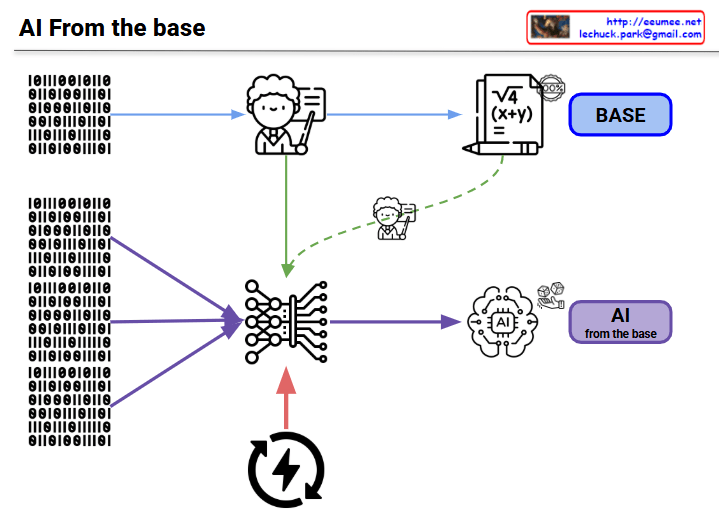
This diagram contrasts two approaches: traditional rule-based systems that achieve 100% accuracy within limited scope using human-designed logic, versus AI systems that handle massive datasets through neural networks with probabilistic reasoning. While traditional methods guarantee perfect results in narrow domains, AI offers scalable, adaptive solutions for complex real-world problems despite requiring significant energy and operating with uncertainty rather than absolute certainty
Upper Process (Traditional Approach):
- Data → Human Rule Creation: Based on binary data, humans design clear logical rules
- Mathematical Operations (√(x+y)): Precise and deterministic calculations
- “BASE”: Foundation system with 100% certainty
- Human-created rules guarantee complete accuracy (100%) but operate only within limited scope
Lower Process (AI-Based Approach):
- Large-Scale Data Processing: Capable of handling vastly more extensive and complex data than traditional methods
- Neural Network Pattern Learning: Discovers complex patterns and relationships that are difficult for humans to explicitly define
- Adaptive Learning: The circular arrow (⚡) represents continuous improvement and adaptability to new situations
- Advantages of Probabilistic Reasoning: Flexibility to handle uncertain and complex real-world problems
Key Advantages:
- Traditional Approach: Clear and predictable but limited for complex real-world problems
- AI Approach: While probabilistic, provides scalability and adaptability to solve complex problems that are difficult for humans to design solutions for. Though imperfect, it offers practical solutions that can respond to diverse and unpredictable real-world situations
AI may not be perfect, but it opens up innovative possibilities in areas that are difficult to approach with traditional methods, serving as a powerful tool for tackling previously intractable problems.
With Claude

 Lechuck Park