From Claude with some prompting
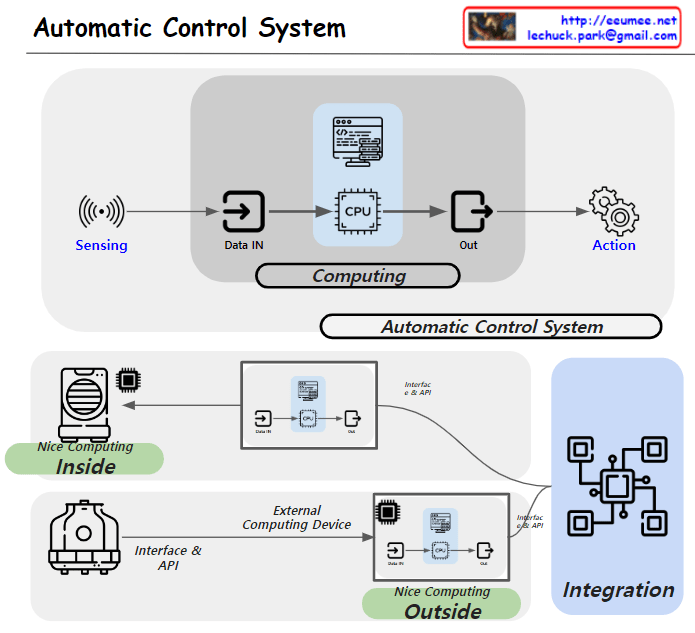
focusing on the importance of computing in automatic control systems and the distinction between devices with sufficient computing power and those without:
- Basic Structure of Automatic Control System:
- The system operates in the sequence of Sensing -> Data IN -> CPU -> Out -> Action.
- This entire process occurs within the ‘Computing’ phase, which is crucial for automatic control.
- Device Classification Based on Computing Capability:
- ‘Nice Computing Inside’: Represents devices with sufficient computing power. These devices can process complex control logic independently.
- ‘Nice Computing Outside’: Indicates devices with limited computing capabilities. These devices rely on external computing resources for automatic control.
- Utilization of External Computing Resources:
- The ‘External Computing Device’ allows devices with limited computing power to perform advanced automatic control functions.
- This is implemented through external computing devices such as PLCs (Programmable Logic Controllers) or DDCs (Direct Digital Controls).
- System Integration:
- ‘Interface & API’ facilitates the connection and communication between various devices and external computing resources.
- The ‘Integration’ section demonstrates how these diverse elements function as a unified automatic control system.
- Importance of Computing:
- In automatic control systems, computing plays a crucial role in data processing, decision-making, and generating control commands.
- By appropriately utilizing internal or external computing resources, various types of equipment can function as part of an efficient automatic control system.
This diagram effectively illustrates the flexibility and scalability of automatic control systems, explaining different approaches based on computing capabilities. The forthcoming explanation about PLC/DDC and other external computing devices will likely provide more concrete insights into the practical implementation of these systems.

 Lechuck Park