From DALL-E with some prompting
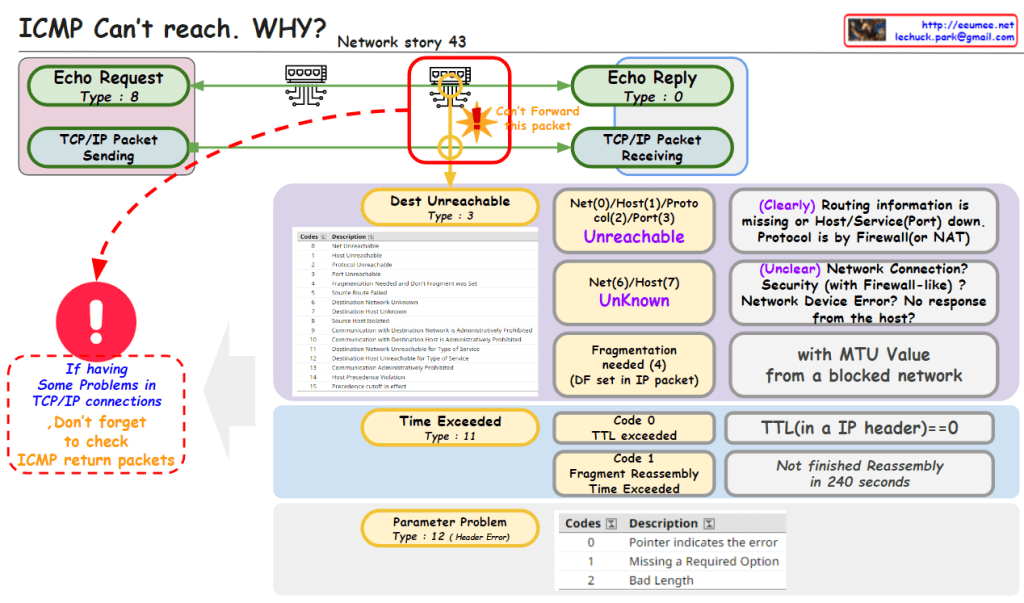
The image is an educational diagram explaining different ICMP (Internet Control Message Protocol) messages that indicate problems in TCP/IP network connections. When an “Echo Request” is sent and the network is unable to forward the packet, the ICMP may return various error messages:
- “Destination Unreachable” (Type 3) can mean that the network/host/protocol/port is unreachable. The reasons can be varied, such as the route is missing, the host or service on the port is down, or the protocol is blocked by a firewall or NAT (Network Address Translation).
- “Time Exceeded” (Type 11) indicates that the time-to-live (TTL) of a packet has reached zero, meaning the packet has taken too long to reach its destination, or fragment reassembly time was exceeded.
- “Parameter Problem” (Type 12) points to issues like header errors where certain required information is missing or incorrect.
The diagram also emphasizes the importance of checking ICMP return packets for troubleshooting network issues. It provides a detailed list of ICMP types and codes along with their descriptions to assist in identifying the specific nature of the network problem.
 Lechuck Park