Parallel Processing System Analysis
System Architecture
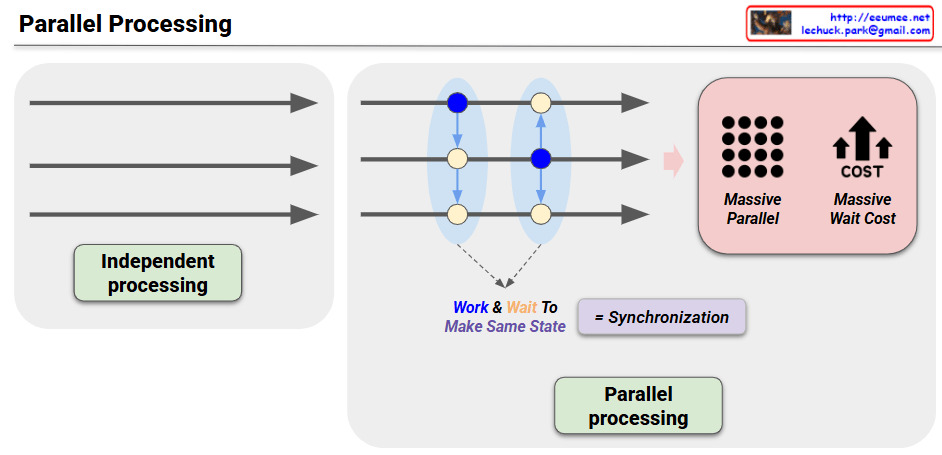
1. Input Stage – Independent Processing
- Multiple tasks are simultaneously input into the system in parallel
- Each task can be processed independently of others
2. Central Processing Network
Blue Nodes (Modification Work)
- Processing units that perform actual data modifications or computations
- Handle parallel incoming tasks simultaneously
Yellow Nodes (Propagation Work)
- Responsible for propagating changes to other nodes
- Handle system-wide state synchronization
3. Synchronization Stage
- Objective: “Work & Wait To Make Same State”
- Wait until all nodes reach identical state
- Essential process for ensuring data consistency
Performance Characteristics
Advantage: Massive Parallel
- Increased throughput through large-scale parallel processing
- Reduced overall processing time by executing multiple tasks simultaneously
Disadvantage: Massive Wait Cost
- Wait time overhead for synchronization
- Entire system must wait for the slowest node
- Performance degradation due to synchronization overhead
Key Trade-off
Parallel processing systems must balance performance enhancement with data consistency:
- More parallelism = Higher performance, but more complex synchronization
- Strong consistency guarantee = Longer wait times, but stable data state
This concept is directly related to the CAP Theorem (Consistency, Availability, Partition tolerance), which is a fundamental consideration in distributed system design.
With Claude
 Lechuck Park