From Claude with some prompting
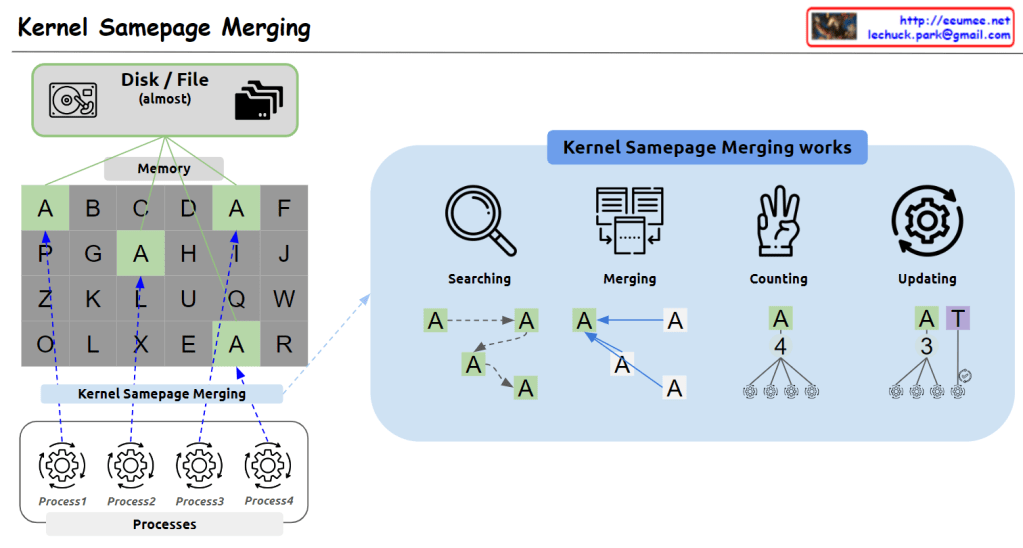
This image illustrates Kernel Samepage Merging (KSM), a memory management technique used to optimize memory usage in computing systems.
Key components of the image:
- Top left: Icons representing disk/file systems (“almost”) and a memory grid.
- Memory grid: Shows memory pages filled with various letters (A-Z). Note the repeated occurrences of ‘A’ pages.
- Bottom: Multiple processes (Process1, Process2, Process3, Process4) sharing this memory.
- Right side: Explains how KSM works in four stages:
- Searching: Locating pages with identical content.
- Merging: Combining identical pages into one.
- Counting: Tallying references to the merged page.
- Updating: Refreshing page references.
KSM works by identifying and merging memory pages with identical content, thus reducing memory usage. This is particularly useful in virtualized environments where multiple virtual machines might be running similar operating systems.
The image effectively demonstrates how KSM can identify duplicate ‘A’ pages across different memory locations and processes, merging them to save memory space while maintaining proper references for each process.
 Lechuck Park