NAPI

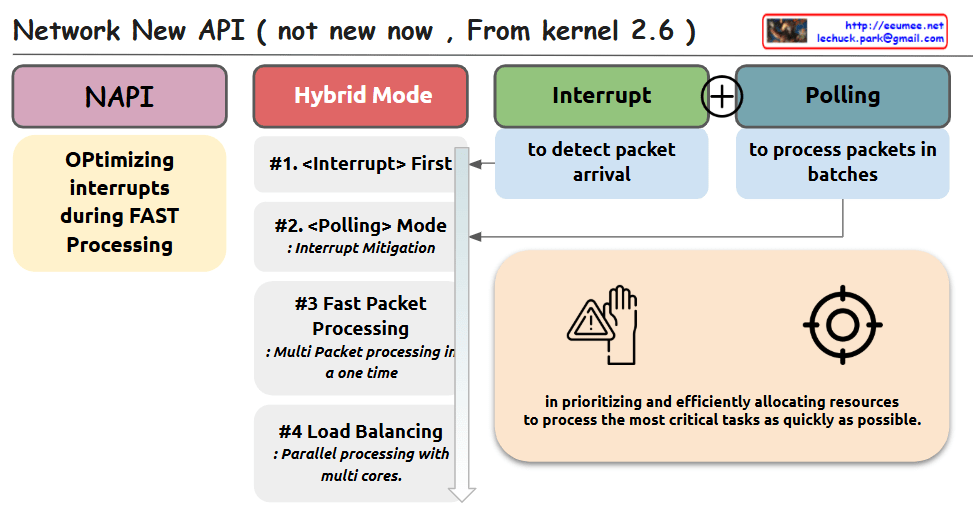
This image shows a diagram of the Network New API (NAPI) introduced in Linux kernel 2.6. The diagram outlines the key components and concepts of NAPI with the following elements:

The diagram is organized into several sections:

  1. NAPI – The main concept is highlighted in a purple box
  2. Hybrid Mode – In a red box, showing the combination of interrupt and polling mechanisms
  3. Interrupt – In a green box, described as “to detect packet arrival”
  4. Polling – In a blue box, described as “to process packets in batches”

The Hybrid Mode section details four key features:

  1. <Interrupt> First – For initial packet detection
  2. <Polling> Mode – For interrupt mitigation
  3. Fast Packet Processing – For multi-packet processing in one time
  4. Load Balancing – For parallel processing with multiple cores

On the left, there’s a yellow box explaining “Optimizing interrupts during FAST Processing”

The bottom right contains additional information about prioritizing and efficiently allocating resources to process critical tasks quickly, accompanied by warning/hand and target icons.

The diagram illustrates how NAPI combines interrupt-driven and polling mechanisms to efficiently handle network packet processing in Linux.

With Claude

Interrupt Handling for real-time

With a Claude’s Help
the real-time interrupt handling :

Interrupt Handling Components and Process:

  1. Interrupt Prioritization
  • Uses assigned priority levels to determine which interrupt should be handled first
  • Ensures critical tasks are processed in order of importance
  1. Interrupt Queuing
  • When multiple interrupts occur, they are placed in a queue for sequential processing
  • Helps maintain organized processing order
  1. Efficient Handling Process
  • Uses a data structure that maps each interrupt to its corresponding Interrupt Service Routine (ISR)
  • Implements this mapping through the Interrupt Vector Table (IVT)
  1. Interrupt Controllers
  • Modern systems utilize interrupt controllers
  • Manages and prioritizes interrupts efficiently
  1. Types of Interrupts
  • Maskable Interrupts (IRQs)
  • Non-Maskable Interrupts (NMIs)
  • High-priority Interrupts
  • Software Interrupts
  • Hardware Interrupts

Real-Time Performance Benefits:

  1. Critical Task Management
  • Ensures critical tasks are always handled first
  • Maintains system responsiveness
  1. System Stability
  • Ensures no interrupt is missed or lost
  • Maintains reliable system operation
  1. Scalability
  • Efficiently manages a growing number of devices and interrupts
  • Adapts to increasing system complexity
  1. Improved User Experience
  • Creates responsive systems that react quickly to user inputs or events
  • Enhances overall system performance and user interaction

This structure provides a comprehensive framework for handling interrupts in real-time systems, ensuring efficient and reliable processing of system events and user interactions.CopyR

Interrupt

From Claude with some prompting
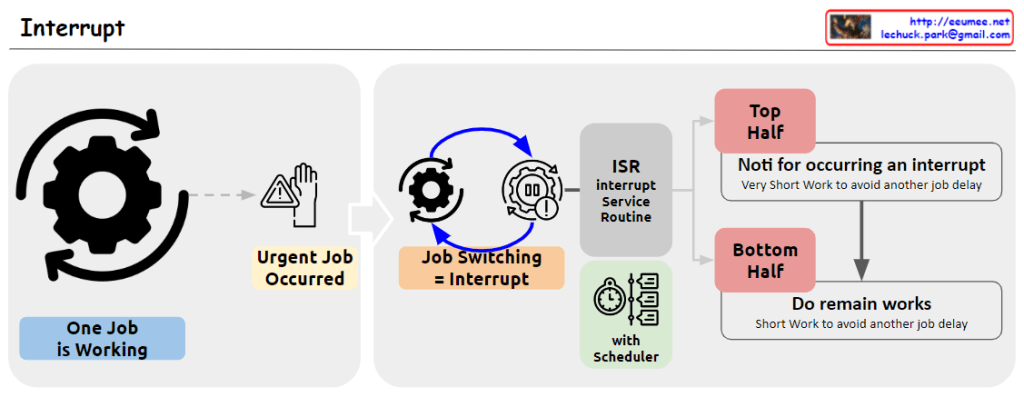
The image illustrates the process of handling interrupts in a computer system. When an urgent job (Urgent Job Occurred) arises while another job (One Job is Working) is executing, an interrupt (Job Switching = Interrupt) occurs. This triggers the Interrupt Service Routine (ISR) to handle the interrupt.
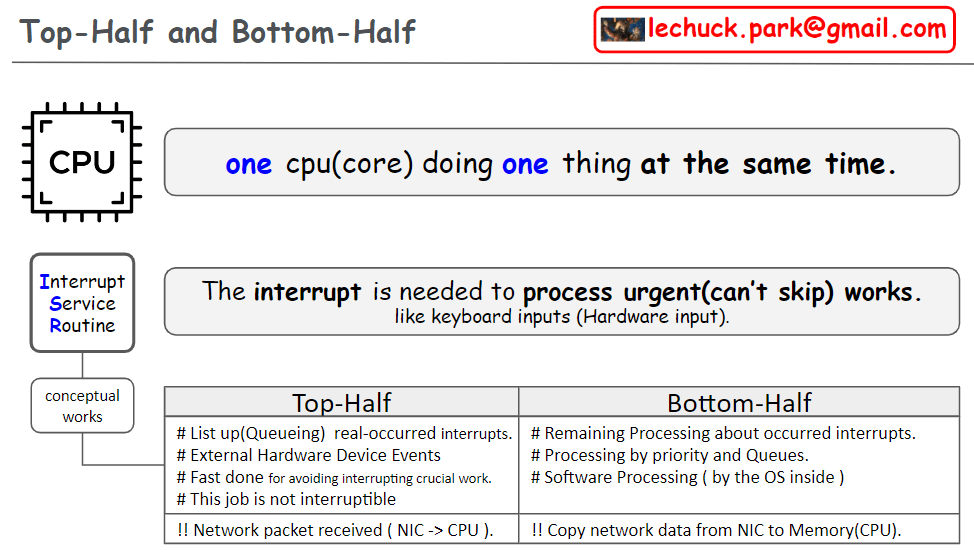
The interrupt handling process is divided into two halves: the Top Half and the Bottom Half. The Top Half performs a “Very Short Work to avoid another job delay” and notifies the system of the interrupt occurrence. The Bottom Half handles the remaining work, also performing “Short Work to avoid another job delay.”

Process scheduler

From DALL-E with some prompting
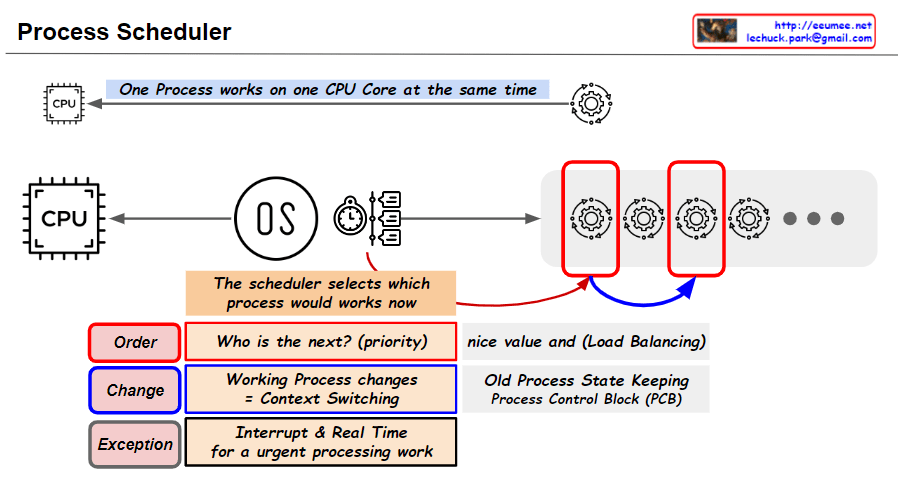
The image highlights the essential mechanisms of process scheduling to share a single CPU core resource among multiple processes. The scheduler determines the order of processes to be executed based on priority and changes the current running process through context switching. Additionally, it promptly addresses exceptions requiring urgent processing through interrupts and real-time handling. This scheduling approach ensures efficient allocation of CPU resources and stable operation of the system.