Traceroute

From Claude with some prompting
This image explains the concept of “Traceroute: First Send, First Return?” for the traceroute utility in computer networking. Traceroute sends IP packets with increasing Time-to-Live (TTL) values, starting from TTL=1, 2, 3, and so on. When the TTL reaches 0 at a network hop, that hop returns an ICMP (Internet Control Message Protocol) message back to the source.

However, the order in which the response packets are received at the source may differ from the order in which they were sent, primarily due to two reasons:

  1. Generation of ICMP response packets is a CPU task, and it can be delayed due to CPU settings or other processing priorities, causing a delay in the response.
  2. The ICMP response packets can take multiple paths to return to the source, as indicated by the text “Packet replies can use multiple paths” in the image. This means that responses can arrive at different times depending on the route taken.

As a result, when analyzing traceroute results, it is essential to consider not only the TTL sequence to determine the network hops but also factors like response times and paths taken by the responses.

The potential delay in ICMP packet generation by the CPU and the use of multiple return paths can cause the actual response order to differ from the sending order in traceroute.

Understanding that the response order may not strictly follow the sending order due to CPU processing delays and the use of multiple return paths is crucial when interpreting traceroute results.

Traceroute works 2

From DALL-E with some prompting
The image provides a detailed explanation of the ‘traceroute’ network diagnostic tool and how it functions, along with potential error messages and their meanings. The ‘traceroute’ command can work with not only ICMP but also TCP/UDP protocols, allowing it to trace the path data packets take through a network to reach the destination. Specifically, the command ‘traceroute -T -p 80 [destination]’ is used to trace the route to the destination over TCP port 80.

The diagram displays several routers (labeled 1, 2, 3, 4) that the traceroute may encounter on its path. Accompanying these are four cases, each illustrating a different error scenario that might occur during the trace:

  • Case1: A TCP block might occur, potentially due to a firewall or Access Control List (ACL), indicated by ICMP Type 3, Code 2 (Protocol Unreachable) or Code 10 (Communication with Destination Host is Administratively Prohibited).
  • Case2: A block on TCP Port 80 might be encountered, also possibly because of a firewall or ACL.
  • Case3: A general TCP block, which might be caused by iptables or similar tools, indicated by ICMP Type 3, Code 2 (Protocol Unreachable) or Code 13 (Communication Administratively Prohibited).
  • Case4: A block on TCP Port 80 or a service not being open on the destination, which can result in messages such as “Port Unreachable” or “Connection Refused”.

Each case provides the relevant ICMP message type and code that might be returned if such a situation occurs, which is crucial for network administrators or IT professionals in diagnosing and resolving network connectivity issues.

Traceroute works I

From The Bard with some prompting
The image is a diagram of how a traceroute works. Traceroute is a tool that uses ICMP packets to determine the path that a packet takes from a source to a destination.

The image shows the following steps:

The source sends an ICMP packet with a TTL (time to live) of 1.
The first router that receives the packet decrements the TTL by 1 and sends it to the next router.
If the TTL reaches 0 before reaching the destination, the router sends an ICMP packet back to the source with an error message.
The source then sends an ICMP packet with a TTL of 2.
The process repeats until the destination is reached.
The text in the image provides additional information about each step. For example, the text for step 1 states that the source sends an ICMP packet with a TTL of 1. This means that the packet will be discarded by any router that receives it after it has traveled 1 hop.

The image also shows the following information:

  • The source IP address is 192.168.1.1.
  • The destination IP address is 203.0.113.5.
  • The RTT (round-trip time) for each hop is shown in milliseconds.

The image is a useful tool for understanding how traceroute works. It can be used to troubleshoot network problems by identifying the routers that are causing delays or errors.

Here is a more concise summary of the image:

Traceroute uses ICMP packets to determine the path that a packet takes from a source to a destination. The source sends an ICMP packet with a TTL of 1. If the TTL reaches 0 before reaching the destination, the router sends an ICMP packet back to the source with an error message. The source then sends an ICMP packet with a TTL of 2. The process repeats until the destination is reached.tunesharemore_vertadd_photo_alternate

PING with “Don’t Fragment”

From DALL-E with some prompting
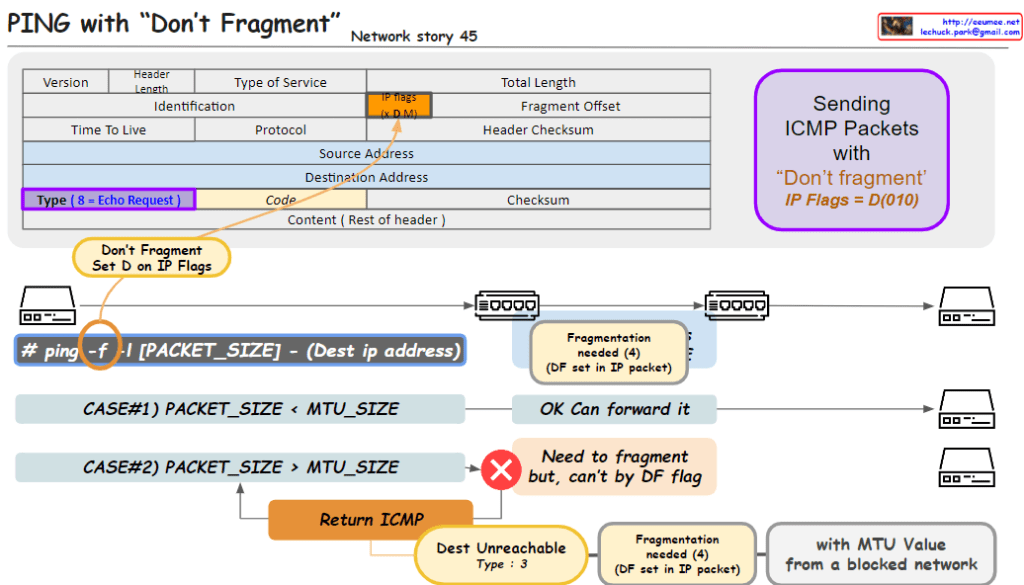
The image outlines a networking concept involving the transmission of ICMP (Internet Control Message Protocol) packets with the “Don’t Fragment” flag set, which is part of the IP (Internet Protocol) flags. Here’s a breakdown of the key elements in the image:

  1. Header Section:
    • Type of Service: Indicates the quality of service for the packet.
    • IP Flags: Contains the “Don’t Fragment” (DF) flag, indicated by setting the D bit to 0. The “MF” bit represents whether the packet is the last fragment.
    • Type: For an ICMP Echo Request, this value is set to 8.
    • Code: Used to further specify the message.
  2. Packet Transmission:
    • The command ping -f is used to send a ping with the DF flag set, which means the packets should not be fragmented, even if their size exceeds the MTU (Maximum Transmission Unit) of the network path.
    • Case #1: If the packet size is less than the MTU, the packet is forwarded without issue.
    • Case #2: If the packet size is greater than the MTU, it needs to be fragmented. However, because the DF flag is set, it can’t be fragmented, resulting in a “Destination Unreachable” message with code 3 (Fragmentation needed and DF set).
  3. Error Handling:
    • The ICMP error message “Destination Unreachable” with a code of “3” is returned if a packet with the DF flag set needs to be fragmented to continue along the network path but cannot be due to the flag.

This image is a guide to understanding how the “Don’t Fragment” flag in IP packets affects their transmission over networks and how ICMP is used for error reporting when the flag is set.

ICMP WHY

From DALL-E with some prompting
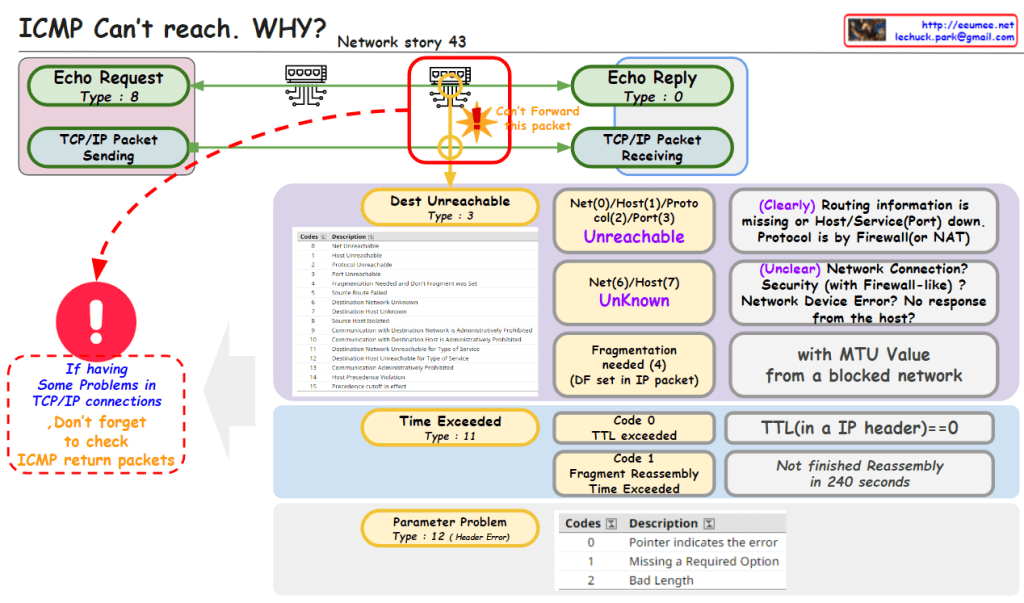
The image is an educational diagram explaining different ICMP (Internet Control Message Protocol) messages that indicate problems in TCP/IP network connections. When an “Echo Request” is sent and the network is unable to forward the packet, the ICMP may return various error messages:

  1. “Destination Unreachable” (Type 3) can mean that the network/host/protocol/port is unreachable. The reasons can be varied, such as the route is missing, the host or service on the port is down, or the protocol is blocked by a firewall or NAT (Network Address Translation).
  2. “Time Exceeded” (Type 11) indicates that the time-to-live (TTL) of a packet has reached zero, meaning the packet has taken too long to reach its destination, or fragment reassembly time was exceeded.
  3. “Parameter Problem” (Type 12) points to issues like header errors where certain required information is missing or incorrect.

The diagram also emphasizes the importance of checking ICMP return packets for troubleshooting network issues. It provides a detailed list of ICMP types and codes along with their descriptions to assist in identifying the specific nature of the network problem.

ICMP2

From DALL-E with some prompting
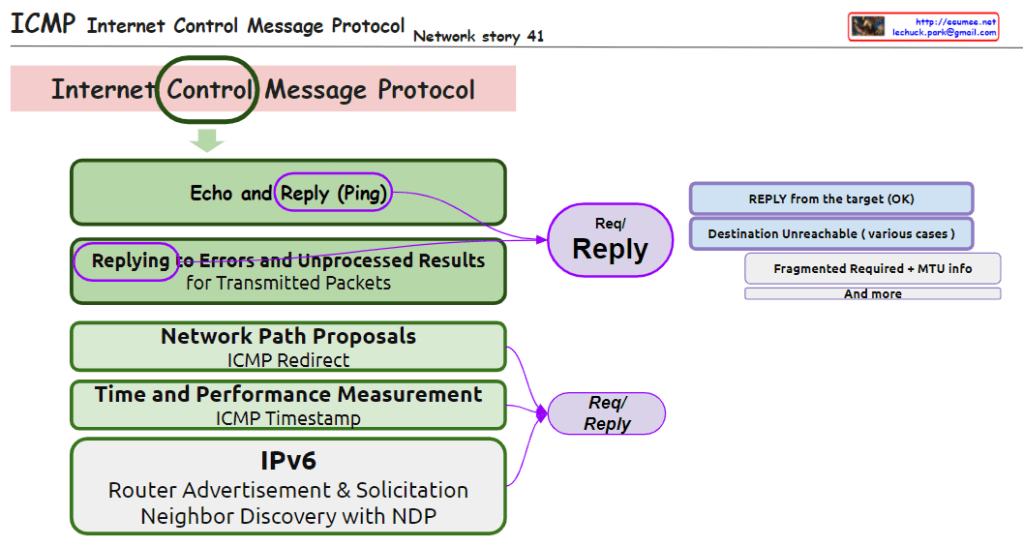
The image introduces the overarching functionality of the Internet Control Message Protocol (ICMP). ICMP serves to provide feedback when network equipment cannot further forward packets, explaining the reasons via messages indicating destination unreachable, time exceeded, parameter problems, among others. It also includes the redirect function, suggesting better routing paths between network devices, thus enhancing the overall network efficiency. Fundamentally, ICMP operates on a request and reply structure, which is essential for checking network status and diagnosing issues.

ICMP overall

From DALL-E with some prompting
This image succinctly demonstrates the essential functions of the Internet Control Message Protocol (ICMP), emphasizing the protocol’s ability to check network paths and status through simple request and response actions. This includes echo (ping) operations, error messages, network path change suggestions, timing measurements, and IPv6 functionalities, all contributing to the efficiency and performance enhancement of network operations.