Evolution … Changes

Evolution and Changes: Navigating Through Transformation

Overview:

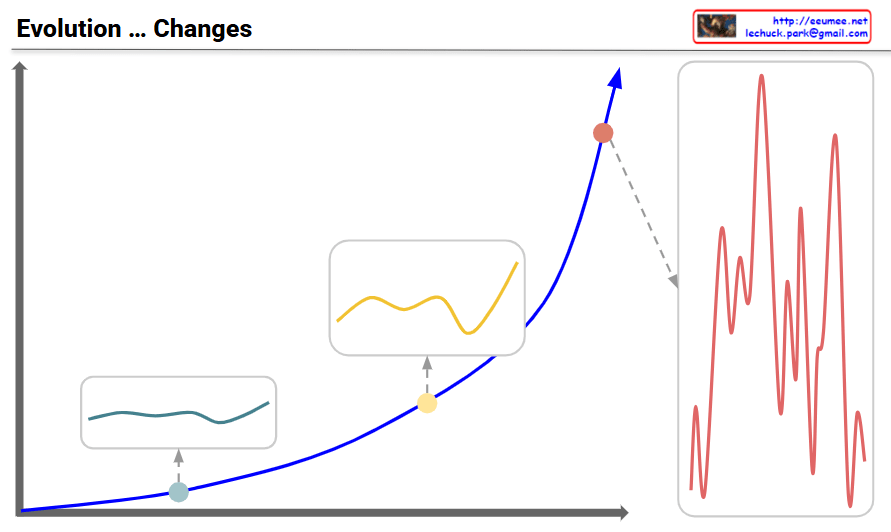
Main Graph (Blue Curve)

  • Shows the pattern of evolutionary change transitioning from gradual growth to exponential acceleration over time
  • Three key developmental stages are marked with distinct points

Three-Stage Development Process:

Stage 1: Initial Phase (Teal point and box – bottom left)

  • Very gradual and stable changes
  • Minimal volatility with a flat curve
  • Evolutionary changes are slow and predictable
  • Response Strategy: Focus on incremental improvements and stable maintenance

Stage 2: Intermediate Phase (Yellow point and box – middle)

  • Fluctuations begin to emerge
  • Volatility increases but remains limited
  • Transitional period showing early signs of change
  • Response Strategy: Detect change signals and strengthen preparedness

Stage 3: Turbulent Phase (Red point and box on right – top)

  • Critical turning point where exponential growth begins
  • Volatility maximizes with highly irregular and large-amplitude changes
  • The red graph on the right details the intense and frequent fluctuations during this period
  • Characterized by explosive and unpredictable evolutionary changes
  • Response Imperative: Rapid and flexible adaptation is essential for survival in the face of high volatility and dramatic shifts

Key Message:

Evolution progresses through stable initial phases → emerging changes in the intermediate period → explosive transformation in the turbulent phase. During the turbulent phase, volatility peaks, making the ability to anticipate and actively respond critical for survival and success. Traditional stable approaches become obsolete; rapid adaptation and innovative transformation become essential.


#Evolution #Change #Transformation #Adaptation #Innovation #DigitalTransformation

With Claude
AI Workload

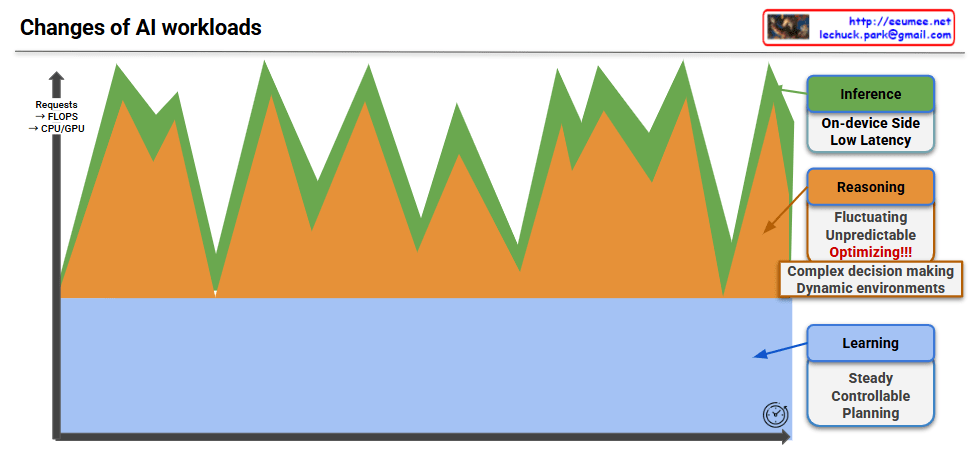
This image visualizes the three major AI workload types and their characteristics in a comprehensive graph.

Graph Structure Analysis

Visualization Framework:

  • Y-axis: AI workload intensity (requests per hour, FLOPS, CPU/GPU utilization, etc.)
  • X-axis: Time progression
  • Stacked Area Chart: Shows the proportion and changes of three workload types within the total AI system load

Three AI Workload Characteristics

1. Learning – Blue Area

Properties: Steady, Controllable, Planning

  • Located at the bottom with a stable, wide area
  • Represents model training processes with predictable and plannable resource usage
  • Maintains consistent load over extended periods

2. Reasoning – Yellow Area

Properties: Fluctuating, Unpredictable, Optimizing!!!

  • Middle layer showing dramatic fluctuations
  • Involves complex decision-making and logical reasoning processes
  • Most unpredictable workload requiring critical optimization
  • Load varies significantly based on external environmental changes

3. Inference – Green Area

Properties: On-device Side, Low Latency

  • Top layer with irregular patterns
  • Executes on edge devices or user terminals
  • Service workload requiring real-time responses
  • Low latency is the core requirement

Key Implications

Differentiated Resource Management Strategies Required:

  • Learning: Stable long-term planning and infrastructure investment
  • Reasoning: Dynamic scaling and optimization technology focus
  • Inference: Edge optimization and response time improvement

This graph provides crucial insights demonstrating that customized resource allocation strategies considering the unique characteristics of each workload type are essential for effective AI system operations.

This visualization emphasizes that AI workloads are not monolithic but consist of distinct components with varying demands, requiring sophisticated resource management approaches to handle their collective and individual requirements effectively.

With Claude