From Claude with some prompting
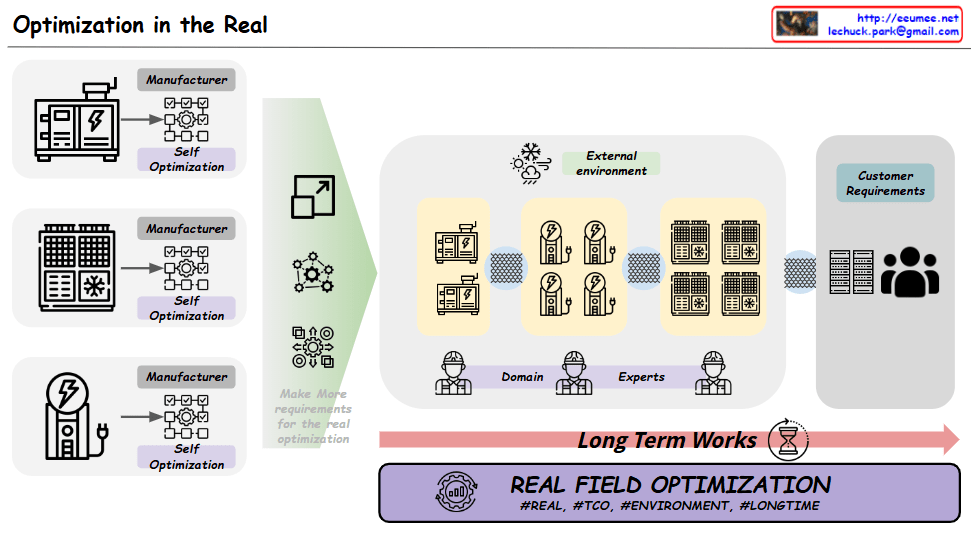
The Real Field Optimization diagram and its extended implications:
- Extended Scope of Optimization:
- Begins with equipment Self-Optimization but extends far beyond
- Increasing complexity in real operating environments:
- Equipment/system interactions
- Operational scale expansion
- Service quality requirements
- Various stakeholder requirements
- Real Operating Environment Considerations:
- Domain Experts’ practical experience and knowledge
- Customer requirements and feedback
- External Environment impacts
- Variables emerging from Long Term operations
- TCO (Total Cost of Ownership) Perspective:
- Beyond initial installation/deployment costs
- Operation/maintenance costs
- Energy efficiency
- Lifecycle cost optimization
- Data-Driven Optimization Necessity:
- Collection and analysis of actual operational data
- Understanding operational patterns
- Predictive maintenance
- Performance/efficiency monitoring
- Data-driven decision making for continuous improvement
- Long-Term Perspective Importance:
- Performance change management over time
- Scalability considerations
- Sustainable operation model establishment
- Adaptability to changing requirements
- Real Field Integration:
- Interaction between manufacturers, operators, and customers
- Environmental factor considerations
- Complex system interdependencies
- Real-world constraint management
This comprehensive optimization approach goes beyond individual equipment efficiency, aiming for sustainable operation and value creation of the entire system. This can be achieved through continuous improvement activities based on real operational environment data. This represents the true meaning of “Real Field Optimization” with its hashtags #REAL, #TCO, #ENVIRONMENT, #LONGTIME.
The diagram effectively illustrates that while equipment-level optimization is fundamental, the real challenge and opportunity lie in optimizing the entire operational ecosystem over time, considering all stakeholders, environmental factors, and long-term sustainability. The implicit need for data-driven optimization in real operating environments becomes crucial for achieving these comprehensive optimization goals.
 Lechuck Park