“Vectors” than definitions.

This image visualizes the core philosophy that “In the AI era, vector-based thinking is needed rather than simplified definitions.”

Paradigm Shift in the Upper Flow:

  • Definitions: Traditional linear and fixed textual definitions
  • Vector: Transformation into multidimensional and flexible vector space
  • Context: Structure where clustering and contextual relationships emerge through vectorization

Modern Approach in the Lower Flow:

  1. Big Data: Complex and diverse forms of data
  2. Machine Learning: Processing through pattern recognition and learning
  3. Classification: Sophisticated vector-based classification
  4. Clustered: Clustering based on semantic similarity
  5. Labeling: Dynamic labeling considering context

Core Insight: In the AI era, we must move beyond simplistic definitional thinking like “an apple is a red fruit” and understand an apple as a multidimensional vector encompassing color, taste, texture, nutritional content, cultural meaning, and more. This vector-based thinking enables richer contextual understanding and flexible reasoning, allowing us to solve complex real-world problems more effectively.

Beyond simple classification or definition, this presents a new cognitive paradigm that emphasizes relationships and context. The image advocates for a fundamental shift from rigid categorical thinking to a nuanced, multidimensional understanding that better reflects how modern AI systems process and interpret information.

With Claude
Definitions

With a Claude’s Help
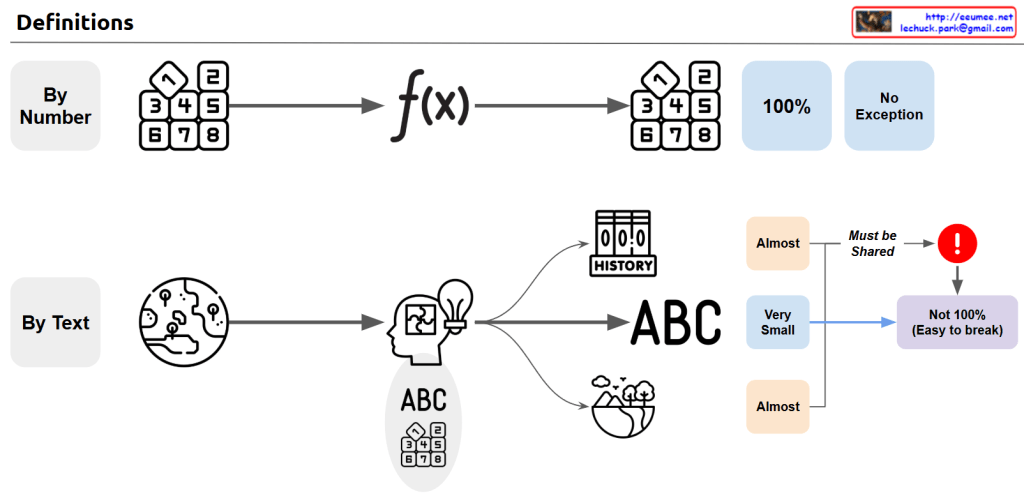
this diagram that illustrates two approaches to definitions:

  1. Definitions By Number:
  • Input and output through function f(x) is precise and clear
  • 100% accuracy in results
  • No exceptions
  • Always yields consistent results regardless of context
  • Mathematical/numerical definitions are unambiguous
  1. Definitions By Text:
  • The concept being defined is connected to multiple contextual elements:
    • Historical background (History)
    • Linguistic expression (ABC)
    • Social/cultural context (represented by the global icon)
  • Characteristics and limitations:
    • Can only directly express a “Very Small” portion of the complete meaning
    • Often uses “Almost” in descriptions
    • Key Point: “Must be Shared”
      • Related background knowledge
      • Historical context
      • Social consensus
      • Cultural understanding
    • If these contextual elements are not properly shared, it becomes “Not 100% (Easy to break)”
      • Perfect communication of meaning becomes difficult
      • Possibility of misunderstanding or misinterpretation exists

The diagram ultimately explains:

  • While numerical definitions are objective and precise
  • Text-based definitions are inherently incomplete on their own
  • For proper understanding of text-based definitions, related contextual knowledge and background must be shared
  • This explains why the same words or sentences can be interpreted differently depending on cultural context and background knowledge

This concept is particularly important in understanding:

  • Why linguistic definitions can vary across cultures
  • The importance of shared context in communication
  • Why mathematical/numerical definitions remain consistent across different contexts
  • The inherent limitations of purely textual definitions without proper context

This diagram effectively shows why precise communication through text alone can be challenging without shared contextual understanding, while numerical definitions remain universally consistent.

Definitions for The MORE NEXT DEVELOPMENT

From DALL-E with some prompting
The image depicts the process of how knowledge and ideas are defined and how these definitions enable advanced thinking and discussions among people. Information obtained from observations and experiences is documented, and these records evolve into definitions such as words, rules, and formulas. These definitions create the foundation of knowledge, upon which discussions and the exchange of ideas build increasingly complex and advanced thoughts. Ultimately, this process leads to exponential development of knowledge, visualized as an ascending growth chart. Definitions act as the pivot enabling advanced thinking and discourse, leading to continuous learning and innovation.