From Claude with some prompting
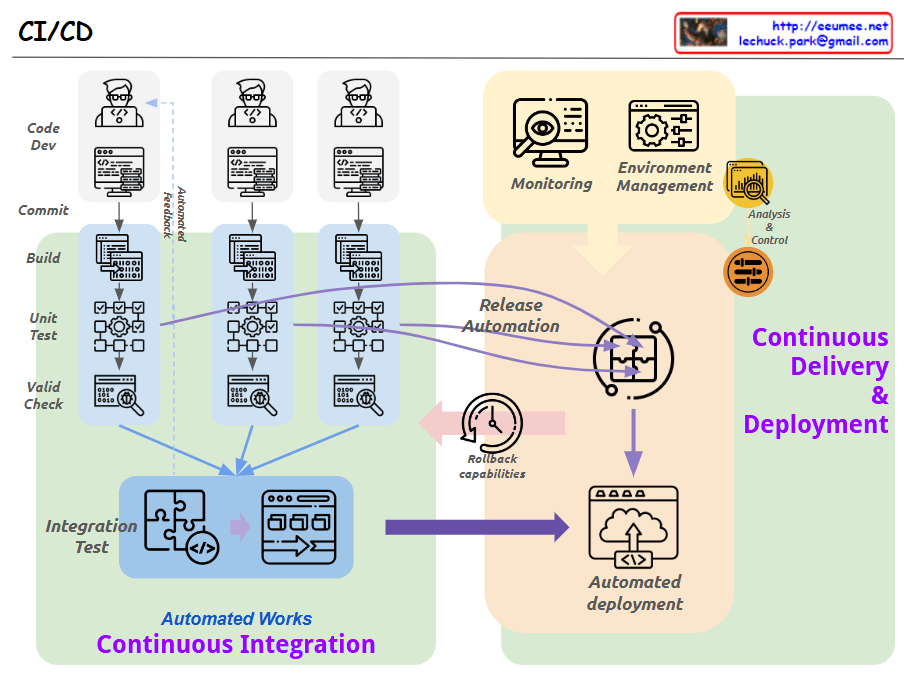
Let me explain this CI/CD (Continuous Integration/Continuous Delivery & Deployment) pipeline diagram:
- Continuous Integration section:
- Code Dev: Developers writing code
- Commit: Code submission to repository
- Build: Building the code
- Unit Test: Running unit tests
- Valid Check: Validation checks
- Integration Test: Running integration tests
- Continuous Delivery & Deployment section:
- Release Automation: Automated release process
- Automated deployment: System for automatic deployment
- Rollback capabilities: Ability to revert to previous versions if issues occur
- Additional Management Features:
- Monitoring: System monitoring
- Environment Management: Managing different environments
- Analysis & Control: Analysis and control functions
This diagram illustrates the automated workflow in modern software development, from code creation to deployment. Each stage is automated, improving the efficiency and reliability of the development process.
Key highlights:
- Automated testing processes
- Continuous integration workflow
- Automated deployment system
- Stability through monitoring and rollback features
The flow shows three parallel development streams that converge into integration testing, followed by release automation and deployment. The entire process is monitored and controlled with proper environment management.
This CI/CD pipeline is crucial in modern DevOps practices, helping organizations:
- Deliver software faster
- Maintain high quality standards
- Reduce manual errors
- Enable quick recovery from issues
- Provide consistent development and deployment processes
The pipeline emphasizes automation at every stage, making software development more efficient and reliable while maintaining quality control throughout the process.
 Lechuck Park