Changes -> Process

From Claude with some prompting
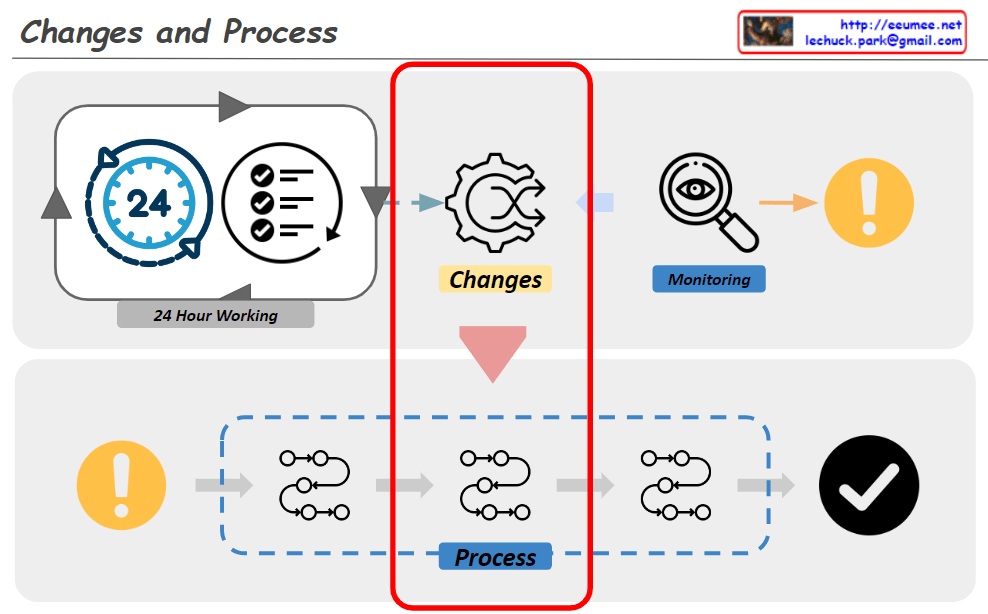
The diagram titled “Changes and Process” illustrates an organization’s system for detecting and responding to changes. The key components and flow are as follows:

  1. 24-Hour Working System:
    • Represented by a 24-hour clock icon and a checklist icon.
    • This indicates continuous monitoring and operation.
  2. Change Detection:
    • Depicted by a gear icon positioned centrally.
    • Captures changes occurring within the 24-hour working system.
  3. Monitoring:
    • Shown as a magnifying glass icon.
    • Closely observes and analyzes detected changes.
  4. Alert System:
    • Represented by an exclamation mark icon.
    • Signals important changes or issues that require attention.
  5. Response Process:
    • Illustrated as a flowchart with multiple stages.
    • Initiates when an alert is triggered and follows systematic steps to address the issue.
  6. Completion Verification:
    • Indicated by a checkmark icon.
    • Confirms the successful completion of the response process.

This system operates cyclically, continuously monitoring to detect changes and activating an immediate response process when necessary. This approach maintains the organization’s efficiency and stability. It demonstrates the organization’s ability to respond quickly and systematically to changing environments.

The diagram emphasizes the interconnectedness of continuous operation, change management, monitoring, and the execution of structured processes, all working together to ensure effective adaptation to changes.

The Time is

From Claude with some prompting
This image explains the concept of time and its relation to gravity. Here’s a breakdown of the main points:

  1. Definition of Time:
    • It’s described as “The smallest unit of change” → “The smallest unit of time change * N” → “1 Second”.
  2. Gravity’s Influence:
    • The image states “Everything is affected by gravity.”
    • Gravity influences gear changes and signal changes, as shown by the icons.
  3. Relationship between Time and Gravity:
    • Time is affected by gravity.
    • The higher the gravity (lower place), the slower the changes, resulting in slower passage of time.
    • The lower the gravity (higher place), the faster the change, leading to faster passage of time.

This diagram simplifies one of the key concepts of Einstein’s General Theory of Relativity – how gravity affects the passage of time. It illustrates this complex idea in a straightforward, visual manner.

The time ??

From Gemini with some prompting
The image depicts the concept of time and its relationship to matter, light, and change. Here’s a breakdown of the image elements:

  • Clock: Represents the measurement of time.
  • Atoms: Symbolize matter.
  • Sun: Represents light.
  • Rays of Light: Represent change.
  • Text: Includes explanations of time units, quantum, light, change, and the interconnectedness of everything.

Image Analysis

The image conveys that time is intricately intertwined with matter, light, and change. Time is used to measure the movement of matter and light, while change signifies the passage of time.

Text Analysis

  • “Time” clearly indicates the image’s subject matter.
  • “Standard” refers to the widely used system of time units.
  • “Standard???” suggests the existence of alternative time unit systems.
  • “Invisible” and “Can be seen” highlight the relativity of time. Time is not absolute but can be perceived differently depending on the observer’s perspective.
  • “Unit of change” emphasizes that time is a unit used to measure change.
  • “Quantum??” raises questions about the concept of time in quantum mechanics. In quantum mechanics, time is sometimes considered not continuous but composed of discrete units.
  • “Light” indicates the connection between light and time. The speed of light is a reference point for time measurement.
  • “Everything affects each other” signifies that time, matter, light, and change are interconnected.

Overall Interpretation

The image is a multifaceted representation of the complexity and diversity of time. It goes beyond time as a mere tool for counting numbers and delves into its profound relationship with matter, light, and change.

The time is

From DALL-E with some prompting
The image conveys that innovation is more than just seeking new things; it is achieved through numerous changes performed within a given absolute time. The upper section shows three change attempts within a limited timeframe, suggesting that evolution occurs through these trials and failures. The lower section emphasizes the capability to undertake nine changes in the same time period, highlighting faster and more substantial evolution. It underlines the idea that digital transformation enables more rapid and extensive changes than those made by humans, which is a crucial element in driving innovation and evolution.

Synchronization

From DALL-E with some prompting
this image illustrates the concept of ‘Synchronization’. Synchronization is a mechanism used to ensure that when multiple processes or threads share data, they all have a consistent view of that data. If each edit were made to shared data concurrently, it could lead to inconsistent data states. The image contrasts ‘Not Same State’ with ‘Same State’, suggesting that only one process at a time should be able to modify shared data to maintain consistency.