WEB SERVICE 3-TIERS

From Claude with some prompting
WEB(Front) Layer

  • Primary Components:
    • Static Data: HTML, CSS, JavaScript files
    • Storage: Browser-based storage solutions
  • Performance Optimization:
    • CDN: Global content delivery
    • Caching: Response time improvement
  • Enhanced Custom Experience:
    • Optimized user interface
    • Client-side performance enhancements
  1. WAS(Back) Layer
  • Core Functions:
    • Program Code: Server-side application logic
    • Computing: Business process handling
  • Development Features:
    • Enhanced Development Environment (CI/CD):
      • Continuous Integration for automated testing
      • Continuous Deployment for automated delivery
      • Automated build and release processes
      • Development workflow optimization
    • Biz Logic: Business rules implementation
    • Microservices: Modular service architecture
  1. DB Layer
  • Data Management:
    • Dynamic Data: Real-time data processing
    • Variable(Memory): Memory-based data handling
  • Business Data:
    • Biz Data Scheme & ACID:
      • Data structure and relationships
      • Transaction integrity
      • Data consistency
    • RDBMS/NoSQL: Flexible database solutions
  1. Infrastructure Characteristics
  • High Availability (Biz Continues):
    • Uninterrupted service operation
    • Fault tolerance
    • Business continuity
  • Scalability (Biz Changes):
    • System expansion capability
    • Business growth support
    • Flexible architecture
  1. Key Integration Points
  • WEB ↔ WAS: Static data and program code interaction
  • WAS ↔ DB: Dynamic data and business logic connection
  • Biz Logic ↔ Biz Data: Direct business data operations

This architecture demonstrates a modern, well-structured web service that emphasizes:

Robust business logic handling
Efficient data management
Clear separation of concerns
Automated development processes
Scalable infrastructure
High availability
Enhanced user experience

Web Service [Server Inside]

From Claude with some prompting
focusing on the key technical aspects and operational considerations for designing a web service application.

Web Service [Server Inside] – Design and Operational Considerations

  1. Service Architecture Design: a. Multi-tier structure:
    • Gateway → Load Balancer → API Gateway → DB Proxy → Database
    • Each layer focuses on specific functions, improving maintainability and scalability b. Microservice Architecture:
    • Implemented through “Programmatic Control” at the API Gateway
    • Ensures service independence, increases development and deployment flexibility
  2. Scalability Design: a. Auto Scaling:
    • Applied at each layer (Load Balancer, API Gateway, DB Proxy)
    • Automatic resource adjustment based on traffic fluctuations for improved stability b. Resource Pooling:
    • “Protecting SVC” functionality for efficient resource management c. Load Balancing:
    • Gateway provides “Route with Load Balancing (2 More Resources)” functionality
  3. Performance Optimization: a. Static/Dynamic Data Separation:
    • Static Data Control: HTML/CSS/JS/IMAGES
    • Utilization of CDN services or On-Premise storage b. Database Optimization:
    • SQL, NoSQL, Hybrid options available
    • Connection management through DB Proxy for database load distribution
  4. Security Design: a. Multi-layered Security:
    • Authentication (OAuth2, etc.)
    • Encryption (SSL/TLS)
    • Firewall/WAF/IPS/IDS b. Request Limiting:
    • “Limiting Requests (Protect Domain Service)” at Gateway for DDoS protection
  5. Monitoring and Analysis: a. Comprehensive Monitoring:
    • Collection of Network, Server, and Application Metrics b. Analysis and Planning:
    • Maintenance & Scaling
    • Service Design Upgrade
    • Resource & Cost Optimization
  6. Error Handling:
    • Specification of 400, 500 series errors (Network Error, Service Unavailable, Server Internal, etc.)
    • Emphasis on Gateway-related errors (502 Bad Gateway, 504 Gateway Timeout)
  7. Network and Protocol:
    • “Protocol Converting” functionality provided at the Gateway
    • Separate management of Network Domain Control
  8. Operational Efficiency:
    • Automation: Minimized manual intervention through Auto Scaling, resource pooling, etc.
    • Flexibility: Possible combination of On-Premise and CDN services
    • Cost Optimization: Efficient resource usage, continuous analysis and improvement

Key Advantages of This Configuration:

  1. High Availability and Stability: Stable service provision through multiple layers and auto-scaling
  2. Excellent Scalability: Flexible response to traffic fluctuations
  3. Strong Security: Multi-layered security structure to address various threats
  4. Efficient Resource Management: Cost efficiency through automation and optimization
  5. Flexible Service Development and Deployment: Utilization of microservice architecture
  6. Comprehensive Monitoring and Analysis: Enables continuous service improvement

This design incorporates almost all essential elements required for modern, large-scale web services, enabling stable and scalable service operations. It reflects a thorough consideration of both technical and operational aspects, providing a robust foundation for complex web applications.

Web(HTTP) Service Inside

From Claude with some prompting
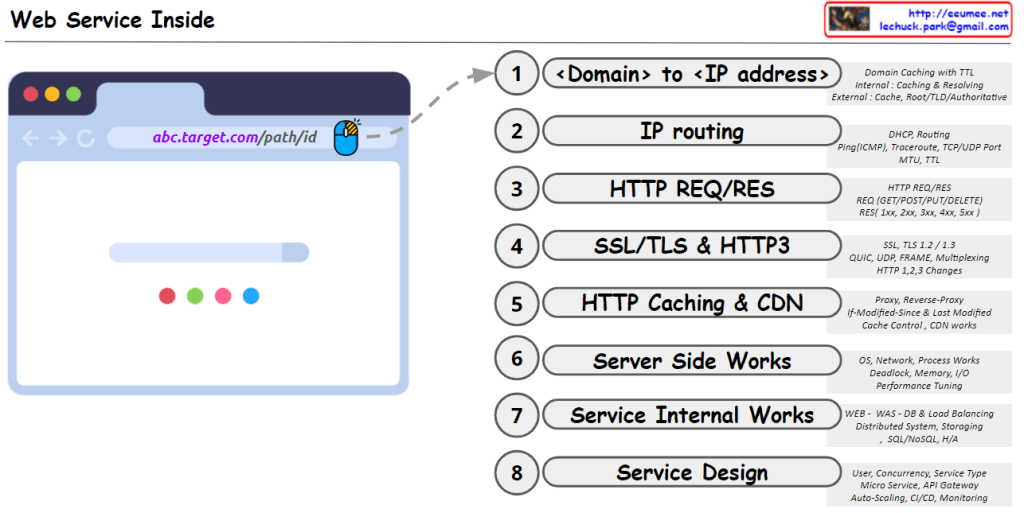
This image titled “Web Service Inside” illustrates the internal workings of a web service in 8 steps, from the browser to service design:

  1. <Domain> to <IP address>: Converts user-friendly domain names into computer-readable IP addresses. This process utilizes multi-level caching for efficiency and ultimately locates the desired web server.
  2. IP routing: Guides data packets to their destination via optimal paths based on the converted IP address. This ensures accurate and efficient information delivery across the complex network of the internet.
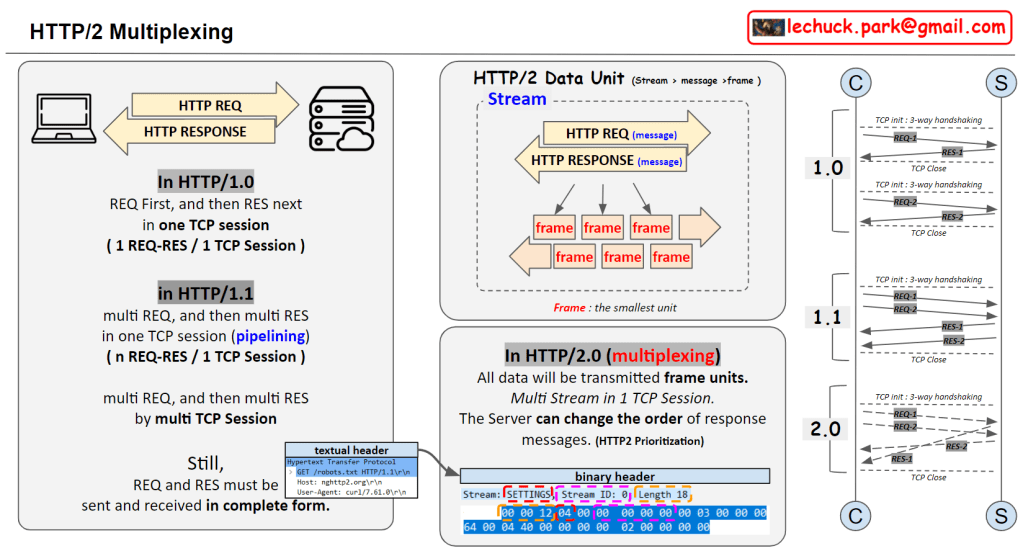
  3. HTTP REQ/RES: Defines the communication rules between clients and servers. It structures how clients make requests and how servers respond, providing a standardized method for exchanging information on the web.
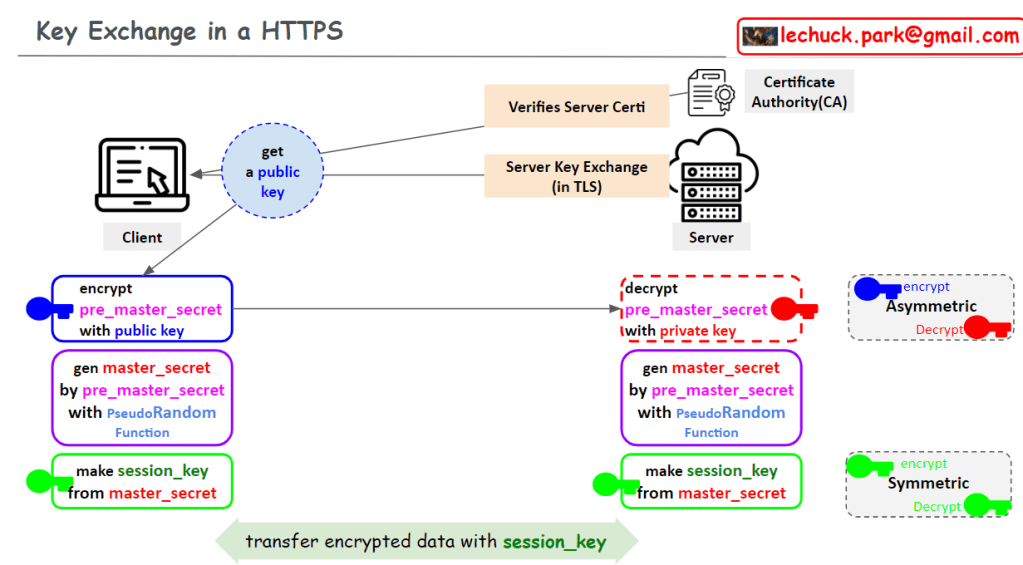
  4. SSL/TLS & HTTP3: Enhances data transmission security and improves performance. It protects information through encryption and enables faster, more efficient communication using the latest protocols.
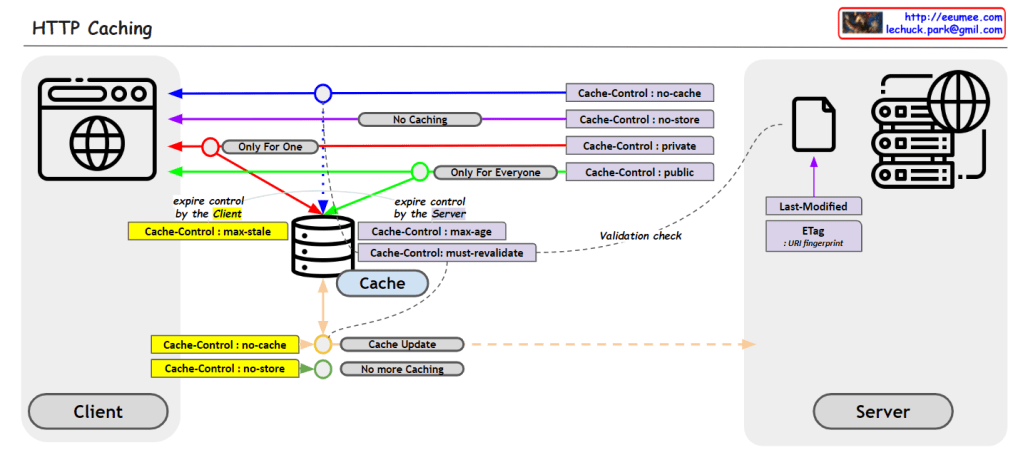
  5. HTTP Caching & CDN: Increases efficiency for repetitive data requests and delivers content to users faster. This plays a crucial role in reducing server load and improving user experience.
  6. Server Side Works: Involves the actual processing of requests and generation of responses on the server. It covers operating systems, network protocols, and resource management to provide an efficient and stable service foundation.
  7. Service Internal Works: Addresses the internal structure and data processing methods of web services. It covers database management, load balancing, and maintaining high availability to provide reliable service to large-scale user bases.
  8. Service Design: Encompasses the overall architecture and operational strategy of the web service. It involves creating optimal service structures considering user requirements, scalability, and maintainability, as well as establishing continuous improvement and monitoring plans.

Each of these stages is essential in creating a web service that efficiently and securely handles user requests, while building a system that is scalable and easy to maintain at a large scale.