
Lying down
The Computing for the Fair Human Life.
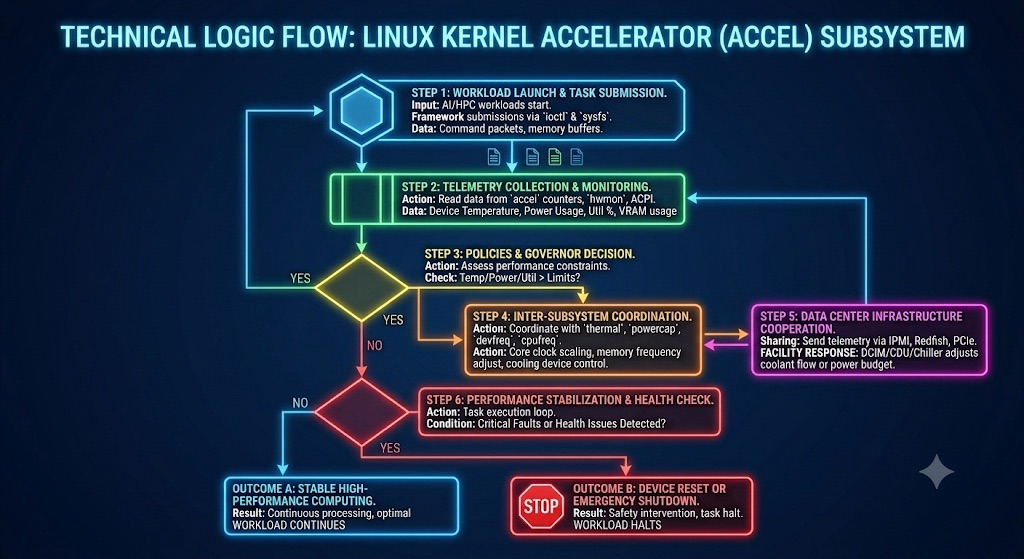
This diagram outlines the sequential, closed-loop technical logic flow of the Linux Kernel Accelerator (accel) subsystem as it manages heavy AI/HPC workloads while interacting with data center cooling infrastructure.
Here is the step-by-step breakdown of how it works:
💡 Summary Takeaway:
It is an automated playbook showing how the Linux kernel balances raw AI computing performance with hardware safety—acting locally on the chip and globally with the data center’s physical cooling loops.
With Gemini
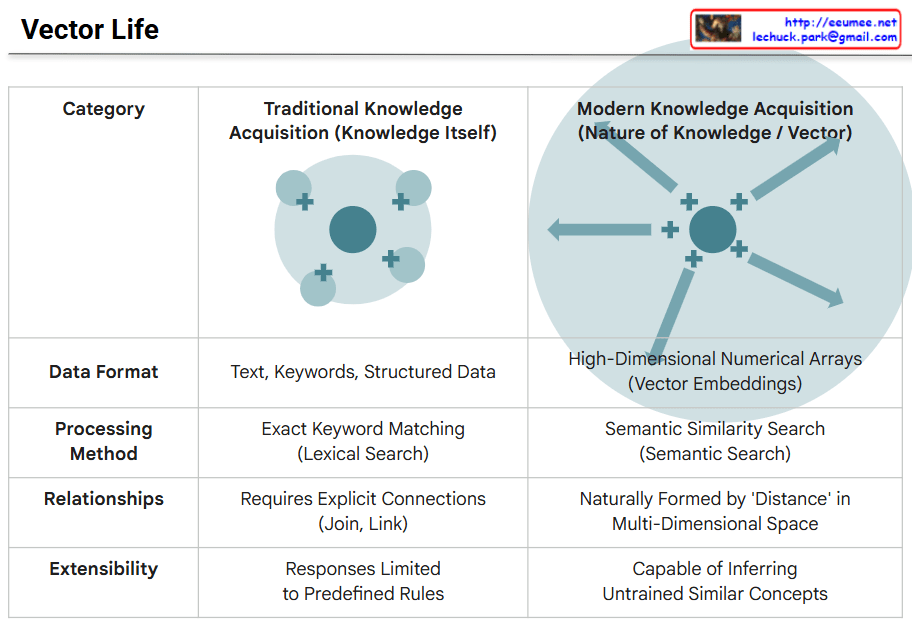
In the traditional paradigm, knowledge is treated as discrete, human-readable symbols (such as text strings, keywords, or rigid database records). To store the concept of an object, the system must record its literal name.
In contrast, the modern AI paradigm translates knowledge into Vector Embeddings—dense, high-dimensional numerical arrays generated by deep learning models. Instead of storing the surface-level text, the system captures the latent features and abstract properties of the knowledge itself.
Traditional computing relies heavily on Lexical Search, where systems perform exact keyword matching. If a user queries a concept using synonyms or slightly altered phrasing, a traditional system fails to retrieve the correct data unless explicit rules are defined.
Modern systems leverage Semantic Search. By mapping both queries and stored data into the same vector space, the system evaluates mathematical similarity (e.g., Cosine Similarity). This allows the system to comprehend the user’s intent, context, and underlying meaning, delivering highly relevant results even when exact words do not match.
In conventional databases (like RDBMS), establishing relationships between data points requires human intervention to design explicit schemas, foreign keys, and complex table joins. Knowledge is strictly confined to these predefined pathways.
In a vector-driven architecture, relationships are emergent and mathematical. Data points are positioned in a multi-dimensional space based on their meaning. The “relationship” between two distinct concepts is naturally determined by their spatial proximity or distance. Concepts that share contextual or thematic similarities naturally cluster closer together without requiring manual mapping.
Rule-based, traditional systems are inherently brittle; they can only respond within the hard-coded boundaries of their programming and existing data. They possess zero adaptability to novelty.
Vector-based architectures offer profound flexibility. Because the vector space captures the continuous spectrum of meaning, the system can generalize and infer connections between entirely new, untrained, or unseen concepts based on where they land in the established vector topology. This capability serves as the foundational bedrock for autonomous AI Agents and advanced Retrieval-Augmented Generation (RAG) systems.
The transition from keyword-centric databases to high-dimensional vector spaces marks a profound evolution in systems engineering. Traditional knowledge acquisition focuses on indexing what the data is (the literal text), whereas modern vector-driven acquisition captures what the data means (the semantic essence). By representing knowledge as coordinates in a continuous multi-dimensional space, modern architectures eliminate the need for rigid, manual relational mapping. This spatial representation allows computing infrastructures, vector databases, and AI agents to execute deep semantic search, handle nuanced context, and exhibit fluid inference capabilities that far exceed the constraints of traditional rule-based software.
#VectorLife #VectorEmbeddings #SemanticSearch #AIArchitecture #KnowledgeGraph #AIAgents #DataScience #VectorDB #TechParadigm #eeumee
With Gemini





 Lechuck Park