From DALL-E with some prompting This diagram illustrates the process by which an application process requests services from the operating system through a system call. Applications running in user space cannot directly access hardware resources and must go through the operating system located in kernel space to perform necessary operations. System calls act as an interface between user space and kernel space, which is crucial for the system’s stability and security. The operating system abstracts hardware resources, facilitating easy access for applications.
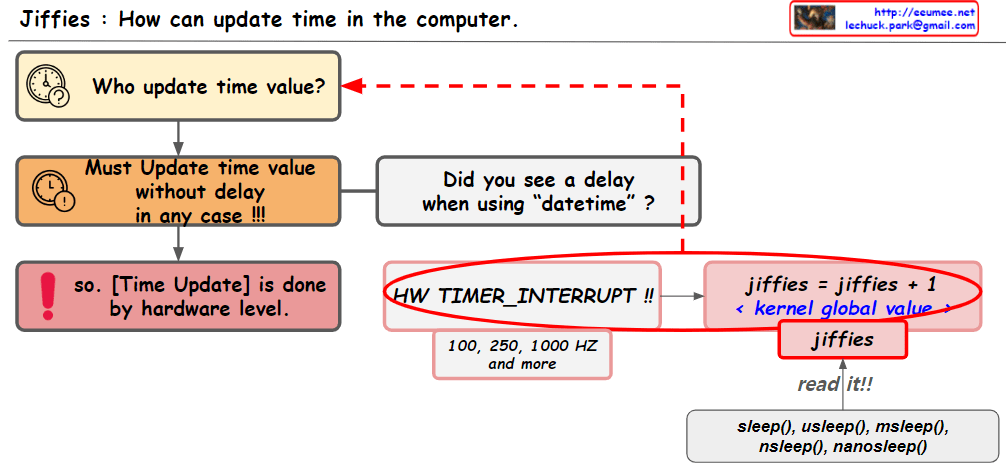
The image provides an explanation of how time updates are handled in computer systems. The key points include:
“Jiffies” refers to a global variable used by the kernel to keep track of time.
Time updates are performed at the hardware level through “timer interrupts,” which are initiated periodically by the system’s real-time clock.
The “HW_TIMER_INTERRUPT” increments the jiffies value by one, and this can be set to various frequencies such as 100, 250, or 1000 Hertz (HZ).
There is a question about whether there is a delay when using “datetime,” which is crucial as time updates need to be processed in real-time.
The jiffies value can be read using the read() function, and functions like sleep(), usleep(), msleep(), nsleep(), and nanosleep() utilize this jiffies value to pause the execution of a program for a certain amount of time.
The image visually represents the concept of how the operating system’s kernel manages time and how time-related functions use the system’s “jiffies” value.
From DALL-E with some prompting this image illustrates the concept of ‘Synchronization’. Synchronization is a mechanism used to ensure that when multiple processes or threads share data, they all have a consistent view of that data. If each edit were made to shared data concurrently, it could lead to inconsistent data states. The image contrasts ‘Not Same State’ with ‘Same State’, suggesting that only one process at a time should be able to modify shared data to maintain consistency.
From DALL-E with some prompting this image illustrates the concept of ‘Mutex (Mutual exclusion)’ and ‘Critical Section’ which are pivotal in multi-threaded programming. Mutexes are used to control simultaneous data access by multiple threads, maintaining data consistency. A critical section is a part of the code that only one thread can access at a time, and it’s where sensitive data is processed. Threads gain access to this section by acquiring a mutex lock (pthread_mutex_lock), and after completing their work, they release the lock (pthread_mutex_unlock) to allow other threads to enter. This mechanism ensures that all threads view and maintain a consistent state of the data, allowing safe modifications and sustained data integrity.
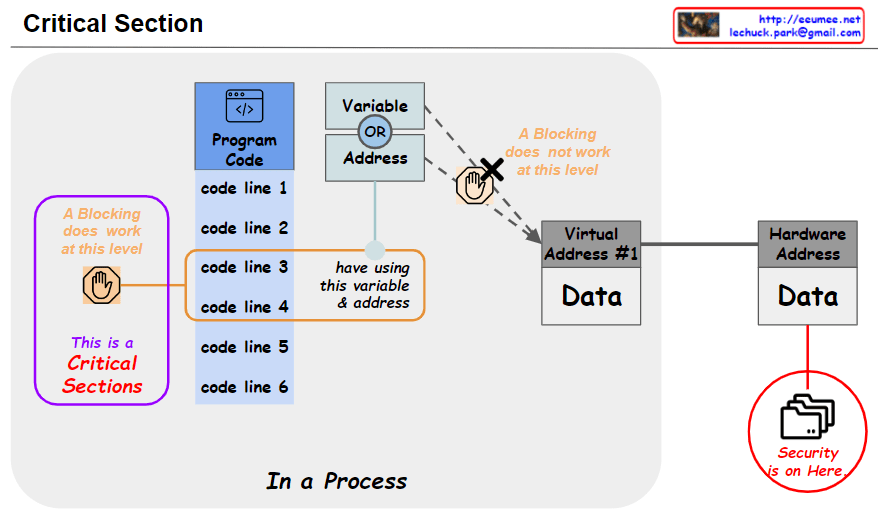
From DALL-E with some prompting The provided image delineates the concept of a “Critical Section” in process execution, where certain areas of the program code are designated as sensitive or exclusive zones to prevent concurrent access. This is not merely a matter of securing a memory location but rather about managing access to specific code blocks that interact with shared variables or addresses.
In the diagram, the “Critical Sections” are highlighted to signify that these blocks of code are where ‘blocking’ occurs, allowing only one thread or process to operate on the shared resources at a time, thus ensuring data integrity and preventing race conditions. The transition from code lines to data, through variable addresses and virtual address mapping to the actual data in hardware, suggests a layered approach to security and access control.
Moreover, the image hints at the abstraction layers from a virtual address space to the physical hardware address, underlining the importance of security protocols at each layer. These critical sections act as a checkpoint not only to enforce sequential access to shared resources but also to facilitate a systematic flow of operations, from programming syntax to system calls, and from understanding the computer architecture to the actual hardware operations. This systematic control is crucial for maintaining security and operational efficiency in digital systems.
From DALL-E with some prompting The image illustrates a comparison between the costs associated with spinlocks and context switching. It contrasts the ‘waiting cost’ incurred when a process is on hold while another process monopolizes a CPU core, with the ‘switching cost’ that arises from transitioning between processes. Spinlocks represent the waiting cost as a process continually attempts to access the CPU, thereby avoiding unnecessary context switches and increasing efficiency. Particularly in multi-CPU environments, the system underscores the ability to handle multiple processes efficiently without the need for operating system-induced switching.
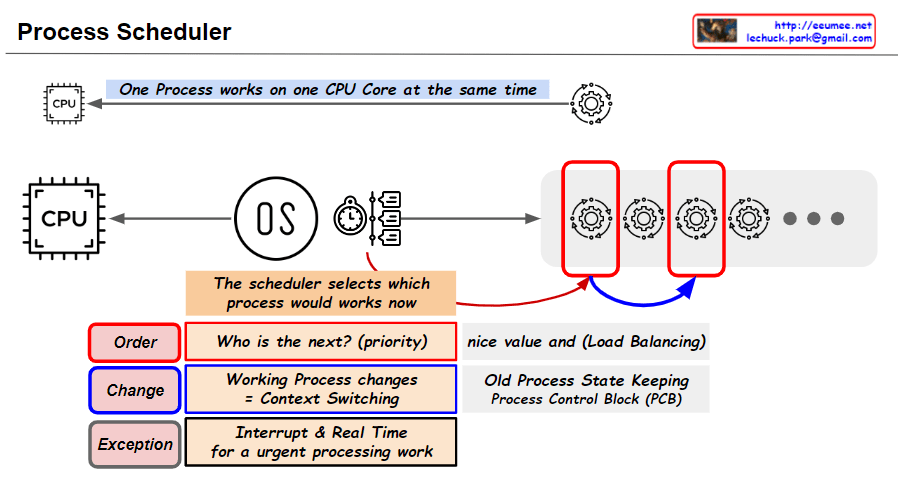
From DALL-E with some prompting The image highlights the essential mechanisms of process scheduling to share a single CPU core resource among multiple processes. The scheduler determines the order of processes to be executed based on priority and changes the current running process through context switching. Additionally, it promptly addresses exceptions requiring urgent processing through interrupts and real-time handling. This scheduling approach ensures efficient allocation of CPU resources and stable operation of the system.




 Lechuck Park