With a Claude’s Help
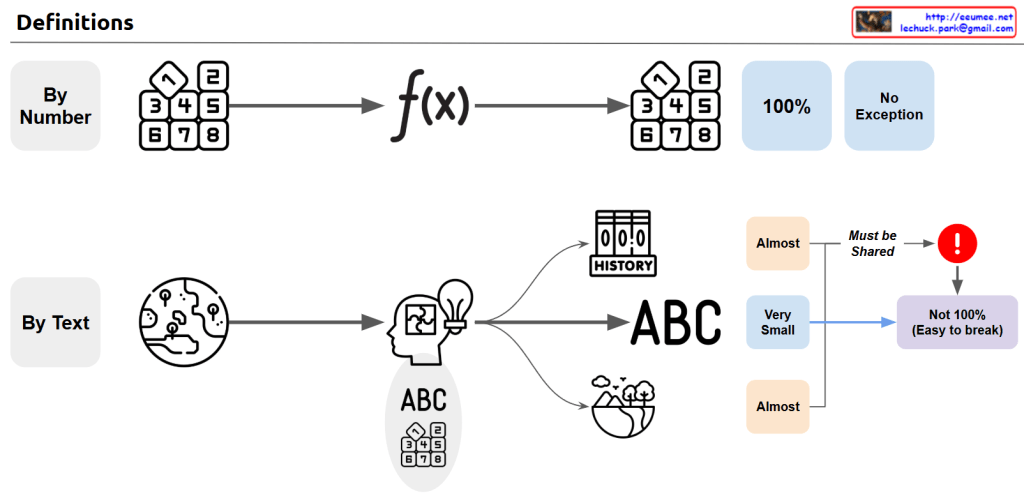
this diagram that illustrates two approaches to definitions:
- Definitions By Number:
- Input and output through function f(x) is precise and clear
- 100% accuracy in results
- No exceptions
- Always yields consistent results regardless of context
- Mathematical/numerical definitions are unambiguous
- Definitions By Text:
- The concept being defined is connected to multiple contextual elements:
- Historical background (History)
- Linguistic expression (ABC)
- Social/cultural context (represented by the global icon)
- Characteristics and limitations:
- Can only directly express a “Very Small” portion of the complete meaning
- Often uses “Almost” in descriptions
- Key Point: “Must be Shared”
- Related background knowledge
- Historical context
- Social consensus
- Cultural understanding
- If these contextual elements are not properly shared, it becomes “Not 100% (Easy to break)”
- Perfect communication of meaning becomes difficult
- Possibility of misunderstanding or misinterpretation exists
The diagram ultimately explains:
- While numerical definitions are objective and precise
- Text-based definitions are inherently incomplete on their own
- For proper understanding of text-based definitions, related contextual knowledge and background must be shared
- This explains why the same words or sentences can be interpreted differently depending on cultural context and background knowledge
This concept is particularly important in understanding:
- Why linguistic definitions can vary across cultures
- The importance of shared context in communication
- Why mathematical/numerical definitions remain consistent across different contexts
- The inherent limitations of purely textual definitions without proper context
This diagram effectively shows why precise communication through text alone can be challenging without shared contextual understanding, while numerical definitions remain universally consistent.

 Lechuck Park