From DALL-E with some prompting
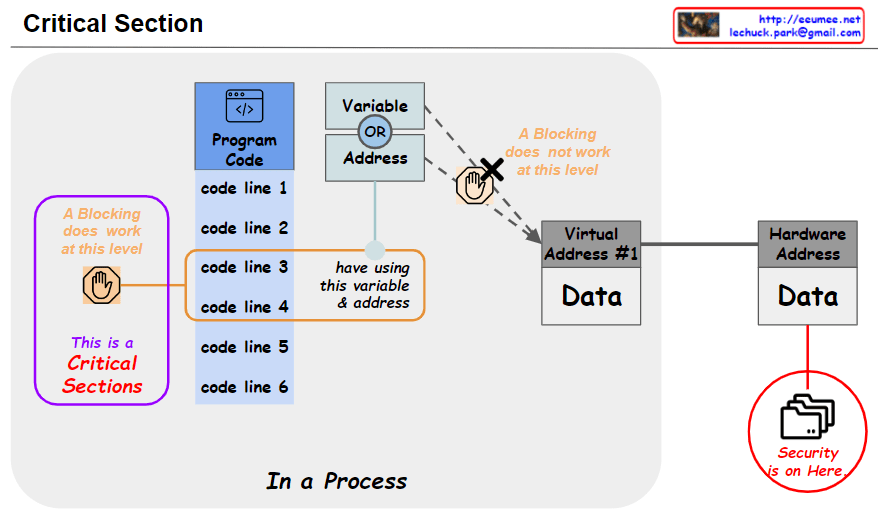
The provided image delineates the concept of a “Critical Section” in process execution, where certain areas of the program code are designated as sensitive or exclusive zones to prevent concurrent access. This is not merely a matter of securing a memory location but rather about managing access to specific code blocks that interact with shared variables or addresses.
In the diagram, the “Critical Sections” are highlighted to signify that these blocks of code are where ‘blocking’ occurs, allowing only one thread or process to operate on the shared resources at a time, thus ensuring data integrity and preventing race conditions. The transition from code lines to data, through variable addresses and virtual address mapping to the actual data in hardware, suggests a layered approach to security and access control.
Moreover, the image hints at the abstraction layers from a virtual address space to the physical hardware address, underlining the importance of security protocols at each layer. These critical sections act as a checkpoint not only to enforce sequential access to shared resources but also to facilitate a systematic flow of operations, from programming syntax to system calls, and from understanding the computer architecture to the actual hardware operations. This systematic control is crucial for maintaining security and operational efficiency in digital systems.

 Lechuck Park